Share

Pineapple Spiky Isopod
🔤 Taxonomy
Cristarmadillidium muricatum (Budde-Lund, 1885) is the accepted name. It was originally described as Armadillidium muricatum, a combination still encountered in older catalogs.
Pineapple spiky isopod, Spanish spiky isopod and Orange Spiky are hobby names referring to the sculptured body, not separate taxa. Do not confuse this small Spanish species with unrelated Asian “spiky” trade cultures.
📌 Description
Adults are only about 0.6-0.8 cm. Raised cuticular projections give the orange-brown body its pineapple-like texture, and the animal can conglobate when disturbed. Its small size makes juveniles and food consumption easy to overlook.
This is an intermediate-to-difficult display culture because colonies often establish slowly. It needs a precise moisture gradient and substantial ventilation; neither a tropical swamp nor a fully arid Spanish setup matches the sheltered limestone microhabitat.
| Care point | Practical target |
|---|---|
| Adult size | 0.6-0.8 cm |
| Starter colony | 25 x 18 x 15 cm or larger |
| Temperature | 18-24°C |
| Moisture | compact damp refuge, much drier ventilated surface elsewhere |
| Staple food | finely crushed decayed leaves and soft rotten hardwood |
| Main failure | large wet feedings and unstable moisture in a tiny colony |
🌍 Distribution
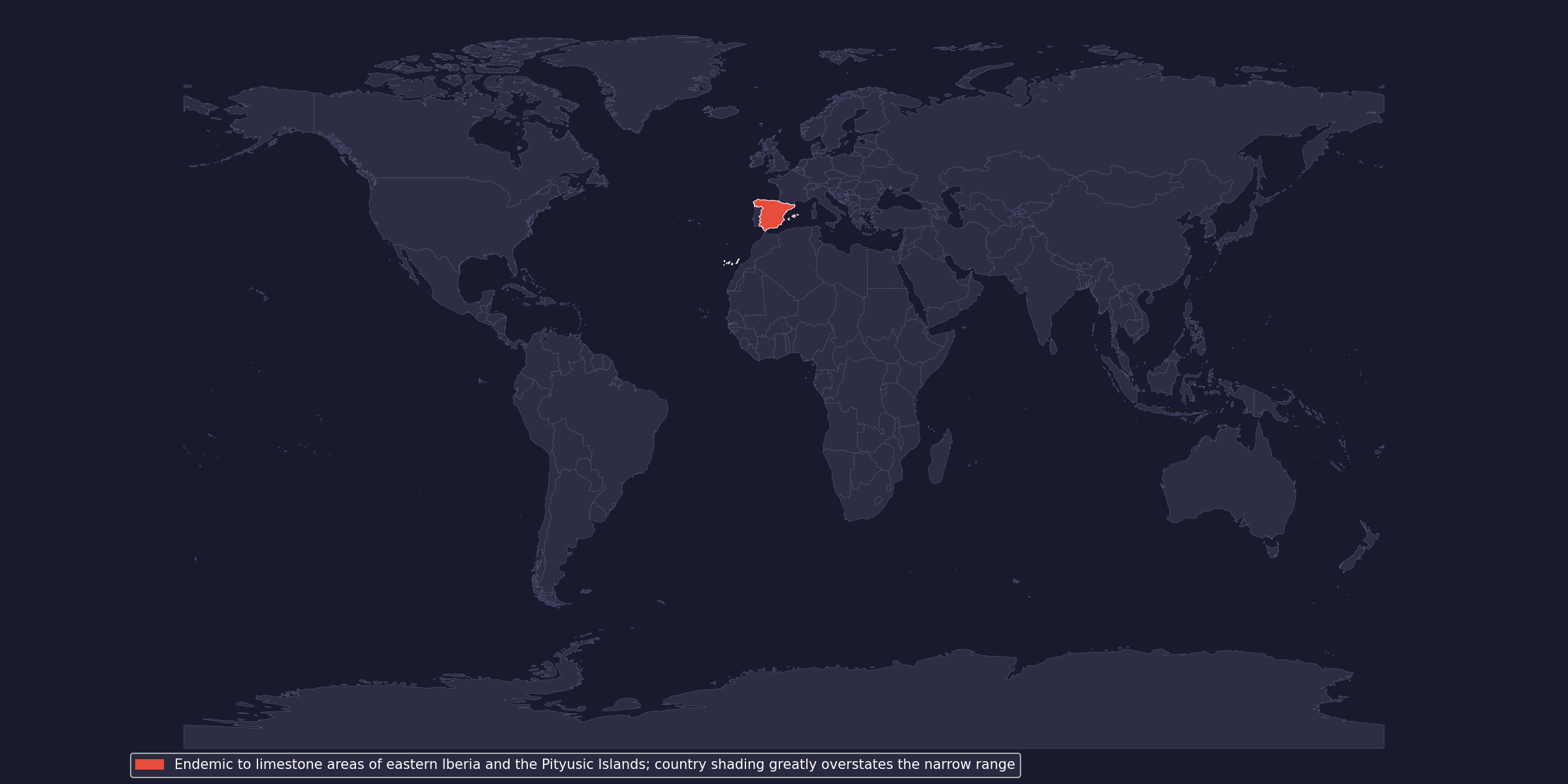
The species is endemic to eastern Spain and the Pityusic Islands. Published records include limestone caves in Alicante and populations in calcareous soils outside caves, including Ibiza. It is therefore described as troglophilic rather than strictly cave-obligate.
Country-level mapping cannot show this narrow eastern Iberian and island distribution; the highlighted Spain polygon should not be read as nationwide occurrence.
⚖️ Legal status
Checked on 2026-08-23: C. muricatum is not listed in the CITES Appendices, Annexes A-D of Commission Regulation (EU) 2026/1383, or Appendices II-III of the Bern Convention. Its limited Spanish distribution makes site and collection law especially important; caves, reserves and regional fauna may be protected independently of those international lists.
Use captive-bred animals with documented origin. Retain invoices and breeder records, confirm Spanish and destination rules before transport, and never collect from caves or release a culture outdoors.
🤌 Husbandry
A fine-vented 25 x 18 cm container gives a small colony enough horizontal gradient without making the animals impossible to monitor. Cover ventilation with mesh that retains mancae and pests. Use several thin bark pieces so the colony can occupy both damp and drier zones.
Quarantine all new stock for 60-90 days. Keep separate tools, count visible adults without dismantling the box, and inspect food stations for mites or other isopods. Work over a catch tub; mancae are minute.
💡 Lighting
UVB is not required. Give 10-12 hours of soft indirect light and retain deep shade under leaf litter and bark. Strong light adds no benefit and can dry the small damp refuge quickly.
🌡 Heating and temperature
Keep 18-24°C, with an 18-21°C cool area and nights around 16-20°C. A warm room is normally sufficient. Avoid prolonged temperatures above 25°C, especially in a small container where moisture reserves change rapidly.
If heating is essential, warm one outside wall under thermostat control and check both ends with probes. Never heat the base.
💧 Humidity and water
Maintain one moss-lined corner moist through the full substrate depth. The remaining surface should be comparatively dry with generous airflow, while the lower layer must not become dust. Add small measured amounts of water to the refuge rather than soaking the entire surface.
No dish is needed. Constant condensation, spreading mold or a sour odor indicate excess water. A colony gathered deep in the wettest point may be warning that the gradient has dried too far.
🌿 Enclosure and decoration
Use 5-7 cm of fine unfertilized topsoil, powdered decomposed leaves and very soft rotten hardwood, with limestone grit or crushed cuttlebone. Small animals need small food particles, but also retain whole leaf pieces and thin cork for cover.
Do not use coir alone, scented or coniferous wood, pesticide-exposed leaves, fertilizer, or heavy rocks that can crush animals when moved. Springtails may help manage fine mold, but introduce only a clean established culture.
🪳 Feeding
Finely broken deciduous leaf litter and crumbly white-rotted hardwood are permanent food. Twice weekly offer a tiny amount of squash, carrot or a complete isopod food; add a pinhead-sized protein portion about weekly only if it disappears cleanly.
Keep calcium continuously available as powder, limestone or cuttlebone. Overfeeding is a greater threat than short-term lack of supplemental food because leftovers overwhelm a small, slow colony.
🥚 Breeding
Reproduction is represented as “viviparous” in structured metadata. The female actually carries eggs and embryos in a ventral marsupium and releases mancae. Do not search for or attempt to incubate eggs separately.
Expect gradual development and relatively small output compared with fast cleanup-crew species. Leave brooding females undisturbed, protect the damp refuge, and wait for several age classes before splitting or selling a starter group.
🩺 Common problems
- Colony disappears: inspect beneath leaves gently; tiny animals may be present, but also verify deep moisture and temperature.
- Mold overwhelms food: reduce portions to specks, add clean springtails and improve dry-side airflow.
- Failed molts: stabilize the moist refuge and permanent calcium source.
- No reproduction: avoid repeated disturbance and confirm that adults, food and moisture have remained stable for months.
- Misidentification: retain origin records; “spiky isopod” alone is not a scientific identification.
📌 Conclusion
The pineapple spiky isopod is best for a patient keeper who can feed very lightly and maintain a small but dependable humid refuge. Its Spanish origin does not justify drying the entire colony, while its cave associations do not justify stagnant tropical humidity.
📚 Sources and further reading
- GBIF: Cristarmadillidium muricatum
- World List of Isopoda (WoRMS): C. muricatum
- Cifuentes 2021: terrestrial isopods of Valencia and Murcia
- Cifuentes & Prieto: the genus Cristarmadillidium
- Multilocus phylogeny and voucher locality
- Specialist captive-care reference
- ReptiFiles — checked; no species-specific care guide was found
- CITES Appendices, valid from 5 March 2026
- Commission Regulation (EU) 2026/1383
- Bern Convention appendices