Share

Chaetophiloscia elongata
🔤 Taxonomy
Chaetophiloscia elongata (Dollfus, 1884) is accepted by GBIF. WoRMS represents the taxon through the nominal subspecies C. elongata elongata. Historical names include Philoscia elongata and Chaetophiloscia syriaica. Adult pigment pattern and male characters are important because other slender philosciids can look similar.
📌 Description
This slender, fast-running woodlouse has a mottled brown back, a stepped body outline and a rounded telson. A Tunisian population study measured animals from 1 to 9.3 mm; reproductive females began at 4.3 mm, so the structured adult range uses 4.3–9.3 mm. The study estimated an 8–10 month life span in that field population, not a guaranteed captive value.
Published habitat and reproduction data are stronger than captive-care evidence. Enclosure recommendations below are cautious ecological inference and should be documented as trials.
🌍 Distribution
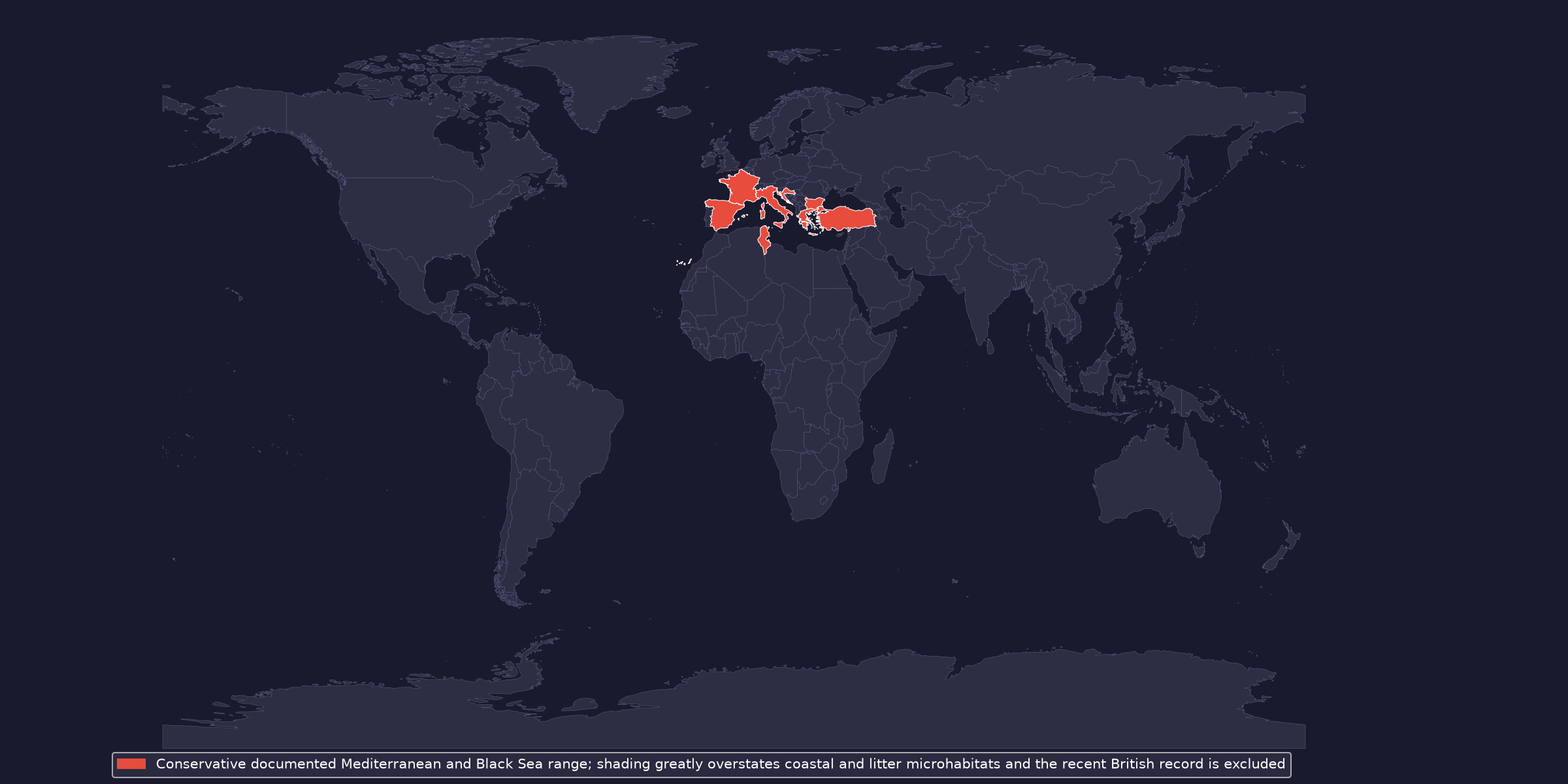
The main range surrounds the Mediterranean and extends to the Bulgarian Black Sea coast. Records include Spain, France, Italy, the Adriatic, Greece, Turkey, Bulgaria and North Africa. A 2024 British record came from tidal litter at a saltmarsh–sea-wall boundary and may reflect transport.
The map shades a conservative Mediterranean and Black Sea set supported by faunistic records. It does not imply continuous inland occupancy, and the recent British locality is excluded.
⚖️ Legal status
Checked on 2026-08-29: C. elongata was not found in CITES, EU wildlife-trade Annexes A–D under Regulation (EU) 2026/1383, or Bern Appendices II–III. Local and national collection, coastal-habitat, reserve, soil-movement, import and invasive-species rules may still apply.
Choose traceable established stock. Do not collect coastal debris from protected sites, and never release animals, substrate or associated organisms.
🤌 Husbandry
Begin a verified group in a secure 25 × 18 × 15 cm box with at least 7 cm of mineral soil, leaf mould and leaves. Establish a horizontal gradient: one deeply moist refuge and one airy surface sector, both with cover. Use fine mesh and open the box inside a catch tub because adults run quickly.
Quarantine for 45–60 days using separate tools. ReptiFiles has no species-specific care guide. Field soil measurements from Tunisia describe seasonal exposure and must not be copied as captive temperature or humidity targets.
💡 Lighting
UVB is unnecessary. Provide indirect room light with shaded bark and litter. A natural day–night rhythm is sufficient; avoid direct sunlight and strong lamps.
🌡 Heating and temperature
Use stable mild room conditions and retain a cooler moist side. The field population experienced wide seasonal soil temperatures, but those extremes are not demonstrated captive optima. Avoid added heat unless a traceable lineage and duplicate enclosure show a clear need.
💧 Humidity and water
Keep roughly one-third to one-half of the lower substrate distinctly damp, while allowing exposed litter on the opposite side to remain airy. Pour measured water into the moist edge rather than misting everything. Do not use an open dish.
Persistent crowding at the wet refuge and poor moults suggest drying. Condensation across the whole lid, sour odour and wall climbing indicate excessive moisture or insufficient ventilation.
🌿 Enclosure and decoration
Blend pesticide-free mineral soil, mature leaf mould, crumbled deciduous litter and soft-decayed hardwood. Add flat bark, small stones secured against collapse, a moss pocket and permanent limestone or cuttlebone. Maintain a generous surface leaf layer.
Climate accordions are omitted because coastal litter, stones, roots and transported sites create microsites that regional station normals do not represent.
🪳 Feeding
Keep deciduous leaves and decomposed wood available. Offer small carrot, squash, mushroom or dried-green fragments twice weekly, a tiny protein portion weekly at most, and constant calcium. A reproductive field study kept sampled females with local litter and carrots under quasi-natural laboratory conditions, but it did not test a complete ration.
Remove fresh leftovers before they sour and record what the colony actually consumes.
🥚 Breeding
Females brood embryos in a marsupium and release mancae; metadata calls this viviparous. In a Tunisian lagoon population, reproduction extended from February to November with spring and autumn peaks, two annual cohorts and reproductive females from 4.3 mm. These are field results, not universal culture settings.
Keep moisture and food stable, do not isolate gravid females, and provide fine litter for mancae. Split only after multiple age classes are established.
🩺 Common problems
- Wrong species: photograph pigment pattern and verify mature animals.
- Escapes: use fine mesh, tight seals and a catch tub.
- Whole colony at one edge: widen the moisture gradient gradually.
- Sour substrate: reduce water and fresh food, then increase airflow.
- Juvenile loss: retain mature fine litter and stable damp refuges.
- Overinterpreting field extremes: never use maximum field measurements as captive targets.
📌 Conclusion
Chaetophiloscia elongata is a small, fast Mediterranean litter species best kept by experienced colony keepers. Its field life history is unusually informative, but a safe captive protocol still requires conservative trials and careful records.
📚 Sources and further reading
- GBIF: Chaetophiloscia elongata
- WoRMS taxon details
- British Myriapod and Isopod Group species account
- BMIG: first British record and habitat
- Vieh et Milieu issue containing the reproductive study
- Spanish distribution review
- Schmalfuss world catalog
- ReptiFiles search completed; no species guide found
- CITES Appendices, valid from 5 March 2026
- Commission Regulation (EU) 2026/1383
- Bern Convention appendices