Share

Arizona Bark Scorpion
🔤 Taxonomy
Centruroides sculpturatus is the accepted name for the Arizona bark scorpion. Older sources may use Centruroides exilicauda for populations now treated as C. sculpturatus, while “bark scorpion” is also applied to other Centruroides. A trade label is therefore not a reliable species diagnosis; verified locality and origin records are essential.
📌 Description
This small, slender yellow-brown scorpion is an exceptionally capable climber that hides behind bark, in rock fissures, and in narrow structural gaps. Adults are commonly about 4-7 cm including the tail. Its small size must not be mistaken for low risk.
Arizona public-health authorities treat it as medically important and potentially life-threatening. This article does not endorse casual private ownership. Any lawful captive setting must be professional or expert, display-only, built around redundant locked containment and a written emergency plan. It is unsuitable for homes with children, elderly people, anyone unable to follow the protocol, or other medically vulnerable occupants.
☠️ Venom
This species is venomous. Venom exposure can cause pain, swelling or other systemic effects, and severity varies with species, locality, bite site and the amount delivered. A small wound or apparently dry bite is not proof of safety; every bite or sting requires urgent medical assessment.
If an incident occurs, move away, call emergency services or a poison centre, keep the patient still, remove rings and other constricting items, and follow dispatcher instructions. Do not use a tourniquet, cut or suck the wound, apply ice or electricity, give alcohol or medicines as a home treatment, or attempt to catch the animal. Antivenom choice and dosing are hospital decisions; verify the relevant product and local availability in advance. Sources: WHO snakebite guidance and appropriate species-specific toxinology or medical references listed below.
🌍 Distribution
The species occurs in the south-western United States and northern Mexico, especially Arizona and Sonora, with records extending into adjacent arid regions. It uses desert scrub, rocky slopes, riparian trees, palm bark, and human structures. It may shelter communally in the wild, but solitary housing is the conservative private-care standard because conflict and escape detection are easier to control.
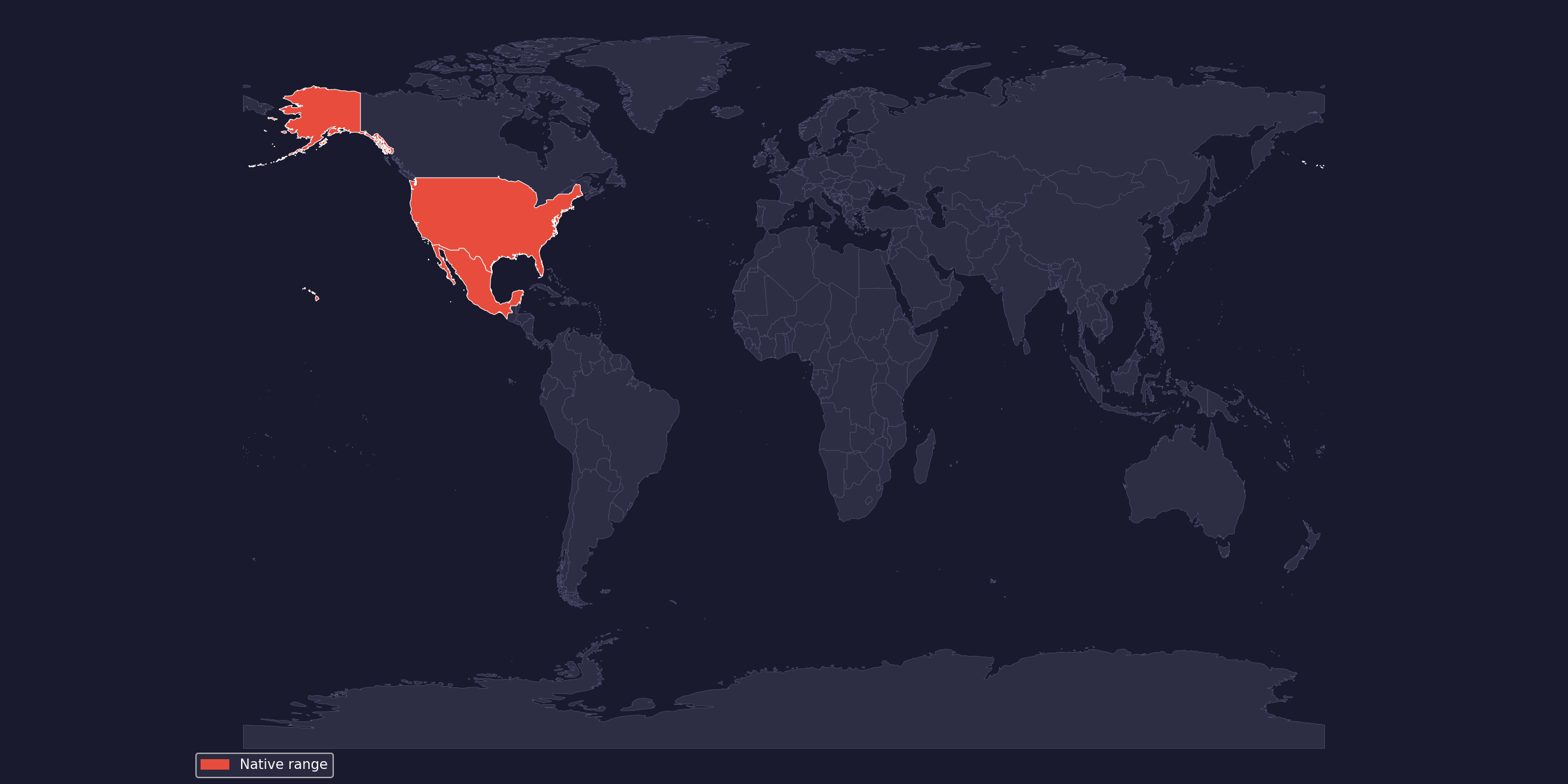
🌡 Climate across the native range
Monthly climate normals from reviewed GBIF occurrence locations across the Sonoran and northern range:
Sonora — Mexico (reviewed occurrence near Hermosillo)
| Month | Min °C | Mean °C | Max °C | RH % |
|---|---|---|---|---|
| January | 9 | 15.6 | 23.6 | 48 |
| February | 9.9 | 16.9 | 25 | 46 |
| March | 12 | 20 | 28.4 | 37 |
| April | 14.5 | 23.1 | 31.6 | 29 |
| May | 17.7 | 26.7 | 34.9 | 27 |
| June | 22.9 | 31.1 | 38.9 | 31 |
| July | 26.2 | 31.9 | 38.3 | 49 |
| August | 26.2 | 31.3 | 37.5 | 57 |
| September | 24.1 | 29.5 | 35.9 | 58 |
| October | 18.7 | 25.6 | 33 | 46 |
| November | 13.2 | 19.9 | 27.6 | 45 |
| December | 9 | 15.2 | 22.8 | 51 |
Arizona — United States (reviewed occurrence near Tucson)
| Month | Min °C | Mean °C | Max °C | RH % |
|---|---|---|---|---|
| January | 3.9 | 10 | 17.1 | 52 |
| February | 5.1 | 11.6 | 18.9 | 48 |
| March | 8 | 15.4 | 22.8 | 38 |
| April | 11.7 | 19.5 | 27 | 25 |
| May | 16.6 | 24.6 | 31.6 | 21 |
| June | 22 | 29.8 | 36.5 | 19 |
| July | 24.1 | 29.9 | 35.8 | 41 |
| August | 23.2 | 29 | 34.9 | 47 |
| September | 20.4 | 26.8 | 33 | 42 |
| October | 14.3 | 21.4 | 28.2 | 36 |
| November | 8.2 | 14.9 | 22 | 41 |
| December | 3.9 | 9.7 | 16.6 | 53 |
Utah — United States (reviewed occurrence near St. George)
| Month | Min °C | Mean °C | Max °C | RH % |
|---|---|---|---|---|
| January | 0.1 | 4.7 | 10.8 | 57 |
| February | 1.9 | 7.2 | 13.5 | 55 |
| March | 5.7 | 11.9 | 18.6 | 45 |
| April | 10 | 16.7 | 23.6 | 32 |
| May | 15.7 | 22.7 | 29.2 | 24 |
| June | 21.7 | 28.9 | 35.2 | 16 |
| July | 25.7 | 32 | 37.6 | 23 |
| August | 24.5 | 30.7 | 36.3 | 26 |
| September | 19.1 | 25.9 | 32.1 | 28 |
| October | 11.8 | 18.3 | 24.7 | 35 |
| November | 5 | 10.5 | 16.6 | 45 |
| December | 0 | 4.5 | 10.2 | 54 |
Weather data by Open-Meteo.com · CC BY 4.0 · Monthly normals calculated by Herpeton Academy from daily archive values.
Location references use GBIF.org occurrence data where available; original occurrence records retain their source dataset licenses.
⚖️ Legal status
Checked on 2026-08-17: C. sculpturatus is not listed in CITES or the EU wildlife-trade annexes, and the Bern Convention is not relevant to this North American species. Those absences do not imply that possession is allowed.
Venomous-animal rules may apply at national, state, provincial, municipal, tenancy, workplace, and exhibition level. Written permission, insurance, transport conditions, and incident reporting may be required. Confirm all rules before acquisition; retain proof of lawful origin and do not release, move, sell, or breed animals outside those permissions.
🤌 Husbandry
Keep a single animal in a gap-proof 25 × 20 × 25 cm primary enclosure with a mechanically latched lid. Place it inside a second locked, escape-resistant cabinet or dedicated room. Use fine metal ventilation, captive fasteners, warning and species labels, an entry log, and a strict key policy. A rack or room door is not a substitute for a secure primary enclosure.
| Parameter | Conservative target |
|---|---|
| Adult enclosure | at least 25 × 20 × 25 cm |
| Day air | 24-29 °C |
| Warm area | 29-32 °C |
| Night | 18-23 °C |
| Relative humidity | 30-50%, with one slightly moist refuge when needed |
| Substrate | 5 cm dry, firm mineral-rich mix |
| Feeding | one suitable invertebrate every 7-10 days |
Quarantine in a separate locked enclosure and use dedicated tools for at least 90 days. Confirm identity, sex, health, and count on arrival. Imported or field-collected animals can be dehydrated, gravid, parasitized, or mislabelled. Never open shipping containers outside the controlled secondary room.
A transfer is a planned two-barrier operation: close and sign the room, seal the door gap, clear the floor, place the primary enclosure in a large smooth-sided tub, and prepare two rigid lidded catch cups. One trained person works with long forceps and a soft guide; a second competent adult watches the animal and barriers. Never touch, pin, or tail-hold it. Close and count every enclosure before the room reopens.
Post the scientific name, emergency number, poison-centre contact, address, access instructions, responsible person, and enclosure count outside the locked area. Review the escape and sting plan with all authorised adults. If an animal is missing, isolate the room and activate the plan; do not conduct an improvised bare-handed search.
💡 Lighting
UVB is not required. Provide 10-12 hours of gentle light and complete darkness at night. Position all fixtures outside both containment barriers. Direct sun and strong lamps can fatally overheat a small enclosure; verify with probes rather than judging by room temperature.
🌡 Heating and temperature
Maintain a 24-29 °C daytime air gradient, a limited 29-32 °C warm surface, and a 21-24 °C cool retreat. Nights may fall to 18-23 °C. Use at least two digital probes and a thermostat with the sensor secured against displacement.
Heat a side wall externally, never the base. Bark scorpions climb, so the hot surface and thermostat wire must be inaccessible. The locked cabinet must still exchange air and must not accumulate heat from multiple enclosures.
💧 Humidity and water
Keep most of the enclosure dry and ventilated at about 30-50% RH. During premoult, maintain one small sheltered area around 50-65% rather than raising the entire enclosure. Constant high humidity is inappropriate and encourages mould.
Provide a very shallow stable water dish. Refill it using a long pipette through a protected service port if the design permits. Do not mist while the enclosure is open, and never put hands inside to retrieve a dish while the animal is uncontained.
🌿 Enclosure and decoration
Use 5 cm of firmly packed sand-clay-soil mix with stable rocks and vertical cork slabs that create narrow crevices. The animal needs climbing and hiding surfaces, but every decoration must be visible and removable with tools. Seat heavy pieces on the base and avoid complex hollow ornaments that prevent a reliable count.
Vent holes must be smaller than the animal’s rigid body width; flexible seams and sliding-door channels need particular scrutiny. Test a new enclosure empty. Keep all service ports capped, attach tamper-evident clips, and perform a visual count before and after every action.
🪳 Feeding
Offer one appropriately sized captive-bred cricket, roach, or similar prey every 7-10 days. Use long forceps and avoid opening more of the lid than necessary. Overfeeding increases waste and can obscure the animal’s position.
Remove uneaten prey with tools within 24 hours, immediately during premoult, and before birth. Whole prey needs no routine supplement dust. Do not use wild-caught insects or leave feeder containers in the secure room.
🦂 Breeding and young
The species is viviparous. Young are born alive and ride on the female until their first moult; no egg incubation is involved. Breeding greatly multiplies the containment, legal, counting, and rehoming risk and should be limited to permitted professional programmes with a documented purpose.
Pair only inside a dedicated locked breeding container under continuous observation. Separate adults promptly. Prepare individually numbered, double-contained juvenile vials before birth, and do not feed the female while young remain on her back. Record every birth, death, transfer, and enclosure count.
🩺 Common problems
- Escape: worn lid seams, oversize vents, uncontrolled feeding, and decor that conceals the count are critical failures.
- Sting exposure: hands in the enclosure, solo transfers, and an absent emergency plan turn a preventable error into an emergency.
- Overheating: small enclosures and locked cabinets can rise above room temperature quickly.
- Bad moults: excessive dryness, prey left inside, or constant wetness can all contribute.
- Misidentification: older names and generic “bark scorpion” labels must not be used for risk assessment.
After a sting, move away, secure the room without further exposure, and call emergency services or a poison centre immediately. Follow their case-specific instructions; do not drive yourself and do not delay for home remedies. Provide the scientific name and provenance without attempting to capture the animal again.
📌 Conclusion
Centruroides sculpturatus is a medically significant, fast, climbing scorpion whose risk dominates every care decision. It is not a beginner species, a handling animal, or suitable for a household with children or vulnerable occupants. Where possession is lawful and justified, expert technique, double locked containment, witnessed transfers, exact counts, and rehearsed emergency response are minimum requirements.
📚 Selected sources
- GBIF species backbone: Centruroides sculpturatus
- Arizona Poison and Drug Information Center: scorpions
- CDC/NIOSH: venomous insects and scorpions
- Arizona-Sonora Desert Museum: Arizona bark scorpion
- University of Wisconsin-Madison laboratory maintenance protocol
- Species-specific husbandry overview
- CITES Appendices