Share

South American Bark Scorpion
🔤 Taxonomy
Centruroides margaritatus is an accepted South American species, but the name was once applied far too broadly. A 2011 revision restored C. edwardsii and limited true C. margaritatus mainly to northwestern South America. Central American or Mexican sale animals bearing the old name must not be assumed to be this species; locality and a specialist identification are necessary.
📌 Description
Adults measure about 6.5–10 cm and have the slender pincers, long metasoma and strong climbing ability typical of bark scorpions. Colour ranges from yellowish brown to darker mottled brown and is not diagnostic. It rests beneath bark, in cracks and around buildings, then moves rapidly after dark.
Colombian clinical and venom research places this taxon among scorpions capable of systemic envenoming, even though an Ecuadorian review described its venom there as comparatively low in vertebrate toxicity. That geographic variation and uncertain identity in older reports are reasons for caution, not reassurance. This is an expert, display-only animal requiring redundant locked containment. It is unsuitable for homes with children or occupants whose age, health or communication needs could delay emergency care. This article is not a recommendation for private ownership.
☠️ Venom
This species is venomous. Venom exposure can cause pain, swelling or other systemic effects, and severity varies with species, locality, bite site and the amount delivered. A small wound or apparently dry bite is not proof of safety; every bite or sting requires urgent medical assessment.
If an incident occurs, move away, call emergency services or a poison centre, keep the patient still, remove rings and other constricting items, and follow dispatcher instructions. Do not use a tourniquet, cut or suck the wound, apply ice or electricity, give alcohol or medicines as a home treatment, or attempt to catch the animal. Antivenom choice and dosing are hospital decisions; verify the relevant product and local availability in advance. Sources: WHO snakebite guidance and appropriate species-specific toxinology or medical references listed below.
🌍 Distribution
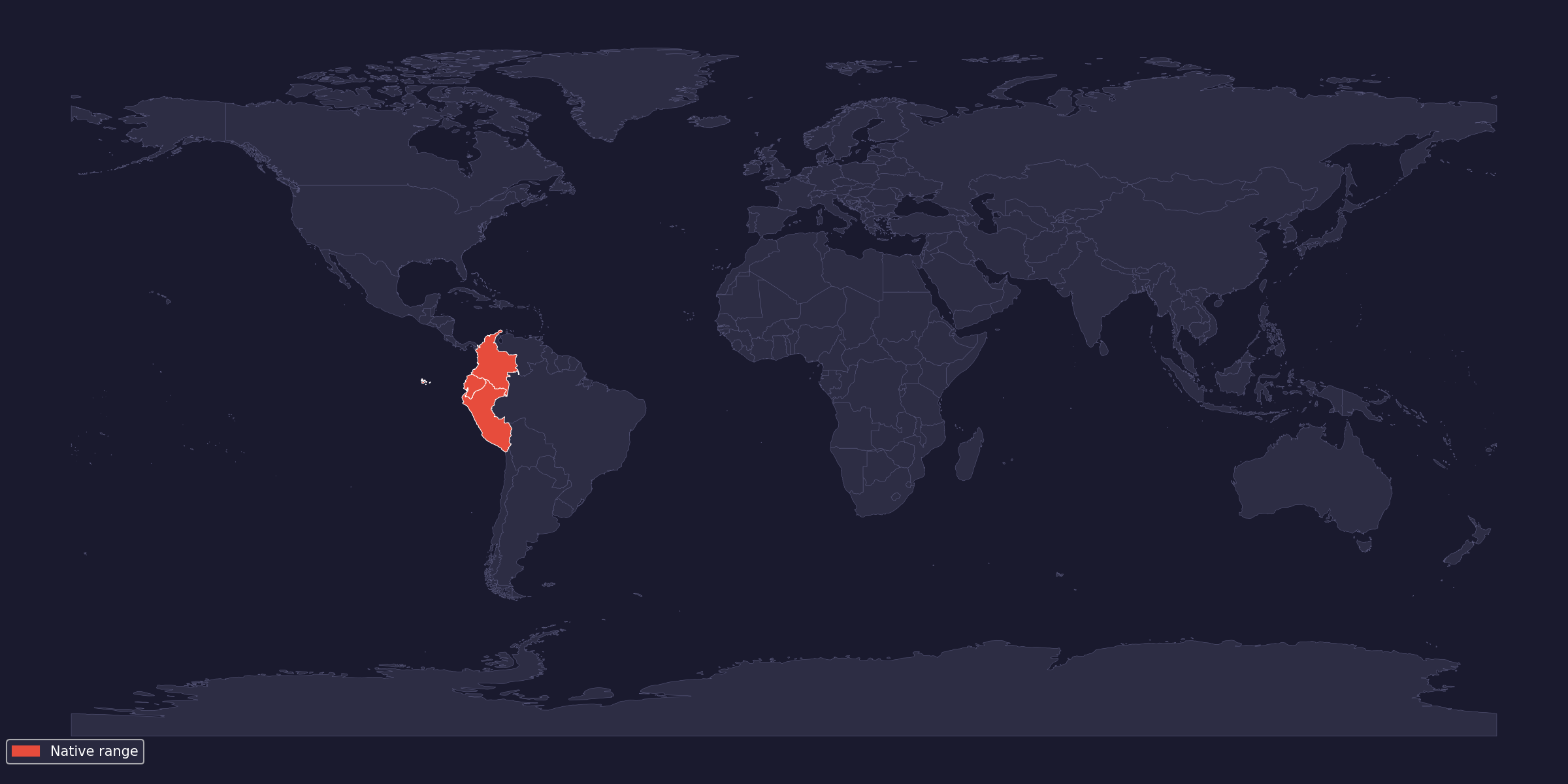
The revised native range includes Colombia, Ecuador and Peru. Populations in Cuba and Jamaica are introduced; confirmed urban records from Panama require care because many older Panamanian records involved other species. It uses seasonally dry forest, humid forest edges, bark and synanthropic crevices from lowlands into foothills.
🌡 Climate across the native range
Monthly climate normals from reviewed GBIF occurrences in the Colombian and Ecuadorian parts of the native range:
Valle del Cauca — Colombia (reviewed native-range occurrence)
| Month | Min °C | Mean °C | Max °C | RH % |
|---|---|---|---|---|
| January | 14.8 | 19.7 | 24.6 | 80 |
| February | 14.9 | 19.8 | 24.7 | 80 |
| March | 15 | 19.9 | 24.9 | 80 |
| April | 15 | 19.7 | 24.4 | 83 |
| May | 15 | 19.6 | 24.1 | 84 |
| June | 14.6 | 19.4 | 24.2 | 83 |
| July | 14.2 | 19.5 | 24.9 | 79 |
| August | 14.2 | 19.6 | 25 | 78 |
| September | 14.5 | 19.6 | 24.7 | 79 |
| October | 14.5 | 19.2 | 23.8 | 82 |
| November | 14.6 | 19.1 | 23.6 | 83 |
| December | 14.9 | 19.5 | 24.1 | 82 |
Guayas — Ecuador (reviewed native-range occurrence)
| Month | Min °C | Mean °C | Max °C | RH % |
|---|---|---|---|---|
| January | 21.7 | 26 | 30.4 | 77 |
| February | 22.1 | 26.2 | 30.3 | 81 |
| March | 22.4 | 26.6 | 30.8 | 80 |
| April | 22.2 | 26.6 | 31 | 79 |
| May | 21.6 | 26 | 30.3 | 79 |
| June | 20.5 | 24.9 | 29.3 | 79 |
| July | 19.7 | 24.1 | 28.6 | 78 |
| August | 19.2 | 24.1 | 29 | 76 |
| September | 19.3 | 24.4 | 29.5 | 75 |
| October | 19.6 | 24.5 | 29.5 | 74 |
| November | 19.9 | 24.8 | 29.7 | 73 |
| December | 20.8 | 25.7 | 30.6 | 73 |
Weather data by WorldClim v2.1 · Monthly normals queried by Herpeton Academy from raster values; relative humidity is derived from vapor pressure and mean temperature.
Location references use GBIF.org occurrence data where available; original occurrence records retain their source dataset licenses.
⚖️ Legal status
Checked on 2026-08-17 against the official CITES Appendices, EU wildlife-trade annex framework and Bern Convention appendices: C. margaritatus is not specifically listed, and Bern is not relevant to this non-European native species. Non-listing is not permission to keep it. National and local dangerously venomous-animal, import, transport, tenancy, insurance and workplace rules may prohibit possession or require a licence. Obtain written confirmation before purchase and retain the breeder, locality, invoice and import trail; never source a wild animal.
🤌 Husbandry
Keep one animal in a labelled, locked primary enclosure inside a second locked, escape-proof cabinet or room. Every vent and door channel must contain juveniles, not merely adults. Quarantine new stock for 90 days in a simple separate unit, use dedicated tools and record origin, feeding, moults and body condition. Do not accept “Central American margaritatus” as an identification.
| Parameter | Conservative target |
|---|---|
| Adult enclosure | 25 × 20 × 30 cm |
| Day air | 24–28 °C |
| Warm upper area | 28–30 °C |
| Cool retreat / night | 21–24 °C / 20–24 °C |
| Relative humidity | 55–75%; 65–80% in the protected premoult refuge |
| Substrate | 5–8 cm, with vertical cork and narrow crevices |
| Feeding | one modest captive-bred invertebrate every 7–10 days |
Plan every opening before unlocking it. Work with the primary enclosure inside a tall, smooth transfer tub in a closed, uncluttered room; close drains and door gaps, count the animal before and after, and use a clear catch cup plus long soft brush. Never pin, tail, free-handle or transfer with bare hands. Keep a written escape response, local poison-centre and emergency numbers, the scientific name and a route to emergency care beside the locked outer barrier.
💡 Lighting
Provide diffuse light for a 10–12-hour day and complete darkness at night; UVB is unnecessary. Lamps and cables remain outside both containment barriers. Shade every retreat and prevent direct sunlight from striking glass, because a narrow tropical enclosure overheats rapidly.
🌡 Heating and temperature
Maintain 24–28 °C air with a small upper-side warm area at 28–30 °C, a 21–24 °C lower retreat and nights of 20–24 °C. Heat only one external side under a thermostat, never the entire floor. Measure temperatures behind the cork as well as in open air; the animal must be able to leave warmth without crossing the door.
💧 Humidity and water
Aim for 55–75% RH with strong cross-ventilation. Moisten one lower corner so the protected premoult refuge reaches about 65–80%, while bark surfaces and the opposite side partly dry between waterings. Supply a shallow stable dish. Persistent condensation, saturated substrate or mould calls for less water and more airflow; complete dryness risks dehydration and moulting failure.
🌿 Enclosure and decoration
Use 5–8 cm of compact soil and sand below firmly anchored vertical cork slabs. Provide several narrow bark gaps at different heights without hollow ornaments that prevent a visual count. Fit fine metal ventilation, locked doors and sealed cable ports. Test the empty enclosure with a thin card before the animal enters; bark scorpions can flatten into surprising gaps and climb textured silicone.
🪳 Feeding
Offer one appropriately sized captive-bred cricket, roach nymph or locust every 7–10 days. Reduce feeding when the mesosoma is broad and remove leftovers within 24 hours, before a moult, and when a female may give birth. Introduce and retrieve prey with long forceps while the scorpion remains visible; never reach around cork or use wild insects.
🦂 Breeding and young
This species is viviparous: newborns ride on the female until their first moult. Species-specific litter and gestation data are too inconsistent for a reliable fixed number, especially where old records used the name broadly. Breeding adds no welfare benefit and multiplies a serious containment risk. If a female arrives gravid, stop disturbance, remove loose prey, prepare many numbered fine-vented units inside the locked room and separate young only after natural dispersal.
🩺 Common problems
- Wrong identity: old trade labels can conceal C. edwardsii or a Central American Centruroides with different risk and climate needs.
- Escape: loose sliding doors, coarse mesh and vertical bark beside an opening create a direct route out.
- Moisture imbalance: stagnant wet substrate promotes mould and mites; uniform dryness causes dehydration and poor moults.
- Overheating: sun or unregulated side heat can make every refuge dangerously warm.
- Sting: do not wait for symptoms or attempt home treatment. Prevent further contact, call emergency services or a poison centre immediately, and provide the scientific name and time of the sting.
📌 Conclusion
Correctly identified C. margaritatus is a large, fast South American bark scorpion with medically important uncertainty. Its care depends on vertical retreats, a ventilated seasonal moisture gradient and moderate warmth, but the decisive requirement is an expert operator with double locked containment, rehearsed transfers and an emergency plan.
📚 Sources and further reading
- GBIF species backbone: Centruroides margaritatus
- de Armas, Teruel & Kovařík (2011): redescription and range revision
- Comparison of Colombian scorpionism including C. margaritatus
- Ecuador checklist with medical-significance notes
- Amateur Entomologists’ Society: scorpion husbandry and safety
- CITES Appendices
- Commission Regulation (EU) 2026/1383
- Council of Europe: Bern Convention appendices