Share

Cabrera's Burrowing Cockroach
🔤 Taxonomy
Byrsotria cabrerai Rehn & Hebard, 1927 is an accepted species in Blaberidae. Older sources sometimes use the misspelling B. cabrerae. Keep it separate from B. fumigata and preserve any locality or culture-line label; similar females and nymphs are not enough to merge stocks.
📌 Description
Cabrera’s burrowing cockroach is a sturdy Cuban ground species, usually about 3.5-4.5 cm as an adult. Males are more elongate and winged; females are broader with reduced wings. It spends much of the day under litter or in substrate, so it is a better natural-history colony than a constantly visible display.
🌍 Distribution
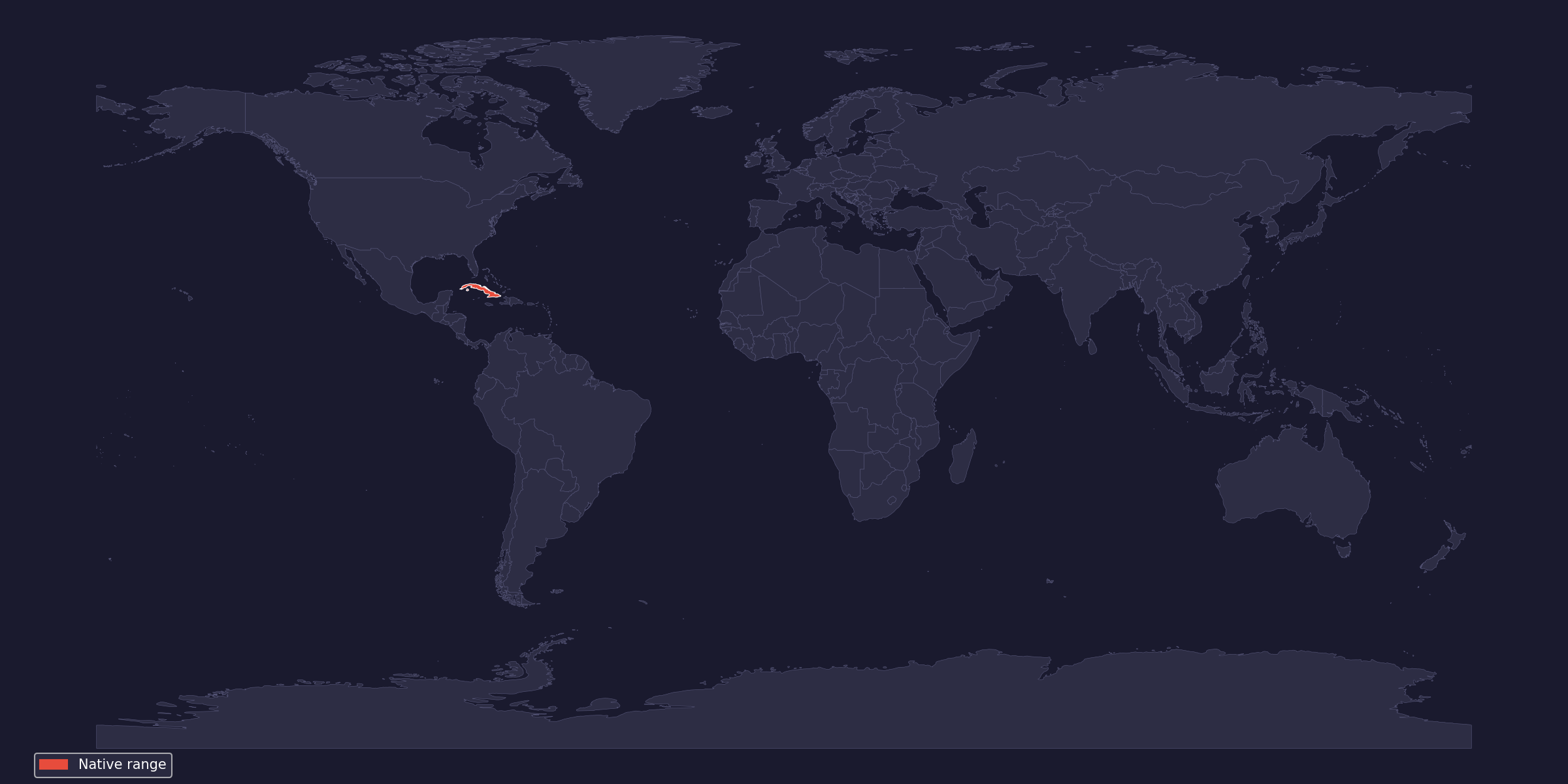
The species is endemic to Cuba. Published natural-history summaries place it on the ground beneath stones and shelter in coastal woods. The whole-country map reflects the defensible national range, not continuous occurrence.
⚖️ Legal status
Checked 2026-08-22: no listing was found in the official CITES Appendices or current EU wildlife-trade annexes; the Bern Convention does not list this Cuban endemic. National import, biosecurity, transport, and live-insect rules may still apply. Retain invoices, breeder and line details, and import papers, and never release animals or substrate.
🤌 Husbandry
House a starter group in at least 30 x 20 x 20 cm. Quarantine new animals for 60 days with separate tools. Inspect without repeatedly excavating the colony: frequent disruption damages tunnels and makes gravid females abandon stable retreats.
💡 Lighting
UVB is not required. An 11-13 hour day under indirect room light is enough; provide deep shade beneath bark.
🌡 Heating and temperature
Maintain 23-28°C, with a 21-24°C cooler end and 20-23°C nights. Warm one side of the enclosure through a thermostatically controlled mat or cable. Do not heat the whole floor, because the animals must be able to burrow away from heat.
💧 Humidity and water
Keep the lower substrate lightly moist while the surface partly dries, giving roughly 55-70% humidity. Supply water crystals or a shallow rough-sided dish. A sour smell, condensation and surface activity by the whole colony usually mean the substrate is too wet or oxygen-poor.
🌿 Enclosure and decoration
Provide at least 8 cm of compactable topsoil, decayed hardwood and leaf litter, with cork flats. Leave a drier feeding corner. The species does not need a tall cage, but male wings and newborn nymphs justify a clipped lid and fine-mesh ventilation.
🪳 Feeding
Keep dead leaves and rotten hardwood available. Two or three times weekly offer carrot, squash, apple or greens; once weekly provide a small portion of fish flake, seed meal or quality dry invertebrate diet. Remove wet leftovers within a day.
🥚 Breeding
This blaberid incubates the ootheca internally and gives birth to live nymphs. Sex adults by body shape and wing development rather than size alone. At 25-28°C a stable mixed-age group may produce roughly 15-30 nymphs per brood, but published culture data for B. cabrerai are sparse. Do not isolate a gravid female unless necessary; leave newborns with the colony and avoid replacing all established substrate at once.
🩺 Common problems
- Dry molts: moisten the lower layers, not the entire surface.
- Mold and grain mites: reduce protein and wet produce, improve airflow, and remove only spoiled patches.
- Poor breeding: verify adult sex ratio, warmth and uninterrupted deep substrate before adding food.
- Wing damage: add flat cork retreats and avoid overcrowding adult males.
- Line loss: maintain a second container and record every transfer.
📌 Conclusion
This species suits a keeper who enjoys observing burrowing behavior and can resist over-cleaning. Deep stable substrate and a documented pure line matter more than elaborate décor.
📚 Sources and further reading
- GBIF species record
- Cockroach Species File
- Roth & Willis: biotic associations of cockroaches
- ReptiFiles — checked; no species-specific guide found
- CITES Appendices
- EU wildlife trade legislation
- Bern Convention appendices