Share

Buthus elmoutaouakili
🔤 Taxonomy
Buthus elmoutaouakili is the accepted name, described in 2006 from Ait Baha. Older records used the unavailable infrasubspecific label Buthus occitanus mardochei alluaudi. The 2017 catalogue warns that parts of its reported range may include misidentified B. parroti, so an “Anti-Atlas Buthus” trade label is not a diagnosis.
📌 Description
The described adults are medium-sized, about 5.1–5.2 cm, yellow to pale yellow with one narrow central and two broader brownish stripes across most abdominal tergites. The tail remains yellow and only the tip of the sting is dark. These characters help a specialist but overlap other Moroccan species.
Its venom lacks a species-specific clinical assessment. The responsible approach is to treat it as a potentially medically significant Buthus: no handling, no open-room transfers and no assumption that small body size means low risk.
| Parameter | Conservative captive target |
|---|---|
| Adult enclosure | At least 30 × 20 × 20 cm |
| Day / warm side | 25–30 °C / 30–33 °C |
| Cool end / night | 21–24 °C / 18–22 °C |
| Humidity | 30–50%; one 50–65% protected pocket |
| Substrate | 8–10 cm of compactable rocky soil |
| Feeding | One suitable insect every 7–14 days |
| Containment | Solitary, latched primary box and locked second barrier |
☠️ Venom
This species is venomous. Venom exposure can cause pain, swelling or other systemic effects, and severity varies with species, locality, bite site and the amount delivered. A small wound or apparently dry bite is not proof of safety; every bite or sting requires urgent medical assessment.
If an incident occurs, move away, call emergency services or a poison centre, keep the patient still, remove rings and other constricting items, and follow dispatcher instructions. Do not use a tourniquet, cut or suck the wound, apply ice or electricity, give alcohol or medicines as a home treatment, or attempt to catch the animal. Antivenom choice and dosing are hospital decisions; verify the relevant product and local availability in advance. Sources: WHO snakebite guidance and appropriate species-specific toxinology or medical references listed below.
🌍 Distribution
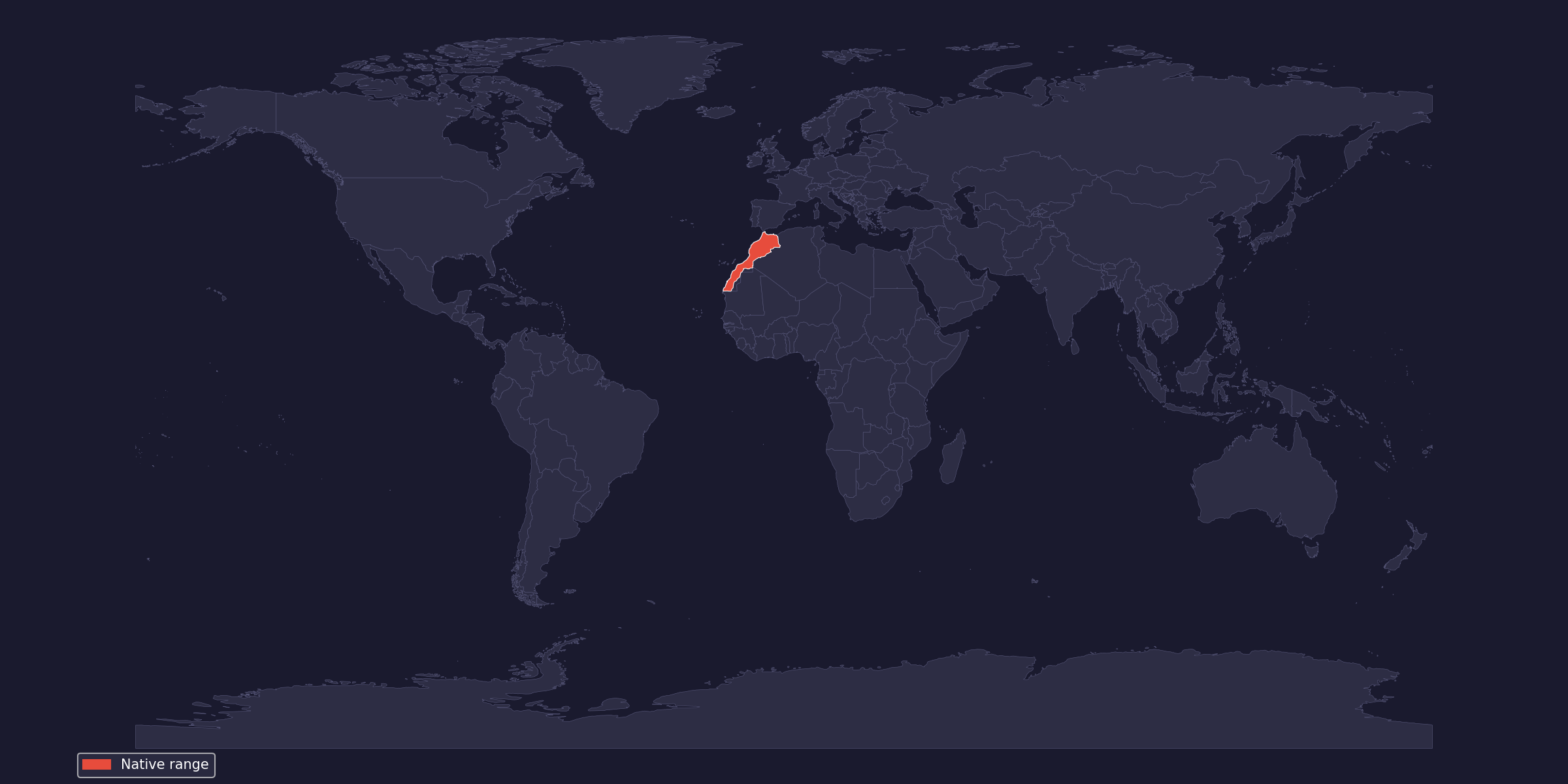
This species is endemic to Morocco. The best-supported range covers the western Anti-Atlas and Souss-Massa around Ait Baha and Tiznit, with molecular and recent field records extending across that landscape. It occurs in argan groves and rocky ground, often beneath stones; field identifications near B. parroti require care.
🌡 Climate across the native range
Monthly climate normals from reviewed GBIF occurrences in the supported western Anti-Atlas range:
Ait Baha area — Morocco (reviewed occurrence)
| Month | Min °C | Mean °C | Max °C | RH % |
|---|---|---|---|---|
| January | 5.2 | 10.9 | 16.6 | 60 |
| February | 7 | 12.5 | 18.1 | 57 |
| March | 9.3 | 15 | 20.7 | 52 |
| April | 11.5 | 16.8 | 22.1 | 53 |
| May | 13.4 | 18.7 | 24 | 52 |
| June | 16.4 | 21.6 | 26.8 | 49 |
| July | 18.7 | 24.3 | 29.8 | 44 |
| August | 19.1 | 24.6 | 30.2 | 44 |
| September | 16.8 | 22.2 | 27.6 | 50 |
| October | 13.7 | 18.9 | 24.1 | 55 |
| November | 10.3 | 15.7 | 21.1 | 56 |
| December | 6.3 | 11.9 | 17.5 | 63 |
Tiznit Province — Morocco (reviewed occurrence)
| Month | Min °C | Mean °C | Max °C | RH % |
|---|---|---|---|---|
| January | 2.6 | 7.8 | 13 | 59 |
| February | 4.1 | 9.4 | 14.7 | 55 |
| March | 6.6 | 12 | 17.5 | 50 |
| April | 9.1 | 14.2 | 19.4 | 50 |
| May | 11.4 | 16.6 | 21.8 | 48 |
| June | 14.8 | 20.1 | 25.4 | 43 |
| July | 17.3 | 23.1 | 28.9 | 37 |
| August | 17.4 | 23.2 | 28.9 | 39 |
| September | 14.8 | 20.3 | 25.8 | 46 |
| October | 11.2 | 16.3 | 21.4 | 53 |
| November | 7.4 | 12.5 | 17.6 | 56 |
| December | 3.7 | 8.8 | 13.9 | 63 |
Weather data by WorldClim v2.1 · Monthly normals queried by Herpeton Academy from raster values; relative humidity is derived from vapor pressure and mean temperature.
Location references use GBIF.org occurrence data where available; original occurrence records retain their source dataset licenses.
⚖️ Legal status
Checked on 17 August 2026, B. elmoutaouakili was not listed under CITES or the EU wildlife-trade annexes; the Bern Convention is not relevant to this Moroccan endemic. Export and collection law in the country of origin, import rules and domestic dangerously venomous-animal restrictions remain separate questions. Prefer documented captive-bred stock and retain invoice, breeder, locality and import records.
🤌 Husbandry
Keep one animal in a mechanically secured enclosure inside a locked secondary cabinet or room. Use a simple layout whose underside retreats can be checked through the wall. Before service, close the room, set out a clear catch cup and long forceps, and confirm the animal’s position.
Quarantine a new arrival for 90 days. Imported Moroccan stock can carry uncertain names as well as mites or injuries. Photograph the animal and labels, record feeding and moults, and never merge lines whose Ait Baha/Tiznit provenance is not traceable.
💡 Lighting
UVB is unnecessary. A 10–12-hour period of low diffuse light is sufficient, with darkness under each stone. Avoid an intense overhead spot: it overheats shallow rock cover and can force the scorpion toward ventilation openings.
🌡 Heating and temperature
Keep daytime air at 25–30 °C, with a small 30–33 °C warm area and a 21–24 °C cool shelter; nights may fall to 18–22 °C. Apply thermostatted heat to one side wall and verify the temperature under the chosen retreat. Do not heat the floor.
The Anti-Atlas is seasonally variable, but routine forced winter cooling is unnecessary. Never cool an animal that is young, thin, recently imported or in premoult.
💧 Humidity and water
Maintain 30–50% RH with strong ventilation and a shallow stable dish. Periodically wet one lower corner, allowing a protected 50–65% pocket while the exposed surface dries. This imitates access to moisture beneath stones rather than rainfall across the entire floor. Persistent condensation or mould requires less water and more airflow.
🌿 Enclosure and decoration
Use 8–10 cm of pesticide-free sandy soil strengthened with clay and small gravel. Seat flat stones directly on the base before packing substrate around them. Provide at least two tight retreats, one slightly more humid, but keep each inspectable from outside. Loose stones and undercut heavy decorations are crushing hazards.
🪳 Feeding
Offer a captive-reared roach nymph, cricket or small locust every 7–14 days. Prey should be no longer than the scorpion’s main body. Use long forceps from the side, remove an uneaten insect within 24 hours and stop feeding when premoult swelling and refusal appear. Routine powders and wild-caught prey are unnecessary.
🦂 Breeding and young
The species is viviparous. Captive reports exist, but dependable published species-level gestation and brood ranges are insufficient for planning by number. Breed only confirmed adults with documented Anti-Atlas origins. Supervise pairing, separate animals afterward and prepare secure individual juvenile tubs before birth; young stay on the mother until their first moult.
🩺 Common problems
- Misidentification: striped yellow Moroccan Buthus cannot be named safely from seller photographs alone.
- Rock collapse: decorations placed on top of excavatable soil can crush the animal.
- Chronic damp: a wet enclosure misrepresents dry rocky habitat and promotes fungi.
- Excess heat: a shallow stone refuge must remain cooler than the exposed warm side.
- Sting: seek emergency medical assistance immediately and do not drive yourself.
📌 Conclusion
Buthus elmoutaouakili is appropriate only for an expert who can verify an Anti-Atlas lineage and maintain locked, tool-only care. The workable enclosure is dry and rocky above, slightly buffered below, and simple enough for an exact safety count.
📚 Sources and further reading
- GBIF species record: Buthus elmoutaouakili
- Lourenço & Qi (2006), original description
- Sousa, Arnedo & Harris (2017), updated Buthus catalogue and range caveat
- Habel et al. (2012), molecular sampling across the Atlas Mountains
- Salhi et al. (2024), Souss-Massa distribution and habitat study
- Veterinary Care of Scorpions
- CITES Appendices
- European Commission: EU wildlife trade