Share

Xiamen Brown Penguin Roach
🔤 Taxonomy
“Blattellidae sp. ‘Xiamen, China’” is an unidentified hobby culture, not a scientific species name. Modern classifications generally place the former Blattellidae within Ectobiidae, which is why the GBIF tree ends at that family. Keepers suspect a Blattella species, but that has not been formally verified. “Blattelidae,” the spelling seen in the supplied sale list, is a trade-list misspelling and is retained here only as a search term, not as a valid family name.
📌 Description
Often sold as the Xiamen or brown penguin roach, this is a small, quick, humidity-dependent culture. All stages climb smooth surfaces, and first-instar nymphs pass through gaps that would contain larger roaches. A healthy colony can multiply rapidly, but drying, stale air, or a mold event can erase a small starter group.
| Care point | Practical target |
|---|---|
| Starter culture | 1-4 l sealed container; expand before crowding |
| Temperature | 24-28°C |
| Humidity | 70-85% with cross-ventilation |
| Hides | Vertical bark plus leaf litter |
| Main caution | Tiny, smooth-climbing hatchlings |
Adult size and reproductive numbers have not been published for an identified species. The 1.5-2.5 cm size and incubation values used here are conservative working ranges for this culture and must not be treated as taxonomic characters.
🌍 Distribution
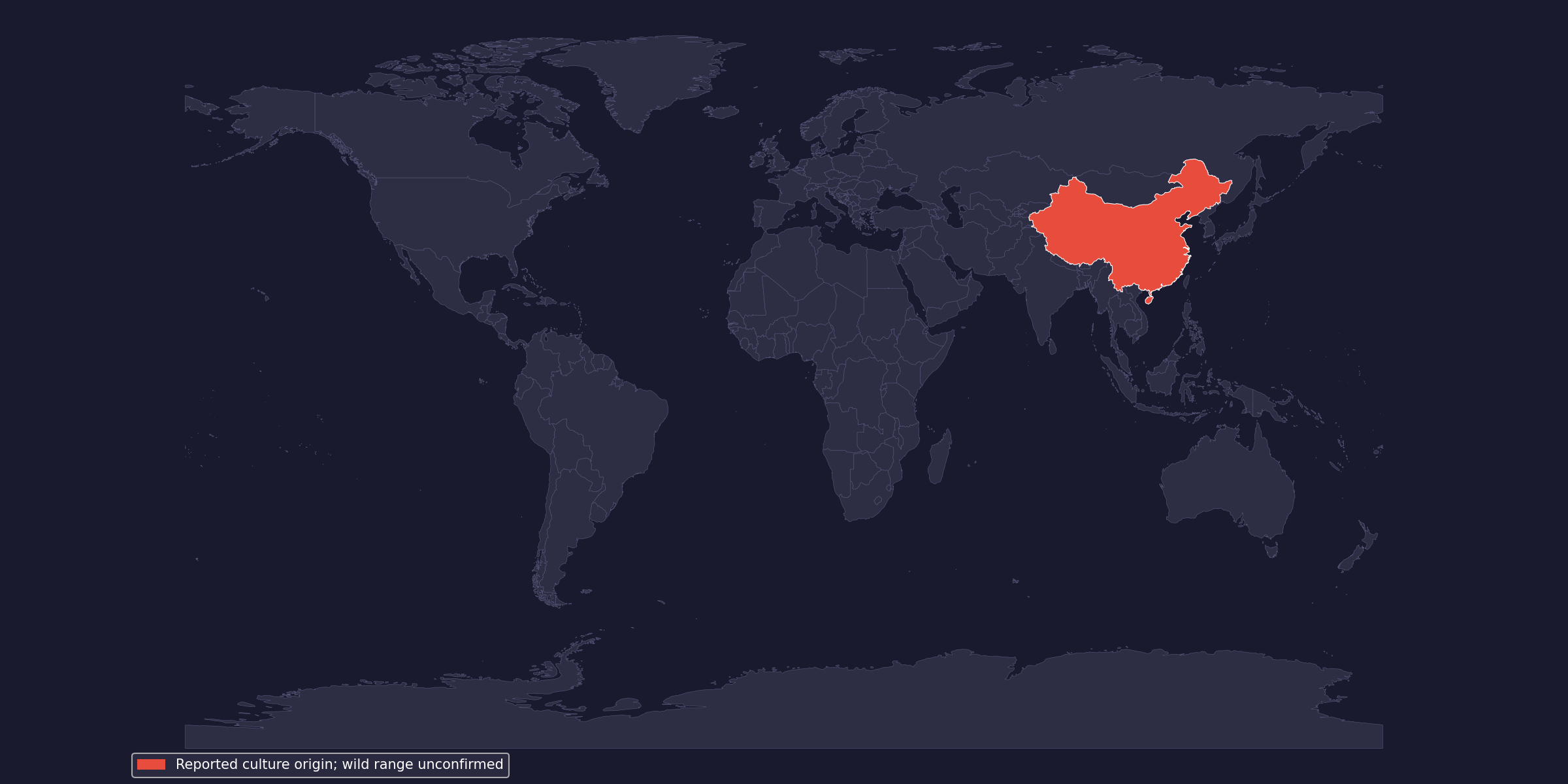
The culture label says Xiamen, China, but no traceable collection record or species description was found. The map highlights China solely as the reported origin of the captive line. It does not claim that the culture represents every small ectobiid in Xiamen or that its wild distribution is known.
⚖️ Legal status
Checked on 2026-08-22: an unidentified Ectobiidae culture cannot be matched to a species entry in CITES, the EU wildlife-trade annexes, or the Bern Convention. No listing was found under the trade label, but that is not equivalent to a formal legal identification.
Import and biosecurity authorities may refuse or restrict live insects that cannot be identified below family level. Keep the original label, breeder and transfer history, and any import documentation. Confirm national rules before shipping, and never release adults, nymphs, oothecae, or culture waste.
🤌 Husbandry
Start a small culture in a 1-4 l gasketed container so food and hatchlings can be monitored. A mature colony can move to roughly 30 x 20 x 30 cm. Cover every opening with microscreen and add abundant pinhole or screened cross-ventilation. Work over a second empty tub in a closed room.
Quarantine the culture for 60 days with separate tools. Do not mix it with the similar “Malaysia–Little Penguin” line or any Blattella culture; once mixed, appearance cannot restore the locality record.
💡 Lighting
UVB is not needed. Use a subdued 10-12-hour room rhythm and plenty of shaded vertical cover. Bright heat lamps dry this small enclosure too quickly.
🌡 Heating and temperature
Maintain 24-28°C, with a small 27-29°C warm edge and a 22-25°C retreat. Night temperatures of 21-24°C are adequate. Reproduction slows when cool, but a tiny sealed box can overheat very quickly.
Warm the room or one outer side with a thermostat. Never place the container on uncontrolled heat cable.
💧 Humidity and water
Aim for 70-85% humidity while keeping air moving. Moisten one part of the substrate and leaf litter; allow another surface patch to become merely damp. The smallest nymphs can drown in condensation or water gel.
Use tiny portions of water-rich vegetables and, for established colonies, a shallow wick or pebble-filled dish. Check daily enough to prevent drying, not by spraying until water runs down every wall.
🌿 Enclosure and decoration
Use 2-3 cm of fine coir/topsoil with leaf litter, thin cork, and vertical bark. Avoid large ventilation holes, poorly fitting cable ports, and loose mesh edges. Keep all climbing material several centimeters below the lid and renew the upper barrier if the chosen product becomes dusty.
Replace substrate in sections. Oothecae and hatchlings can be lost in discarded leaves, so freeze removed material before sealed disposal.
🪳 Feeding
Offer a dry base of quality invertebrate diet, pollen, or finely ground wholegrain food, plus tiny portions of apple, carrot, squash, or leafy greens. Feed fresh food daily or every other day in a large colony and remove it before mold threads develop.
Small foods matter: first instars cannot use a hard block efficiently. Avoid persistent high-protein pet food, seasoned scraps, and produce with pesticide residues.
🥚 Breeding
Females produce oothecae, but reliable published data for this unidentified line are lacking. At 24-29°C, keepers should treat 30-60 days as a monitoring window rather than a proven incubation period. Do not open or manually detach an attached capsule.
Once numbers rise, divide the culture into two independent containers. This protects the lineage from one ventilation failure, mite bloom, or unnoticed dry-out.
🩺 Common problems
- Escapes: coarse mesh, warped lids, hides touching the top, or sorting outside a secondary tub.
- Sudden crash: drying, overheating, pesticide exposure, or stagnant saturated air.
- Mold-entangled nymphs: food portions too large or poor removal of leftovers.
- Deformed molts: unstable humidity and lack of vertical surfaces.
- Lost identity: mixing locality cultures or silently converting “probably Blattella” into a species name.
📌 Conclusion
The challenge is not supplying food; it is balancing high humidity with microscreen ventilation while preserving an honest label. Keep duplicate colonies and never present “Xiamen” as a described species or verified Blattella identification.
📚 Sources and further reading
- GBIF Backbone Taxonomy: Ectobiidae
- Specialist notes: Blattellidae sp. “Xiamen, China”
- Cockroach Species File: Ectobiidae
- CITES Appendices, valid from 5 March 2026
- EU wildlife-trade annexes: Regulation (EU) 2026/1383