Share

Oriental Cockroach
🔤 Taxonomy
Blatta orientalis is the accepted name. “Oriental cockroach,” “black cockroach,” and “waterbug” are common names; the last is ambiguous and also applied to aquatic insects. This is a synanthropic pest species, not a domesticated display line.
📌 Description
Adults are dark brown to nearly black and about 1.8-3 cm long. Males have wings covering much of the abdomen; females have short wing pads, and neither sex flies. The species favors cool, damp ground-level refuges and can complete its life cycle in buildings. That makes an escape far more consequential than the loss of a tropical display roach.
| Care point | Practical target |
|---|---|
| Colony vessel | At least 40 x 30 x 30 cm, inside a second contained area |
| Temperature | 20-26°C; no tropical hot rack |
| Humidity | 60-80% with ventilation and no condensation |
| Reproduction | About 16 eggs per deposited ootheca |
| Main caution | Established household pest and potent allergen source |
🌍 Distribution
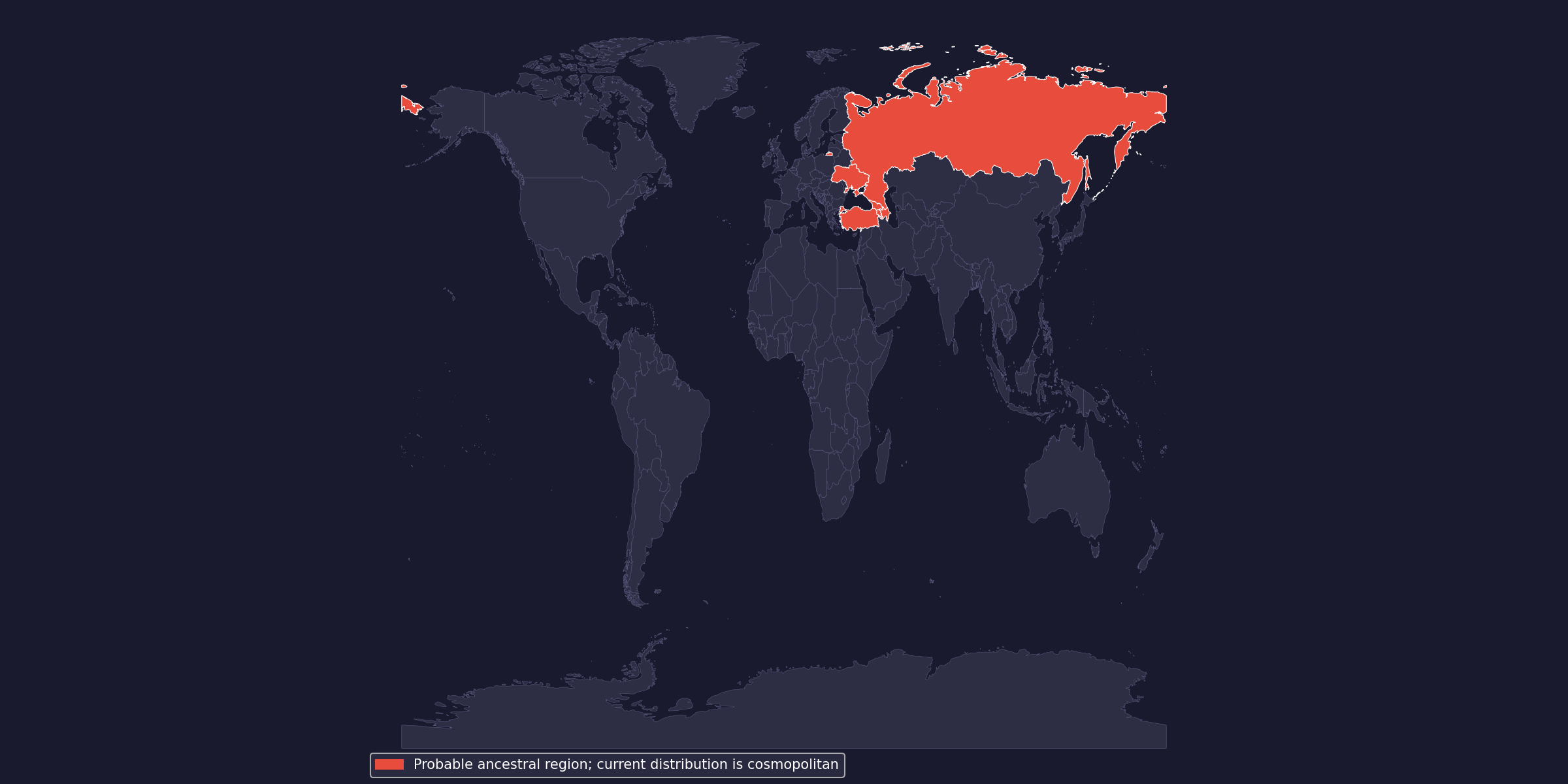
The prehistoric origin is uncertain. A Black Sea-Caspian and southern Russian origin is considered more likely than older North African proposals; human transport subsequently made the species widespread across temperate regions. The map therefore shows the probable source region, not its now-cosmopolitan pest distribution.
⚖️ Legal status
Checked on 2026-08-22: Blatta orientalis is not CITES-listed, has no species-specific entry in the current EU wildlife-trade annexes or the EU Union list of invasive alien species, and is not listed in the Bern Convention appendices.
It is nevertheless a regulated or actionable public-health and structural pest in many jurisdictions. Sale, shipping, laboratory culture, landlord obligations, and deliberate release may be restricted. Before keeping it, obtain written confirmation from the relevant local authority and property owner; preserve supplier and containment records. Never culture a wild household infestation as pet stock.
🤌 Husbandry
Keeping this species is hard to justify outside supervised education or research. If it is legal and necessary, use a gasketed smooth container inside a second lidded bin, in a dedicated room with door seals, sticky monitoring traps, and no open drains. Ventilation must be fine metal mesh; ordinary screen gaps can pass early nymphs.
Use separate tools and treat every animal, egg case, and handful of substrate as an escape risk. Count stock where practical and freeze waste securely before sealed disposal according to local rules.
💡 Lighting
UVB is unnecessary. Use a normal 10-12-hour day-night cycle and opaque refuges. Darkness does not make an insecure container safe; inspect seals and monitoring traps in daylight.
🌡 Heating and temperature
Maintain 20-26°C, with a slightly warmer 24-28°C area only when planned reproduction is permitted. A cool retreat of 16-21°C and nights of 16-22°C reflect its temperate tolerance. It does not need the 30°C rack conditions used for tropical Blaberus colonies.
Any heater must be external and thermostatically controlled. Warmer culture accelerates reproduction and raises the consequences of unnoticed escapes.
💧 Humidity and water
Provide 60-80% relative humidity with a moist retreat, not a wet enclosure. Damp leaf litter or one watered substrate corner is safer than condensation across the lid. Supply water-rich vegetable in a removable dish and, if used, a very shallow pebble-filled water dish.
Stale wet air favors mold and allergen buildup. Good containment must be paired with filtered ventilation, not a sealed swamp.
🌿 Enclosure and decoration
Use 3-5 cm of topsoil/coir mix and low cork flats. Keep all furniture well below the lid and eliminate seams around cables. Pale oothecae can be hidden in cracks, so choose removable, washable décor and inspect it over a secondary tub.
Do not use cardboard that will be discarded loose. Keep an inventory of oothecae during breeding and never compost substrate.
🪳 Feeding
Offer small portions of whole-grain dry diet, leafy vegetables, carrot, squash, and apple two or three times weekly. The species favors starchy food but will consume many forms of organic waste. Remove leftovers before they decay.
Do not feed animals collected from drains, kitchens, sewers, or pesticide-treated buildings to other pets. They may carry contaminants, and a fast individual can establish outside a feeding enclosure.
🥚 Breeding
A female produces about eight oothecae in her lifetime, each usually containing around 16 eggs. She carries a capsule for hours to several days and then deposits it in a warm, sheltered crack. At 24-28°C, hatching commonly takes about 42-81 days; development from nymph to adult may approach a year.
Breeding increases containment and disposal risks. Collect each ootheca into a second secured incubating cup rather than allowing it to disappear into décor, and do not breed the species without a documented endpoint for all offspring.
🩺 Common problems
- Escape or trap capture: stop work, seal the room, inspect the inner and outer containers, and follow the prewritten containment plan.
- Allergy and asthma symptoms: frass, body fragments, and shed skins are important indoor allergens; stop exposure and seek medical advice for breathing symptoms.
- Mold or odor: excessive wet food, poor ventilation, and accumulated feces.
- Pesticide die-off: wild-derived stock and household aerosols can contaminate a colony.
- Hidden oothecae: complex porous décor prevents reliable stock control.
📌 Conclusion
For most private keepers, a non-pest display cockroach is the responsible choice. B. orientalis belongs only in a legal, double-contained setting whose escape response and waste-disposal method exist before the culture arrives.
📚 Sources and further reading
- GBIF Backbone Taxonomy: Blatta orientalis
- UF/IFAS: Oriental cockroach biology and life cycle
- WHO: pest cockroach distribution and public-health significance
- European Environment Agency: cockroach allergens
- CITES Appendices, valid from 5 March 2026
- EU Union list update: Regulation (EU) 2025/1422