Share

Pantanal Cave Roach
🔤 Taxonomy
“Blaberus sp. ‘Pantanal’” is a provisional culture label, not a formally described species name. Specialist culture records more precisely call the lineage Blaberus cf. chacoensis “Pantanal, Brazil”: “cf.” means that it resembles B. chacoensis, not that the identification has been confirmed. The name “Pantanal roach” is also used for Eublaberus serranus, a different animal, so retain the full genus and lineage label on transfers.
📌 Description
This is a broad, heavy-bodied cave roach with distinctive brown patterning. Adults are commonly around 4-5.5 cm; nymphs burrow, while adults use angled bark above the substrate. It is kept for display and lineage conservation rather than reliable bulk production. Cultures have a reputation for irregular reproduction and sudden decline.
| Care point | Practical target |
|---|---|
| Small group | At least 45 x 30 x 30 cm |
| Temperature | 24-28°C; warm edge 28-30°C |
| Moisture | Keep only one-quarter to one-third of the substrate moist |
| Substrate | 8-10 cm, chunky and aerated |
| Main caution | Male aggression and unconfirmed identity |
🌍 Distribution
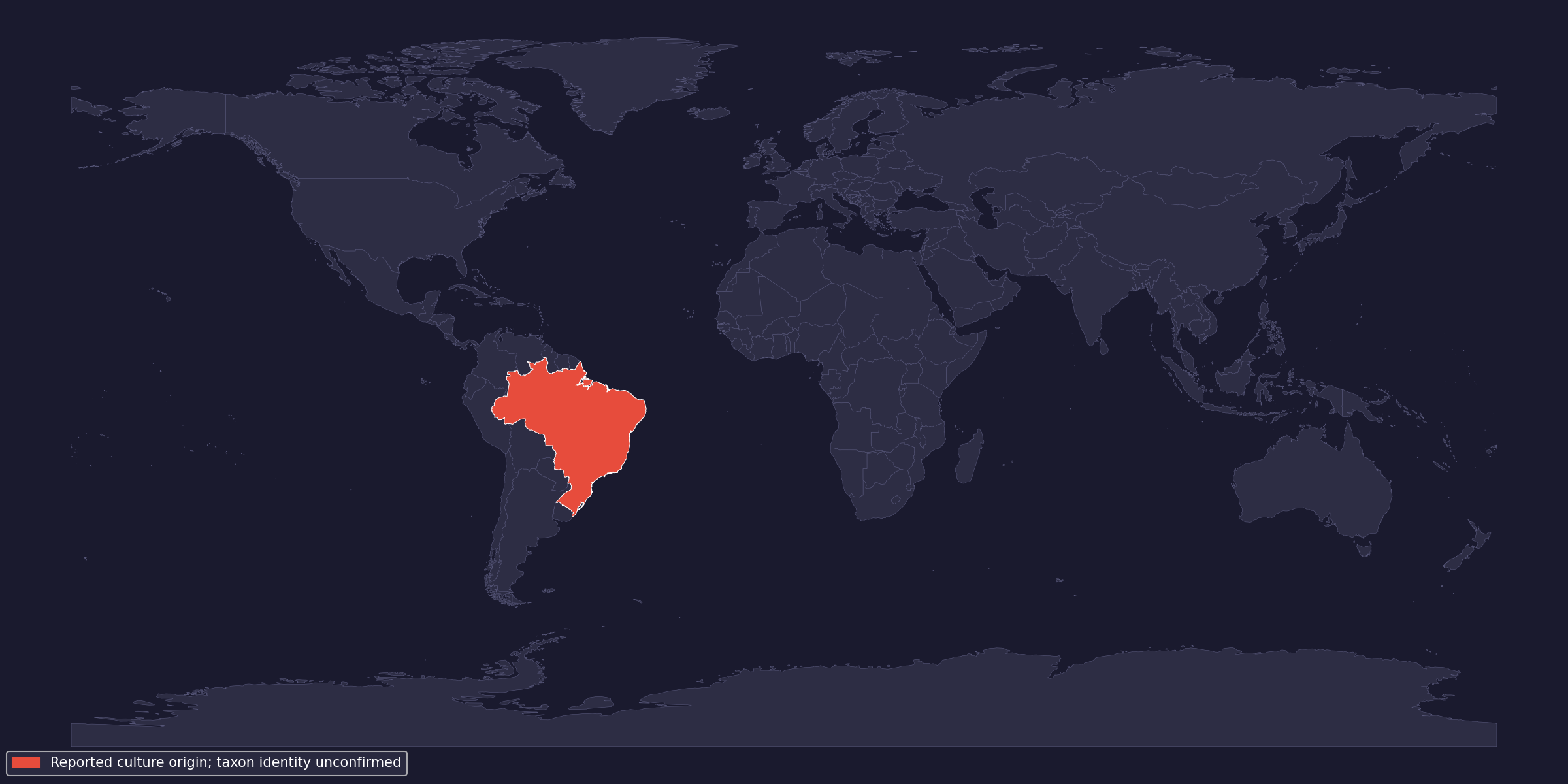
The locality label points to the Pantanal of Brazil, but it is not a published range statement for a confirmed species. Blaberus chacoensis itself was described from Chaco National Park in Argentina. Until diagnostic work ties the culture to that species, the map highlights Brazil only as the stated culture origin, not a verified native range.
⚖️ Legal status
Checked on 2026-08-22: no CITES, EU wildlife-trade annex, or Bern Convention listing could be attached to this unidentified Blaberus lineage. That conclusion must not be substituted for species identification at customs: authorities may require an identifiable taxon and proof of origin.
National live-invertebrate, plant-health, import, and transport rules still apply. Keep the original “Blaberus cf. chacoensis ‘Pantanal, Brazil’” label, seller and transfer records, and photographs of the breeding stock. Never release the animals or discard live substrate outdoors.
🤌 Husbandry
House a small female-biased group in a sealed, ventilated enclosure of at least 45 x 30 x 30 cm. Provide multiple retreats and remove surplus males if chasing, torn wings, or freshly molted injuries appear. Do not mix this culture with any other Blaberus: related lineages may hybridize and destroy its identification value.
Quarantine additions for 60 days with separate tools. Because the line is uncommon, stability matters more than rapid harvesting or repeated rearrangement.
💡 Lighting
No UVB is required. A dim 10-12-hour room cycle is sufficient. Give full shade beneath bark and keep the container out of direct sun.
🌡 Heating and temperature
Maintain 24-28°C with a small thermostatically controlled warm side at 28-30°C and a cooler retreat at 22-25°C. Nights may fall to 20-24°C. If females withhold broods, verify actual substrate temperature before adding more heat.
Heat the side or the room, never the base. Buried nymphs need a cooler downward escape route.
💧 Humidity and water
This lineage should not be kept uniformly humid. Moisten only one-quarter to one-third of the substrate and let the remainder stay dry, while keeping a deeper moist refuge available for molts. Cross-ventilation is essential.
Offer moist vegetables and a shallow, nymph-safe water source. A colony that is both hot and saturated can collapse quickly; one that is entirely dry may suffer incomplete molts.
🌿 Enclosure and decoration
Provide 8-10 cm of chunky topsoil, coir, leaf litter, and rotten hardwood. Place several angled cork slabs so adults can perch and nymphs can complete the final molt with clear space. Avoid fine waterlogged compost and tightly packed cardboard.
Inspect without repeatedly digging up the moist refuge. Remove corpses and mold promptly, replacing only the affected portion of substrate.
🪳 Feeding
Keep leaf litter available. Offer squash, carrot, sweet potato, apple, pear, and leafy greens two or three times weekly, plus a small portion of fish food, pollen, or balanced invertebrate diet weekly. Remove leftovers promptly from the moist zone.
Steady access to fresh carbohydrate-rich foods is preferable to alternating starvation with large fruit portions. Avoid pesticide residues and protein-heavy pet food as the staple.
🥚 Breeding
Reproduction follows the Blaberus pattern: females retain an ootheca internally and release live nymphs. Published species-specific litter and gestation data are not available for this provisional lineage; a cautious working expectation is roughly 15-30 nymphs after several warm months.
When breeding stalls, change one variable at a time. Check adult sex ratio, male aggression, the dry-moist boundary, ventilation, and food freshness. Do not sell a visually similar replacement as the same lineage without traceable provenance.
🩺 Common problems
- Culture crash: saturation, stale heat, pesticides, or an unstable male-heavy group.
- Freshly molted deaths: insufficient vertical space, harassment, or a missing moist refuge.
- No broods: cool substrate, disturbance, incompatible sex ratio, or lineage-specific infertility.
- Mold and flies: excess food in the wet quarter or unremoved corpses.
- Label drift: shortening the name to “Pantanal roach” risks confusion with Eublaberus serranus.
📌 Conclusion
This lineage suits a keeper prepared to preserve records and adjust a moisture boundary, not someone seeking a guaranteed feeder colony. Keep its full provisional name with every transfer and treat any identification as B. chacoensis as a hypothesis.
📚 Sources and further reading
- GBIF Backbone Taxonomy: genus Blaberus
- Lopes & Oliveira: Blaberus chacoensis description and Brazilian records
- ITIS: Blaberus chacoensis
- Specialist notes for Blaberus cf. chacoensis “Pantanal”
- CITES Appendices, valid from 5 March 2026
- EU wildlife-trade annexes: Regulation (EU) 2026/1383