Share

Giant Cave Cockroach
🔤 Taxonomy
Blaberus giganteus is an accepted species in the giganteus group. “Giant cave cockroach,” “Central American giant cave cockroach,” and “Brazilian giant cockroach” all occur in English-language material. Large Blaberus are frequently confused or hybridized in captivity, so obtain locality and breeder-line records rather than identifying pale adults by size alone.
📌 Description
At 7-10 cm long, this is among the longest cockroaches kept in Europe. Its broad, flattened body fits under bark and into cave crevices; adults have long wings and can flutter or glide when startled. Nymphs spend much more time buried. A healthy colony may live for two years, but needs more room and better airflow than a feeder-roach tub.
| Care point | Practical target |
|---|---|
| Adult group | At least 60 x 40 x 40 cm; expand for a large colony |
| Temperature | 24-28°C, with a 28-30°C warm area |
| Humidity | 65-80%, never stagnant |
| Substrate | 8-12 cm of moist, aerated organic mix |
| Main food | Leaves, vegetables, fruit, and modest dry protein |
🌍 Distribution
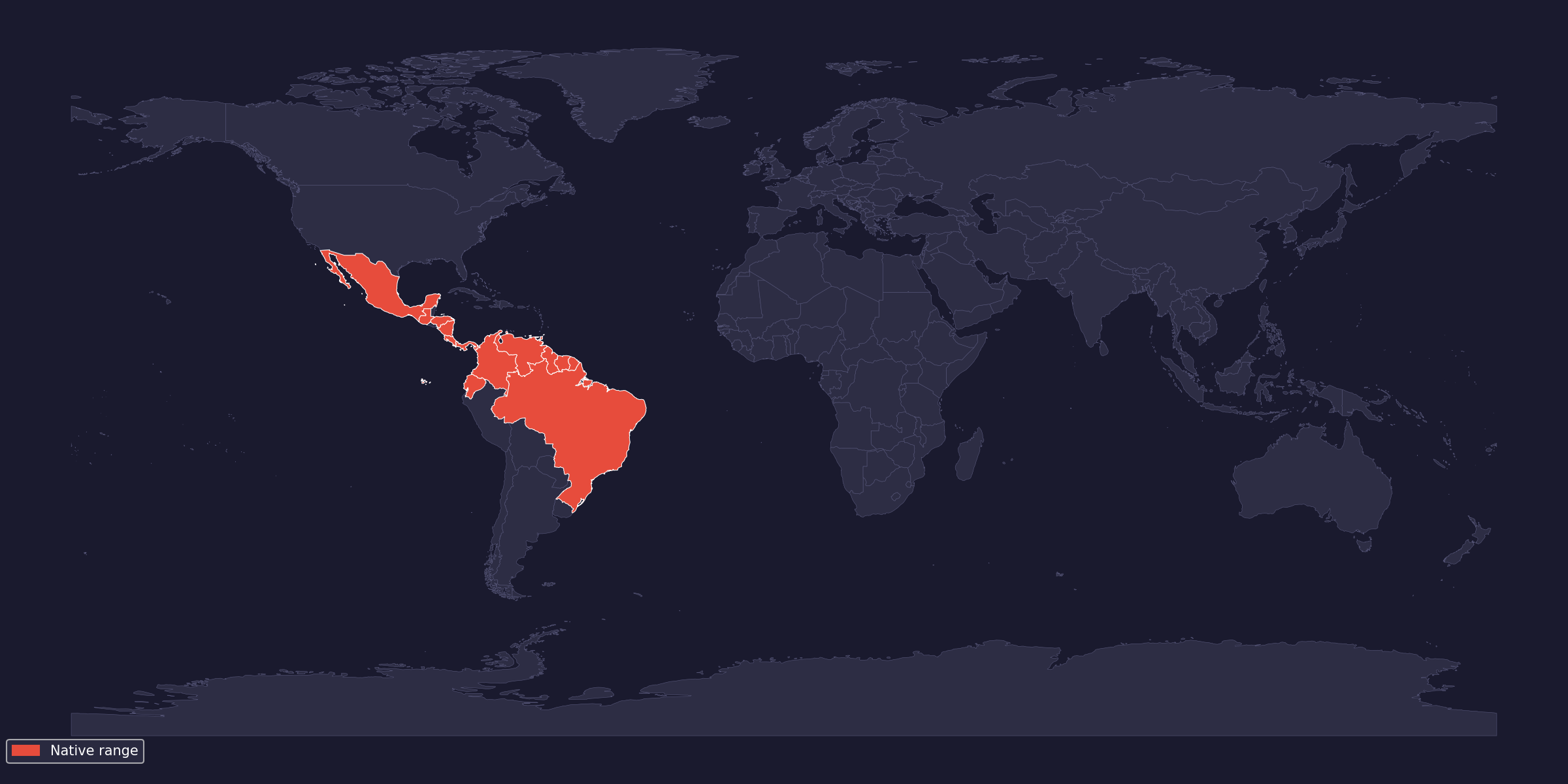
The species occurs through warm Neotropical forests and caves from Mexico and Central America into northern South America and Trinidad. Records are associated with humid rainforest, hollow trees, rock fissures, and bat caves rich in guano and decaying organic matter. The map shows the documented native region rather than occasional captive escapes.
⚖️ Legal status
Checked on 2026-08-22: Blaberus giganteus is not listed in the CITES Appendices, no species-specific entry was found in the current EU wildlife-trade annexes, and the Bern Convention is not relevant to this non-European species.
Live-invertebrate, agricultural-pest, import, transport, and tenancy rules can still restrict it. Keep the invoice, breeder identity, locality or strain label, and import documents where applicable. Never release roaches, oothecae, substrate, or enclosure waste outdoors.
🤌 Husbandry
Use at least 60 x 40 x 40 cm for a small adult group, with a tightly fitted lid and microscreen ventilation. Maintain several female-biased groups or separate surplus adult males: crowded males may damage one another. Inspect a new culture separately for 60 days and use dedicated tools, especially when its lineage or health is uncertain.
The colony should offer both moist burrowing substrate and airy above-ground refuges. A bare breeding bin deprives nymphs of normal cover and makes the humidity less stable.
💡 Lighting
UVB is not required. Provide a subdued 10-12-hour day-night rhythm and deep shade beneath bark. Direct sun can overheat the enclosure within minutes; night viewing is better done with dim ambient light than with a bright lamp left on continuously.
🌡 Heating and temperature
Keep most of the enclosure at 24-28°C and one upper side at 28-30°C. The opposite end should remain around 22-25°C, with nights near 21-24°C. Breeding and growth slow when the colony remains cool.
Warm a side wall or the room with a thermostat. Do not heat from below: burrowing nymphs move downward when stressed and may become trapped against a hot base.
💧 Humidity and water
Maintain roughly 65-80% relative humidity with strong cross-ventilation. The lower substrate should remain lightly moist, while the leaf-litter surface can partly dry. Persistent condensation, sour odor, or wet cardboard means the enclosure is too closed.
Offer a shallow dish filled with pebbles or provide water-rich vegetables; tiny nymphs must not be able to drown. Fresh fruit cannot compensate for a completely dry substrate during molts.
🌿 Enclosure and decoration
Use 8-12 cm of pesticide-free topsoil, coir, rotten hardwood, and dry leaves. Add large, firmly supported cork slabs at steep angles. These vertical surfaces are essential when the last-instar nymph expands its adult wings.
Keep heavy décor low, leave open clearance around molting sites, and prevent bark from reaching the lid. Remove dead animals promptly, but replace substrate in sections so the colony is not stripped of all familiar refuges at once.
🪳 Feeding
Keep decomposed hardwood leaves available and offer vegetables or fruit two or three times weekly: squash, carrot, sweet potato, apple, pear, and banana are useful choices. Add a modest dry protein source such as quality fish flakes, bee pollen, or a balanced invertebrate diet once or twice weekly.
Remove wet leftovers before mold develops. Constant high-protein dog or cat food promotes waste accumulation and is unnecessary; fresh plant food and carbohydrate availability are particularly relevant to active adults.
🥚 Breeding
Mature females retract the ootheca into a brood chamber and normally release 20-34 live nymphs after about two months, although cooler or disturbed colonies take longer. Nymphs may need four to eight months to mature. Never pull on a briefly exposed ootheca.
Provide space, steady warmth, fresh food, and several vertical hides. If reproduction stops, first check sex ratio, male aggression, heat, ventilation, and whether the colony is actually pure B. giganteus.
🩺 Common problems
- Damaged wings: insufficient vertical clearance or unstable molting surfaces.
- Male injuries: crowding, a male-heavy group, or too few separate refuges.
- Mold and phorid flies: dead roaches and wet food left in warm substrate.
- Failed molts: drying, poor ventilation, or forced disturbance of buried nymphs.
- Colony decline: overheating, pesticides, stale substrate, or mixed/hybrid stock with poor fertility.
- Allergy: frass and shed skins can irritate sensitive airways; ventilate the room and use gloves and a mask when cleaning a large dry colony.
📌 Conclusion
Choose this species for a large nocturnal display, not for the smallest possible culture tub. Have deep substrate, tall bark, a controlled warm side, and a plan for surplus males ready before the first nymph matures.
📚 Sources and further reading
- GBIF Backbone Taxonomy: Blaberus giganteus
- University of the West Indies: ecology of B. giganteus
- Toronto Zoo: Brazilian giant cockroach
- Specialist Blaberus culture notes
- CITES Appendices, valid from 5 March 2026
- EU wildlife-trade annexes: Regulation (EU) 2026/1383