Share

Tanzanian Red Bark Scorpion
🔤 Taxonomy
Babycurus jacksoni is the accepted name; the original combination was Rhoptrurus jacksoni. A 2018 genus review restricts the species to Kenya and Tanzania. Older hobby sheets also listed Uganda, Cameroon and the Democratic Republic of the Congo, but those broad assignments should not define a modern range or a captive lineage.
📌 Description
Adults are usually 6–9 cm, orange-brown to dark red with darker bands and black pedipalp fingers. They climb bark, move abruptly and may remain motionless before sprinting. Species-specific evidence does not establish it as medically significant, but a sting can be painful and the limited clinical record is not a safety guarantee. It is an advanced, display-only scorpion—not a handling animal.
☠️ Venom
This species is venomous. Venom exposure can cause pain, swelling or other systemic effects, and severity varies with species, locality, bite site and the amount delivered. A small wound or apparently dry bite is not proof of safety; every bite or sting requires urgent medical assessment.
If an incident occurs, move away, call emergency services or a poison centre, keep the patient still, remove rings and other constricting items, and follow dispatcher instructions. Do not use a tourniquet, cut or suck the wound, apply ice or electricity, give alcohol or medicines as a home treatment, or attempt to catch the animal. Antivenom choice and dosing are hospital decisions; verify the relevant product and local availability in advance. Sources: WHO snakebite guidance and appropriate species-specific toxinology or medical references listed below.
🌍 Distribution
Confirmed modern records are from Kenya and Tanzania, in warm savanna and woodland mosaics. It shelters below bark, stones and litter, makes shallow scrapes and can climb to forage. Coastal and inland sites receive seasonal rain; the useful captive lesson is access to a moist retreat plus ventilation, not a uniformly wet box.
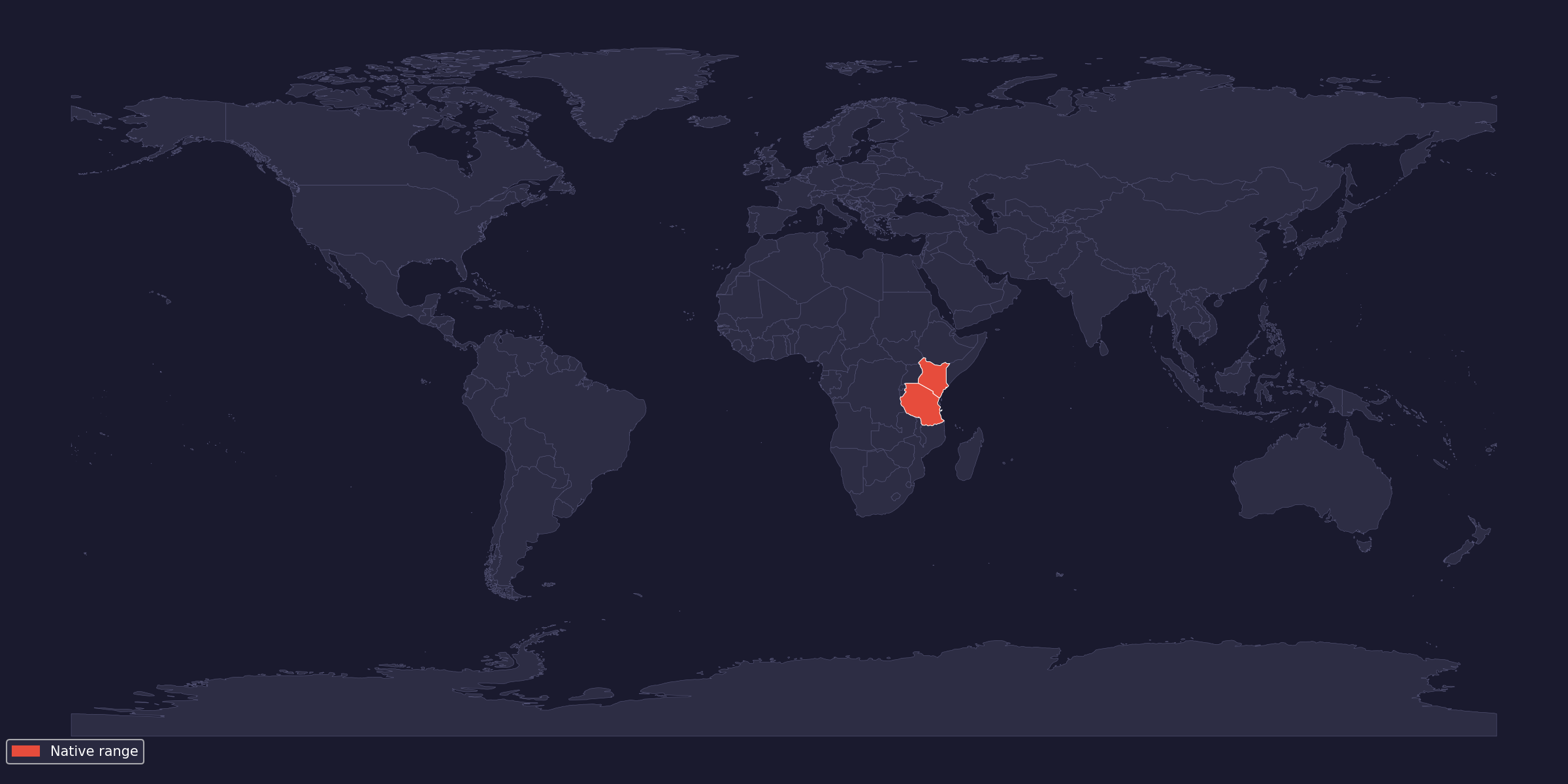
🌡 Climate across the native range
Monthly climate normals from reviewed GBIF occurrences in the modern Kenya–Tanzania range:
Kilifi — Kenya
| Month | Min °C | Mean °C | Max °C | RH % |
|---|---|---|---|---|
| January | 24.8 | 26.9 | 30 | 77 |
| February | 24.9 | 27.1 | 30.5 | 77 |
| March | 25.3 | 27.6 | 30.6 | 78 |
| April | 24.9 | 26.9 | 29.4 | 81 |
| May | 24.1 | 25.7 | 27.8 | 82 |
| June | 23.4 | 25 | 27 | 78 |
| July | 22.6 | 24.2 | 26.4 | 78 |
| August | 22.4 | 24.3 | 26.7 | 78 |
| September | 22.8 | 24.8 | 27.5 | 77 |
| October | 23.5 | 25.5 | 28.2 | 79 |
| November | 24 | 26.2 | 28.8 | 81 |
| December | 24.7 | 26.8 | 29.6 | 80 |
Morogoro — Tanzania
| Month | Min °C | Mean °C | Max °C | RH % |
|---|---|---|---|---|
| January | 21.8 | 25.1 | 30.3 | 79 |
| February | 21.9 | 25.3 | 30.5 | 78 |
| March | 21.8 | 24.6 | 29 | 83 |
| April | 21 | 23.5 | 27.2 | 86 |
| May | 19.7 | 22.7 | 26.6 | 82 |
| June | 17.8 | 21.7 | 26.3 | 74 |
| July | 17.1 | 21.4 | 26.2 | 69 |
| August | 17.7 | 22 | 27 | 69 |
| September | 18.5 | 23.1 | 28.5 | 67 |
| October | 19.8 | 24 | 29.5 | 70 |
| November | 20.9 | 24.5 | 29.6 | 76 |
| December | 21.5 | 24.8 | 29.8 | 79 |
Weather data by Open-Meteo.com · CC BY 4.0 · Monthly normals calculated by Herpeton Academy from daily archive values.
Location references use GBIF.org occurrence data where available; original occurrence records retain their source dataset licenses.
⚖️ Legal status
Checked on 2026-08-17 against the official CITES Appendices and EU wildlife-trade annex framework: Babycurus jacksoni is not specifically listed. The Bern Convention is not relevant to this non-European native species. Non-listing is not permission to own it. National or local venomous-animal, import, tenancy and workplace rules may still apply. Obtain written confirmation before acquisition and retain invoice, breeder identity, origin and import documents.
🤌 Husbandry
Keep one B. jacksoni in a mechanically latched enclosure whose upper vents, lid rim and cable ports have been tested against the narrow body of a juvenile. Upright cork should remain visible from outside so a bark-climbing animal can be confirmed before the lid moves. During a 90-day quarantine, use dedicated tools and record feeding, moults and the documented Kenya–Tanzania origin; inspect both faces of every bark panel during each count.
| Parameter | Conservative target |
|---|---|
| Adult enclosure | 30 × 20 × 25 cm |
| Day air | 24–29 °C |
| Warm area | 29–31 °C |
| Night | 20–23 °C |
| Relative humidity | 60–75%; 70–80% in the protected premoult refuge |
| Substrate | at least 8 cm |
| Feeding | one suitable invertebrate every 7–10 days |
A motionless juvenile may suddenly sprint or climb the forceps. Before opening, remove loose bark from the work path, put the whole enclosure in a tall smooth-sided tub and have two ventilated catch cups ready. Guide from behind with a soft brush; do not test immobility by touching it. Recount the animal after every bark panel is returned and latch the lid before lifting the enclosure from the tub.
💡 Lighting
This bark-dweller needs a reliable day–night cue, not UVB. Give 10–12 hours of diffuse room light and full darkness at night, with lamps and cables outside the enclosure. Check the upper cork after the light has been on for several hours: it must not become a hot, desiccating shelf while the lower moist retreat stays cool.
🌡 Heating and temperature
Maintain 24–29 °C daytime air, with one upper-side area at 29–31 °C and a shaded lower retreat at 22–24 °C; allow 20–23 °C at night. Heat a limited section of one wall through a thermostat rather than the floor. Place one fixed probe near the climbing cork and another low beside the moist refuge, because a safe gradient for this species is both vertical and horizontal.
💧 Humidity and water
Keep the general range around 60–75% RH with cross-ventilation and a protected retreat around 70–80% during premoult or for small juveniles. Add water to one deep corner rather than spraying the animal or saturating the whole floor. Supply a shallow stable water dish. Condensation, mould or flies mean moisture and airflow are out of balance.
🌿 Enclosure and decoration
Use at least 8 cm of pesticide-free leaf soil mixed with roughly one-third sand so it holds a shallow scrape without becoming airless. Keep the surface mostly dry, but water one lower corner. Add upright cork slabs with visible narrow gaps and a low stone hide, both seated on the base. This species climbs readily, so lid rims, cable holes and upper vents need the same gap test as the floor seams.
🪳 Feeding
Offer a small captive-bred roach, cricket or locust every 7–10 days, placing it near a visible bark edge with forceps rather than releasing several prey into the decor. Use abdominal fullness and the approach of a moult to adjust the interval; a hidden, uneaten cricket can injure a soft juvenile. Remove prey and fragments within 24 hours, use no wild-caught insects, and never reach behind cork by hand.
🦂 Breeding and young
The species is viviparous, and a female may carry roughly 18–30 young on her back until their first moult. Bark can hide both a gravid female and dispersing juveniles, so breeding is for experienced keepers who already have individually numbered, fine-vented units and homes for the brood. Keep the Kenya–Tanzania lineage record with every offspring, withdraw live prey before birth, and postpone any transfer while young remain on the mother.
🩺 Common problems
- Sprint after freezing: apparent catalepsy can end in an abrupt run; never assume a still animal is safe to approach.
- Stale, wet substrate: uniform saturation encourages mites and poor moults; retain one moist lower corner and real cross-flow.
- Dry premoult refuge: juveniles may fail to separate cleanly from the old cuticle.
- Wrong identity: Central African labels may represent another Babycurus.
- Sting: withdraw, contain the work area and obtain poison-centre or medical advice; limited published severity data are not permission for home treatment.
📌 Conclusion
Babycurus jacksoni suits an experienced keeper who can manage a fast bark-climber and a moisture gradient without treating it like a tropical swamp species. Its modern Kenya–Tanzania identity, locked lid, visible cork retreats and secondary transfer tub should be settled before acquisition. It remains a look-only animal despite the absence of proven severe species-specific scorpionism.
📚 Sources and further reading
- GBIF species backbone: Babycurus jacksoni
- Kovařík, Lowe & Šťáhlavský (2018): review of Babycurus
- The Scorpion Files: B. jacksoni natural history and husbandry
- Amateur Entomologists’ Society: scorpion husbandry and safety
- CITES Appendices
- European Commission: EU wildlife trade
- Council of Europe: Bern Convention