Share

Atlantoscia floridana
🔤 Taxonomy
Atlantoscia floridana (Van Name, 1940), originally described as Philoscia floridana, is accepted by the World List of Isopoda and GBIF in Philosciidae. “Florida Fast” is a hobby common name, not a locality guarantee; keep any collection or breeder data attached to the culture.
📌 Description
This slender philosciid reaches at most about 7 mm. It cannot roll into a ball and escapes disturbance by running rapidly. Its small size and delicate cuticle suit humid surface litter but make handling, counting, and containment difficult.
Unlike most species in this set, field population and reproduction data are available from southern Brazil. Captive target values remain starting points, but the humidity, size, and clutch fields have a stronger species-level basis than generic hobby advice.
🌍 Distribution
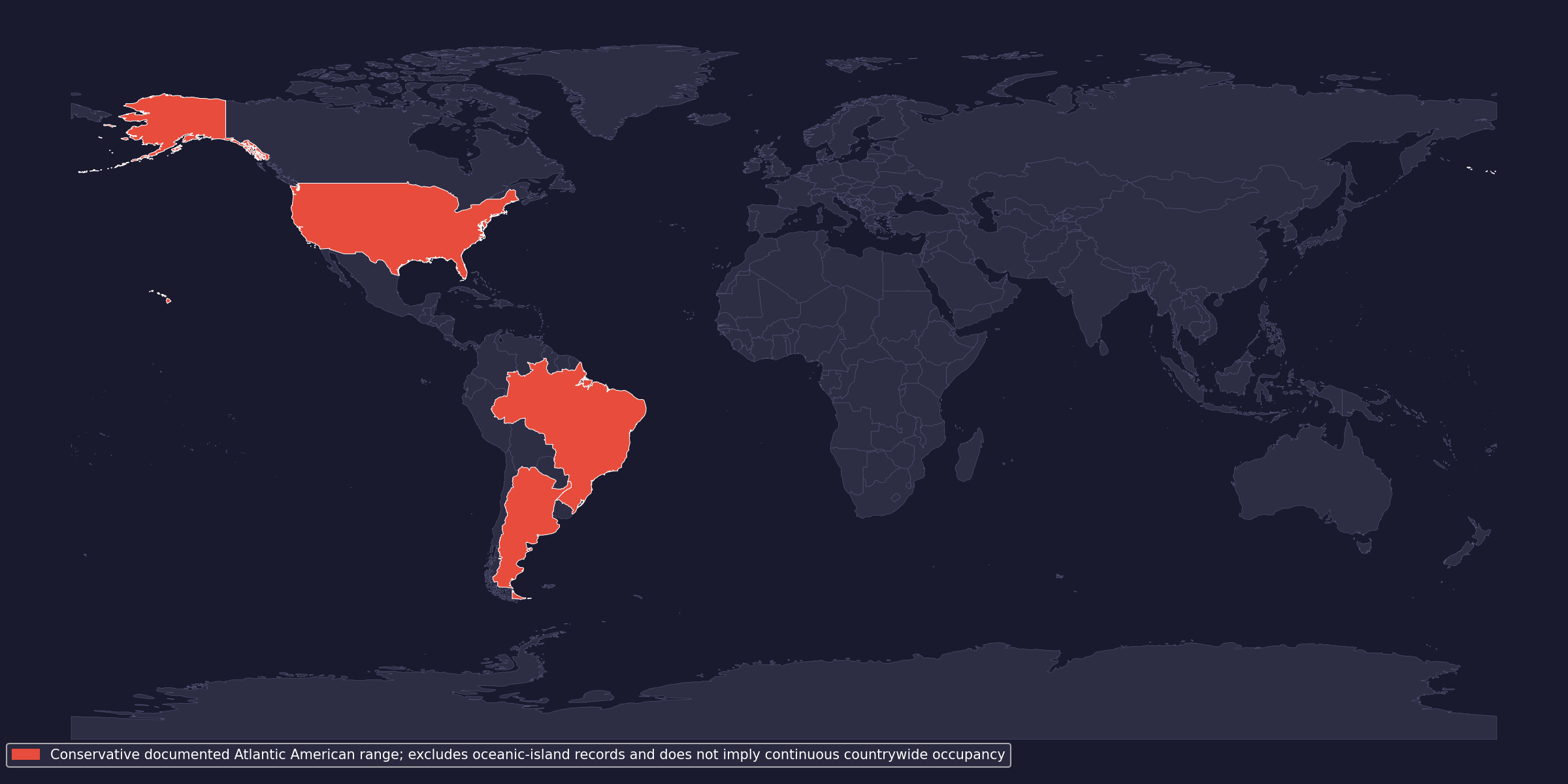
Published records form a striking Atlantic American pattern: Florida in the United States and a broad coastal South American range, especially Brazil to Argentina. Ascension and St Helena records are excluded from the conservative map because their origin is unclear. Country shading does not imply continuous occupancy.
⚖️ Legal status
Checked on 2026-08-29: A. floridana was not found in the CITES Appendices, EU wildlife-trade Annexes A-D under Regulation (EU) 2026/1383, or Bern Convention Appendices II-III. Local collecting, protected-area, import, soil, and invasive-organism rules still apply.
Use captive stock and retain its provenance. Never release a culture or discard live substrate outdoors, even within a country where the species occurs: genetic origin and local presence are not interchangeable.
🤌 Husbandry
Use at least 25 × 20 × 15 cm for a starter colony. Fit the lid and every ventilation opening with fine escape-proof mesh. Keep about two-thirds of the lower substrate damp, with a smaller aerated zone whose leaf surface can approach dry.
| Parameter | Conservative starting target |
|---|---|
| Adult length | 0.4-0.7 cm |
| Temperature | 18-26 °C |
| Moisture | mostly damp leaf litter, never stagnant |
| Substrate | 5-7 cm leaf-rich soil and rotten hardwood |
| Staples | leaves, rotten wood, calcium |
| Evidence level | species field biology plus cautious captive practice |
Quarantine for 60 days with springtails and separate tools. Open the container only over a large pale tray.
💡 Lighting
UVB is unnecessary. Provide a 10-12-hour diffuse photoperiod and deep shade beneath leaves and bark. Direct sun can both overheat and dry the thin surface layer.
🌡 Heating and temperature
Maintain 18-26 °C, with a 16-22 °C retreat and cooler nights. The Brazilian population study recorded marked seasonal temperature variation, so a stable moderate enclosure is preferable to constant tropical heat.
If warming is needed, heat one side wall under thermostat control. Avoid bottom heat and prolonged temperatures above 28 °C, especially when ventilation is limited.
💧 Humidity and water
Keep most lower substrate and leaf litter damp but airy. Published restinga measurements included high relative humidity and moist litter; this does not justify saturation. Aim for a 65-85% RH trend while judging the refuge by touch.
Pour water into the damp side. A water dish is unnecessary. Condensation, sour smell, and animals climbing the walls indicate waterlogging or poor gas exchange; repeated failed moults indicate the damp refuge is unstable.
🌿 Enclosure and decoration
Use pesticide-free soil or leaf soil with generous deciduous leaf mould and soft rotten hardwood. Add a thick loose leaf layer, thin cork, a damp moss patch, and continuous cuttlebone or calcium carbonate.
Avoid aromatic wood, fertilizer, pure coconut fibre, and coarse ventilation. Keep decoration low and light so fast animals cannot be crushed during maintenance.
🪳 Feeding
Leaves and decayed hardwood remain available at all times. Every three to five days offer a small shaving of vegetable, mushroom, dried greens, or complete isopod food. Provide a tiny protein portion once weekly.
Place supplements on bark and remove wet remains after 24-48 hours. The species can reach high density; adjust portions to actual consumption rather than colony size guessed from surface activity.
🥚 Breeding
Females brood embryos in a marsupium and release mancae. A 19-month Brazilian study found continuous reproduction, autumn and spring peaks, and 5-23 eggs per female, averaging about 11. Those are field data, not a promise for every captive lineage.
Maintain warmth, litter moisture, calcium, and several age classes. Split a growing colony early enough to prevent crowding, transferring leaf substrate that contains hidden mancae.
🩺 Common problems
- Escapees: use fine mesh, a smooth upper wall, and a maintenance tray.
- Sudden decline: check for a dried lower layer or overheating before adding food.
- Mold or mites: reduce supplements and improve cross-ventilation.
- Failed moults: stabilize damp litter and continuous calcium.
- Miscounted colony: inspect substrate samples; surface sightings vary strongly.
📌 Conclusion
A. floridana is productive but not careless-beginner proof. Its best enclosure combines humid edible litter with real airflow, moderate temperatures, tiny meals, and unusually strict escape control.
📚 Sources and further reading
- World List of Isopoda: Atlantoscia floridana
- GBIF species record: Atlantoscia floridana
- Araujo & Bond-Buckup (2005), population structure and reproduction
- Quadros et al. (2009), life-history thesis and experimental context
- Brazilian terrestrial-isopod catalogue
- ReptiFiles site check; general clean-up-crew reference
- CITES Appendices
- EU wildlife-trade Annexes: Regulation (EU) 2026/1383
- Bern Convention appendices