Share

Mediterranean Hissing Isopod
🔤 Taxonomy
Armadillo officinalis Duméril, 1816 is the accepted spelling. “Armadillo officionalis” and “Armadillidium officinalis” are common trade errors: Armadillo and Armadillidium are different genera. Older combinations include Cubaris invenustus and Pentheus punctatus.
Brown/orange and Pink Mix are captive colour selections of A. officinalis, not species or subspecies. They belong in one care guide and should retain separate line records only when breeders want to preserve their appearance.
📌 Description
This broad, heavily armoured roller reaches roughly 1.5-2.2 cm. When disturbed it forms a tight ball and can produce audible stridulatory sound, hence “hissing isopod.” It is mainly active at night and aggregates in shaded retreats during hot, dry periods.
The species tolerates a drier surface than many hobby isopods, but it still breathes with moisture-dependent pleopodal structures. A dry Mediterranean setup therefore means a broad ventilated dry zone plus a protected humid refuge, never a completely desiccated box.
| Care point | Practical target |
|---|---|
| Adult size | 1.5-2.2 cm |
| Starter colony | 35 x 25 x 20 cm or larger |
| Temperature | 20-26°C; cool retreat 18-22°C |
| Moisture | small deep moist refuge, broad drier zone |
| Staple food | dry and decayed hardwood leaves, rotten wood |
| Main failure | confusing drought tolerance with permission to dry the whole enclosure |
🌍 Distribution
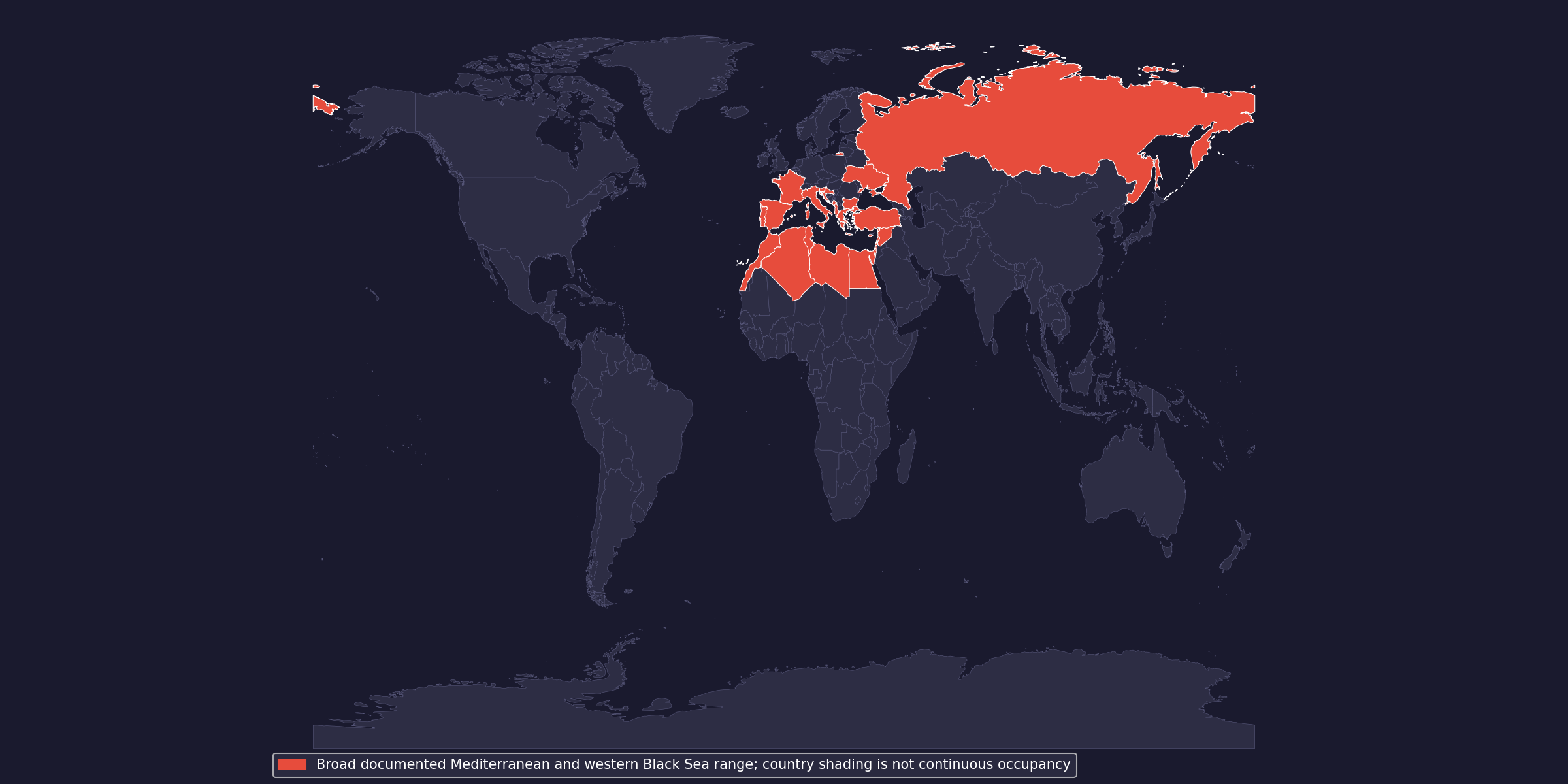
A. officinalis is widespread around the Mediterranean basin and along western Black Sea coasts, from the Iberian Peninsula and North Africa through southern Europe, the Balkans and western Asia. Studies document populations in dry Mediterranean habitats, with animals sheltering under stones and in other shaded sites where soil moisture remains moderate.
The country-level map depicts the broad native region, not uniform occurrence. Captive colour lines have no separate natural range.
⚖️ Legal status
Checked on 2026-08-23: A. officinalis is not listed in the CITES Appendices, Annexes A-D of Commission Regulation (EU) 2026/1383, or Appendices II-III of the Bern Convention. National collection, protected-area, plant-health, import, transport and sales rules can still apply across its large range.
Keep invoices, breeder and colour-line details, and import or transfer documents. Check destination rules before shipping and never release animals or culture substrate outdoors.
🤌 Husbandry
Use at least a 35 x 25 cm floor area for a starter colony and increase it as large adults and offspring fill the hides. Provide fine cross-ventilation, a tight lid and several bark slabs. A hide spanning the moisture line lets animals choose conditions while remaining concealed.
Quarantine new stock for 60-90 days with separate tools. Watch for hidden dehydration, incomplete molts, predatory mites, flies and mixed isopod species. Do not combine Brown/orange, Pink Mix or unlabelled stock if line integrity matters.
💡 Lighting
UVB is not needed. Use 10-13 hours of indirect light, with a somewhat longer summer day if the colony is kept on a seasonal cycle. Always provide darkness beneath leaves and bark. Direct sun and unshielded lamps can create lethal heat in minutes.
🌡 Heating and temperature
Maintain 20-26°C during active care, leaving an 18-22°C cool end and ordinary night cooling to 16-21°C. Laboratory and field work show that temperature affects activity, water loss and feeding, so measure inside the enclosure rather than assuming a warm-room reading is representative.
If heat is necessary, use a thermostat on one outside wall. Never warm from below and do not push the entire colony toward 26°C; gravid females and mancae must be able to retreat to cooler moist substrate.
💧 Humidity and water
Keep roughly one-quarter to one-third of the substrate deeply moist beneath moss and bark. Most of the surface can dry between waterings, supported by generous airflow. Check the lower layer with a clean finger or wooden skewer; ambient humidity alone does not reveal whether the refuge is usable.
An open water dish is unnecessary. Repeated whole-box spraying defeats the gradient, while bone-dry substrate causes poor molts and juvenile losses. Condensation everywhere or sour soil means the enclosure is too wet.
🌿 Enclosure and decoration
Use 7-10 cm of unfertilized topsoil with crushed deciduous leaves, crumbly rotten hardwood and some sand or fine mineral material on the drier side. Cover the surface with a deep leaf layer and stable cork or stone-like hides that cannot collapse during maintenance.
Provide cuttlebone, limestone or baked crushed eggshell continuously. Avoid fertilized soil, aromatic or resinous wood, sprayed leaves, fine dusty sand as the sole substrate, and heavy stones resting on loose soil.
🪳 Feeding
Dry hardwood leaves and decayed wood are the permanent base. Larger adults also take squash, carrot, sweet potato and small amounts of oats. Offer a small protein portion such as dried shrimp or fish food once weekly, then remove leftovers before mites find them.
Calcium remains available at all times. Do not use rich pet food as a staple; heavy protein and moist food foul warm Mediterranean cultures quickly.
🥚 Breeding
The broad metadata category is “viviparous,” but A. officinalis is a marsupial brooder. Eggs and embryos remain in the female’s ventral brood pouch and young emerge as mancae. A Libyan field study recorded broods during the humid part of the warm season and an average marsupial development period of about 32 days; timing and brood number vary with population, female size and conditions.
Do not remove a brooding female for “incubation.” Keep her moist refuge stable and reduce disturbance. Move several sizes and substrate material when establishing a new colony because small mancae are easily overlooked.
🩺 Common problems
- Dry-season crash: restore one refuge gradually and reduce heat; flooding a hot container adds stress.
- Incomplete molt: check deep moisture and calcium rather than making the whole box humid.
- Slow breeding: confirm mature animals of both sexes, seasonal temperature and a protected damp retreat.
- Mites or odor: cut rich food, remove spoiled patches and improve ventilation.
- Line confusion: Brown/orange and Pink Mix labels describe breeding lines; mixed offspring remain A. officinalis and must be labelled honestly.
📌 Conclusion
The Mediterranean hissing isopod is a robust, distinctive display species for a keeper who respects its two opposing needs: abundant ventilation and permanent deep moisture in one refuge. Its colour lines require no separate articles or different care.
📚 Sources and further reading
- GBIF: Armadillo officinalis
- World List of Isopoda (WoRMS): A. officinalis
- Breeding and population biology in Benghazi, Libya
- Temperature, water loss, growth and feeding in A. officinalis
- Stridulatory apparatus in the manca stages
- EAZA Management Guideline Manual for Invertebrate Live Food Species
- ReptiFiles — checked; no species-specific care guide was found
- CITES Appendices, valid from 5 March 2026
- Commission Regulation (EU) 2026/1383
- Bern Convention appendices