Share

Werner's Pill Woodlouse
🔤 Taxonomy
Armadillidium werneri Strouhal, 1927 is the accepted name. Its scientific redescription describes five rows of yellow spots, yellow lateral plates and telson, and adults up to 21 mm.
The species was originally described with Kefalonia as the locality, but later authors treated that label as erroneous; verified material is from Corfu. Orange is a captive line name, not a taxonomic rank.
📌 Description
Adults reach about 1.6-2.1 cm and form a tight ball when disturbed. Typical animals show five pale or yellow spot rows against a dark ground, while captive Orange stock departs from the usual colour. Pattern alone cannot establish provenance.
Although colonies can breed well, the narrow verified range and frequent confusion of trade labels justify intermediate status. Good records are as important as routine moisture and feeding.
| Care point | Practical target |
|---|---|
| Adult size | 1.6-2.1 cm |
| Starter colony | 30 x 20 x 15 cm or larger |
| Temperature | 18-24°C |
| Substrate | 6-8 cm, leaf-rich and calcium-supported |
| Moisture | damp refuge with a ventilated drier end |
| Main failure | line mixing, heat or uniform wetness |
🌍 Distribution
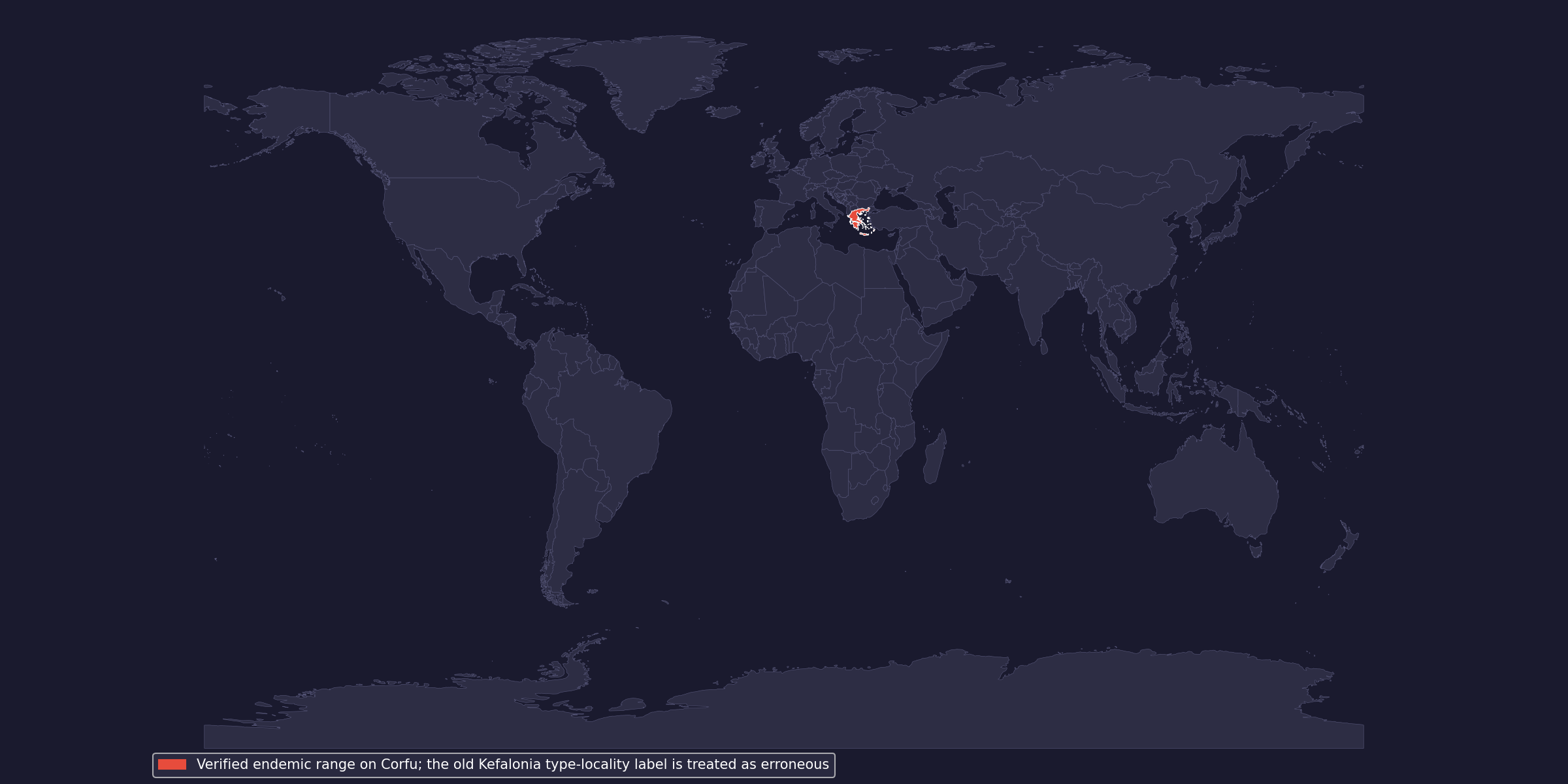
Verified records are restricted to the Greek Ionian island of Corfu, from low olive groves to Mount Pantokrator at about 900 m. The old Kefalonia type-locality label is considered an error and is not used for the map.
⚖️ Legal status
Local and national rules may still apply.
Checked on 2026-08-29: A. werneri is not listed in the CITES Appendices, EU wildlife-trade Annexes A-D under Regulation (EU) 2026/1383, or Bern Convention Appendices II-III. Its small verified range makes documented lawful origin especially important.
Buy captive-established animals, keep invoices and the exact culture-line label, and check Greek, transit and destination rules on collection, export, import, breeding and sale. Never release specimens or viable substrate.
🤌 Husbandry
Use a secure 30 x 20 x 15 cm tub for a 10-20-animal starter group. Provide fine ventilation on opposite walls, more strongly over the less-wet half. Thick leaves and several cork pieces allow a large-bodied colony to use the moisture boundary without crowding.
Quarantine for 45-60 days using separate tools. Keep standard and Orange cultures apart, photograph representative adults, and note the original supplier and locality wording before labels are lost.
💡 Lighting
UVB is unnecessary. Provide 10-14 hours of diffuse seasonal light and deep shade below cork and leaves. Avoid direct sun and heat-producing lamps.
🌡 Heating and temperature
Maintain 18-24°C, with a 16-20°C retreat and nights around 15-20°C. Records from both olive groves and higher Corfu sites support offering choice rather than maintaining constant warmth. Forced cooling is unnecessary, especially for new or weak stock.
Avoid sustained temperatures above 26°C. Heat one external wall only if required, under thermostat control, and preserve a cooler damp zone.
💧 Humidity and water
Keep about one-third of the substrate damp through its depth, with a broad transition to a ventilated, less-wet end. Approximate 50-70% RH is useful, but animals must always be able to reach moist soil below cover.
Add water to the damp corner rather than misting the whole box. Do not use an open dish. Persistent condensation suggests waterlogging; incomplete moults and crowding at the moss indicate drying.
🌿 Enclosure and decoration
Provide 6-8 cm of pesticide-free topsoil, mature leaf mould and rotten deciduous wood. Cover most of the surface with safe hardwood leaves. Add cork flats, a small moss pocket and a continuous calcium source such as cuttlebone or limestone.
Avoid fertilized soil, pesticide-exposed litter, aromatic wood and sterile coir-only mixes. Replace leaves gradually and leave mature substrate undisturbed during routine feeding.
🪳 Feeding
Decayed leaves and rotten hardwood remain continuously available. Offer modest pieces of carrot, squash, mushroom, courgette or sweet potato two or three times weekly and a small protein pinch about once a week.
Large colonies benefit from several feeding points. Remove wet remains within 24-48 hours; excessive protein encourages mites and fouling.
🥚 Breeding
The repository uses “viviparous” for marsupial brooding. Females carry eggs and embryos in a ventral pouch and release mancae, so no exposed eggs need incubation.
Stable moderate temperatures, calcium and a connected damp refuge support reproduction. Do not isolate brooding females. Divide a productive colony only by transferring mature substrate and multiple age classes, while copying the full line label.
🩺 Common problems
- Failed moults: restore deep moisture and check calcium and temperature.
- Few juveniles: reduce disturbance and ensure fine leaves remain at the damp refuge.
- Mites or fungus: remove excess food and improve dry-side airflow.
- Line mixing: keep Orange and normally coloured stock separately labelled.
- False locality claims: do not repeat the obsolete Kefalonia label as verified modern provenance.
📌 Conclusion
Werner’s pill woodlouse is best for a keeper who values provenance as much as appearance. A cool, ventilated moisture gradient keeps the animals stable; disciplined labels keep the Corfu species and its captive lines meaningful.
📚 Sources and further reading
- GBIF: Armadillidium werneri
- Schmalfuss 2011: redescription and Corfu records
- Schmalfuss 2013: summary of Greek Armadillidium
- Schmalfuss 2003: world catalog of terrestrial isopods
- Kight 2008: reproductive ecology of terrestrial isopods
- ReptiFiles — checked; no species-specific care guide was found
- CITES Appendices, valid from 5 March 2026
- Commission Regulation (EU) 2026/1383
- Bern Convention appendices