Share

Variable Pill Woodlouse
🔤 Taxonomy
Armadillidium versicolor Stein, 1859 is the accepted name. Older references may use Armadillidium quinqueseriatum, now treated as a synonym. Colour alone is unreliable because the brown ground colour and yellow rows of spots vary among individuals and populations.
📌 Description
Adults measure about 0.9-1.4 cm. They have a smooth, long-oval body, can close into a complete ball, and normally show yellowish spotting on brown. The broadly rounded telson helps separate them from similar Armadillidium, but a photograph of colour pattern is not enough for a secure identification.
This temperate species is less forgiving of prolonged warmth and whole-box drying than common Mediterranean rollers. It suits a keeper already comfortable judging moisture below the surface rather than relying on a hygrometer alone.
| Care point | Practical target |
|---|---|
| Adult size | 0.9-1.4 cm |
| Starter colony | 30 x 20 x 15 cm or larger |
| Temperature | 17-23°C; cooler retreat always available |
| Moisture | moist third, intermediate middle, ventilated drier end |
| Staple food | decayed hardwood leaves and soft rotten wood |
| Main failure | heat combined with a dry lower substrate |
🌍 Distribution
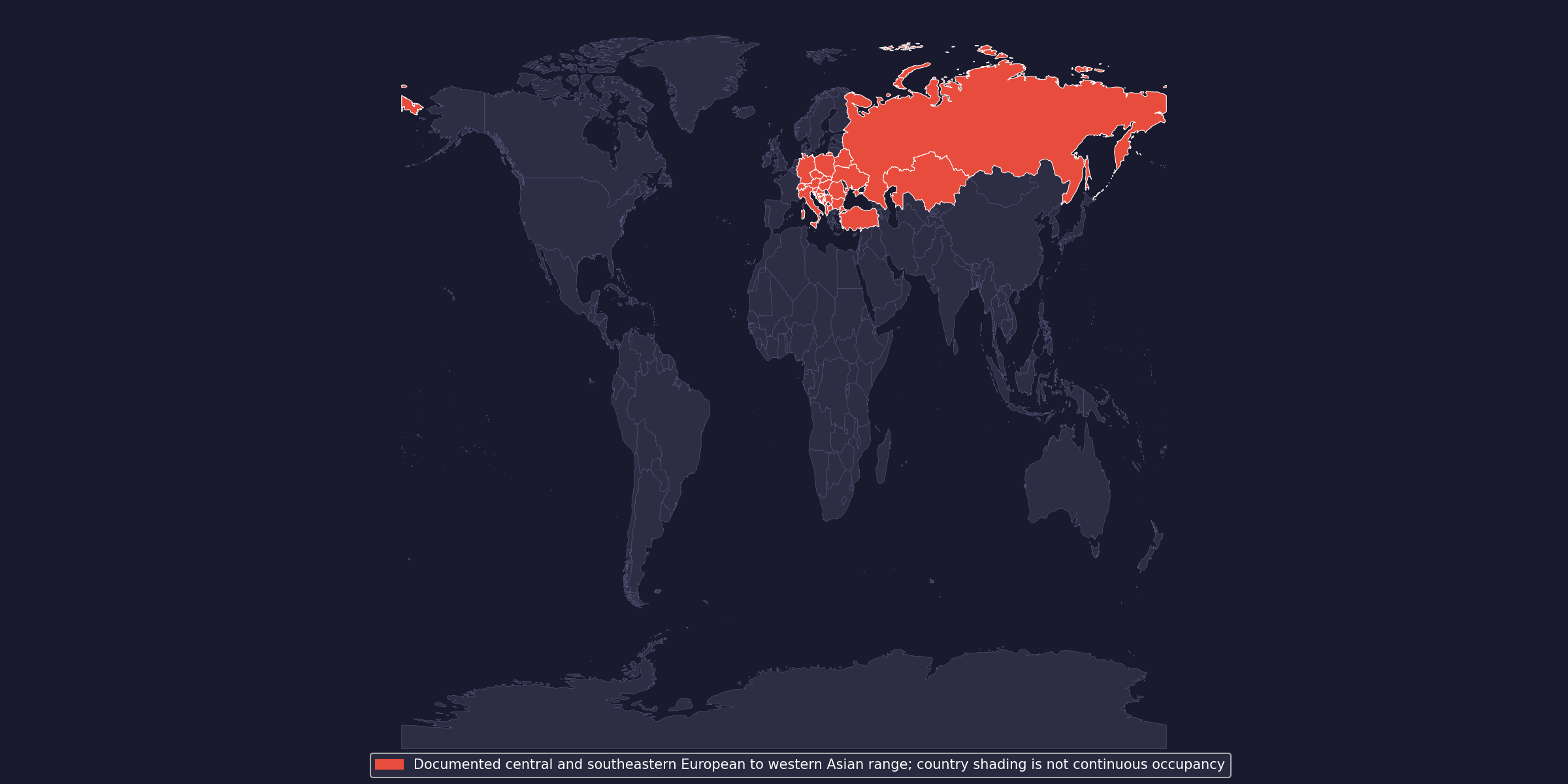
The species ranges from central and southeastern Europe east through Ukraine, Russia and Kazakhstan. Verified European records are concentrated around the eastern Alps, Danube region, Balkans and eastern Europe. It occurs in mineral-rich soils, including loess near water, damp woodland margins and sheltered sites beneath bark, wood, grass and stones.
The map shows the documented Eurasian range at country resolution; it does not imply that the species occupies every habitat within each highlighted country.
⚖️ Legal status
Checked on 2026-08-23: A. versicolor is not listed in the CITES Appendices, Annexes A-D of Commission Regulation (EU) 2026/1383, or Appendices II-III of the Bern Convention. National rules for collecting native invertebrates, protected sites, import, transport and sale may still apply.
Prefer captive-established stock and retain the invoice, breeder identity and locality or line information. Never release surplus animals, leaf litter or used substrate outdoors, including within countries where the species occurs naturally.
🤌 Husbandry
A fine-vented box with a 30 x 20 cm footprint is adequate for a small starter colony. Cross-ventilation should exchange air above the drier half without stripping moisture from the refuge. Keep more space and leaf cover available as numbers increase.
Quarantine additions for at least 60 days with separate forceps and food dishes. Check the culture for fungus gnats, predatory mites and other isopods, and record deaths, molts and first mancae before merging verified lines. Open the container over a larger catch tub.
💡 Lighting
UVB is unnecessary. Provide 10-12 hours of indirect room or plant light and deep shaded cover. Avoid sunlit windowsills and hot display lamps; a small plastic box can exceed the safe temperature before the room feels warm.
🌡 Heating and temperature
Keep most of the enclosure at 17-23°C, with a 16-20°C retreat and ordinary night cooling to 14-19°C for an established colony. Reproduction may slow in winter. Do not interpret that seasonal pause as a reason to heat the entire container.
If the room remains below target, warm one outside wall with a thermostated source. Never heat from underneath, and avoid sustained temperatures above 25°C. Use probe thermometers at substrate level on both ends.
💧 Humidity and water
Maintain the lower substrate in roughly one-third of the enclosure consistently moist, not saturated. The middle should be lightly moist and the surface at the ventilated end may dry between watering. Pour a measured amount into the moist corner when the layer below the moss begins to lighten.
No water bowl is needed. Whole-lid condensation, a sour smell or animals staying at the vents signal excessive wetness or weak airflow; clustering only in the wet corner signals that too much of the box has dried.
🌿 Enclosure and decoration
Use 6-8 cm of pesticide-free topsoil mixed with decomposed deciduous leaves and soft white-rotted hardwood. Add leaf litter across the whole surface, a moss patch at the damp end, and bark spanning the gradient. A little limestone grit can reflect the species’ association with mineral soils while providing calcium.
Keep cuttlebone, limestone or baked crushed eggshell available. Avoid fertilized potting mixes, fresh or resinous conifer wood, scented bark, hardwood collected beside treated roads or fields, and coir-only substrate with little food value.
🪳 Feeding
Leaves and rotten wood must remain continuously available. Offer a small amount of carrot, squash or sweet potato two or three times weekly and a tiny pinch of fish food or dried invertebrate protein about once a week. Remove moist extras before mold spreads.
Calcium should be available as a separate permanent source. Heavy protein feeding is unnecessary and can drive mites, odor and fouling faster than the colony can process it.
🥚 Breeding
The repository classifies reproduction as “viviparous,” while the precise process is marsupial brooding. Eggs and embryos develop in the female’s fluid-filled ventral marsupium; juveniles leave it as mancae. There are no exposed eggs to remove or incubate.
Breeding is moderate rather than explosive. Stability matters more than extra food: protect the moist refuge, avoid turning all bark at every check, and move leaf litter plus several age classes when dividing a colony.
🩺 Common problems
- Failed molts: check deep moisture, ventilation and the calcium reserve together.
- Sudden summer losses: measure the substrate-level temperature and cool the room; spraying an overheated box is not enough.
- Mites or fungus gnats: reduce rich foods, remove only fouled patches and improve airflow over the dry end.
- No visible young: confirm that the group contains mature animals, then give it several quiet months before changing conditions.
- Identity drift: do not mix locality lines or similarly patterned species without a defensible identification.
📌 Conclusion
A. versicolor rewards a keeper who can offer cool, mineral-rich and continuously leaf-fed conditions. Its crucial requirement is a moist lower refuge paired with real ventilation, not a uniformly damp tropical box.
📚 Sources and further reading
- GBIF: Armadillidium versicolor
- World List of Isopoda (WoRMS): A. versicolor
- Senckenberg Bodentier⁴ species account
- EAZA Management Guideline Manual for Invertebrate Live Food Species
- Kight 2008: reproductive ecology of terrestrial isopods
- ReptiFiles — checked; no species-specific care guide was found
- CITES Appendices, valid from 5 March 2026
- Commission Regulation (EU) 2026/1383
- Bern Convention appendices