Share

Beautiful Pill Woodlouse
🔤 Taxonomy
Armadillidium pulchellum (Zenker in Panzer, 1799) is accepted by GBIF and WoRMS; some older literature cites 1798. It is readily confused with juvenile A. pictum. Adult size, the mottled pattern and the dark patch near the rear lateral plate help, but uncertain cultures need expert confirmation.
📌 Description
This small pill woodlouse reaches about 5 mm and can roll into a ball. Its dark ground colour carries cream, yellow and reddish mottling. Wild populations occupy open grassy and rocky habitats, limestone pavement, heath, scree, moss and leaf litter; it is not simply a warm, dry Armadillidium.
No controlled species-level captive study defines lifespan, thermal limits or a breeding optimum. The protocol below is conservative habitat and genus inference.
🌍 Distribution
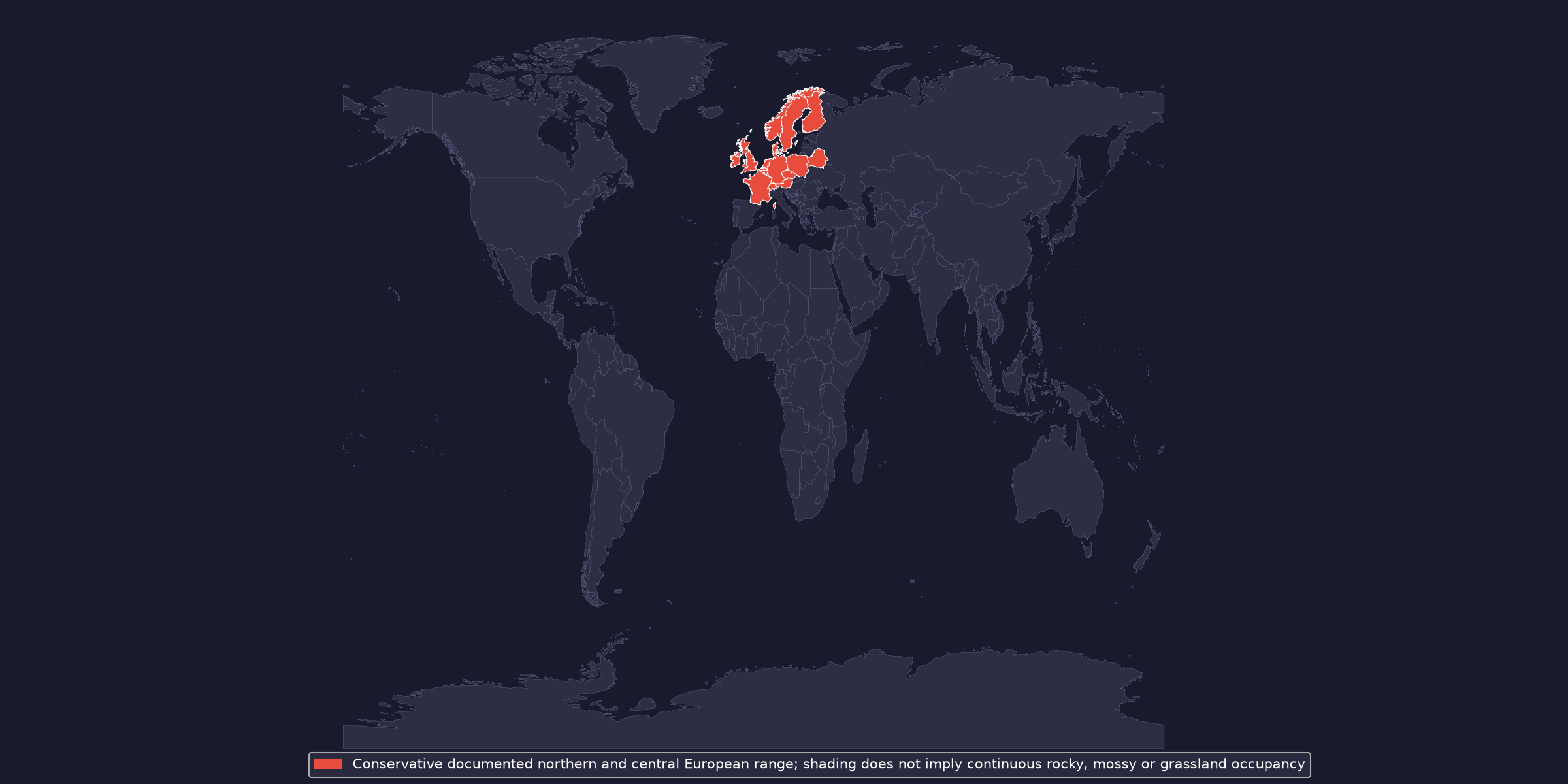
The species is European, concentrated in northern, western and central regions and largely absent from the Mediterranean and southeast. Catalog and modern records include Britain, Ireland, Belgium, France, Germany, Switzerland, Denmark, Norway, Finland, Poland, the Czech lands and Belarus.
The map shows conservative country-level documentation. Shading does not imply continuous occupancy, because colonies can be localized to suitable rocky, mossy or grassy sites.
⚖️ Legal status
Checked on 2026-08-29: A. pulchellum was not found in CITES, EU wildlife-trade Annexes A–D under Regulation (EU) 2026/1383, or Bern Appendices II–III. Local and national collection, reserve, limestone-pavement, heathland, import and soil-movement rules may still apply.
Prefer traceable captive-bred stock and retain locality records. Never collect from protected habitat or release animals, substrate or companion microfauna.
🤌 Husbandry
Start a verified group in a ventilated 25 × 18 × 15 cm container with at least 7 cm of mature substrate. Maintain a clear horizontal moisture gradient: damp soil and moss beneath cover at one end, airy litter and rock at the other. Most surface area should remain covered by leaves, bark or stable stone.
Quarantine for 45–60 days with separate tools. ReptiFiles has no species-specific guide, so general clean-up-crew advice cannot supply missing limits for this species.
💡 Lighting
UVB is unnecessary. Use indirect room light and shaded refuges. Avoid direct sun; even a northern species can overheat quickly in a closed box.
🌡 Heating and temperature
Cool-to-mild room conditions without added heat are the safest starting point. Northern and upland occurrence does not justify freezing a culture, and sun-exposed records do not prove heat tolerance. Preserve a cool damp refuge and change conditions gradually.
💧 Humidity and water
Keep roughly one-third of the lower substrate damp, including a live or rehydrated moss pocket, while allowing the opposite surface to stay less wet and well ventilated. Add water to the damp edge; do not use an open dish.
Constant crowding at the wet end, incomplete moults and juvenile loss suggest drying. Persistent condensation, sour odour and abandonment of the substrate indicate excessive water or poor airflow.
🌿 Enclosure and decoration
Use pesticide-free mineral soil, leaf mould, crumbled deciduous leaves and soft-decayed hardwood. Add cork, securely placed limestone pieces, moss and permanent crushed limestone or cuttlebone. Keep fine litter for juveniles.
Climate accordions are omitted because the animal selects buffered pockets beneath stones, plant mats and moss across a broad range; station normals would imply unsupported precision.
🪳 Feeding
Keep deciduous leaf litter and soft decomposed wood available continuously. Offer small mushroom, squash, carrot or dried-green portions once or twice weekly and a tiny protein item no more than weekly. Maintain calcium and remove fresh remnants promptly.
These are genus-level starting practices; a controlled A. pulchellum ration has not been published.
🥚 Breeding
Females brood embryos in a ventral marsupium and release mancae; repository metadata calls this viviparous. Dependable captive brood size, maturity, seasonality and lifespan are unavailable.
Prioritize stable moisture, mature litter and fine protected spaces. Do not isolate gravid females or warm the colony merely to speed reproduction. Split only after several age classes are established.
🩺 Common problems
- Confusion with juvenile A. pictum: verify mature adults before distribution.
- Dry moss and poor moults: deepen the damp refuge without wetting the whole box.
- Stagnant substrate: improve cross-ventilation and reduce watering.
- Crushing: place stonework securely before adding animals.
- Slow growth: check food maturity, identity and long-term stability.
- Blue iridescence: isolate affected stock because iridovirus is possible.
📌 Conclusion
The beautiful pill woodlouse needs cooler, airier and more moss-rich care than a generic dry-climate pillbug. Its small size, localized ecology and sparse captive record reward conservative, well-documented colony keeping.
📚 Sources and further reading
- GBIF: Armadillidium pulchellum
- WoRMS: Armadillidium pulchellum
- British Myriapod and Isopod Group species account
- NERC: British woodlice habitat and distribution
- BMIG Bulletin: Belarus range record
- Schmalfuss world catalog
- ReptiFiles search completed; no species guide found
- CITES Appendices, valid from 5 March 2026
- Commission Regulation (EU) 2026/1383
- Bern Convention appendices