Share

Armadillidium pictum
🔤 Taxonomy
Armadillidium pictum Brandt, 1833 is accepted by the World List of Isopoda and GBIF. Historical names include A. grubei, A. rhenanum, and A. garumnicum. It can conglobate into a tight ball, but colour pattern alone does not distinguish it safely from other patterned Armadillidium.
📌 Description
Adults measure roughly 7-9 mm. The glossy dark body commonly carries pale yellow or cream longitudinal marks, but pattern strength varies. When disturbed it rolls completely. Its small size makes repeated handling and open-container maintenance risky.
This is an advanced woodland isopod because wild populations are localized and species-specific captive trials are lacking. Published habitat evidence—not a breeder formula—supports a cool, leaf-rich, humid but aerated enclosure. All numeric husbandry values below are conservative starting points that should be adjusted to the colony’s behavior.
🌍 Distribution
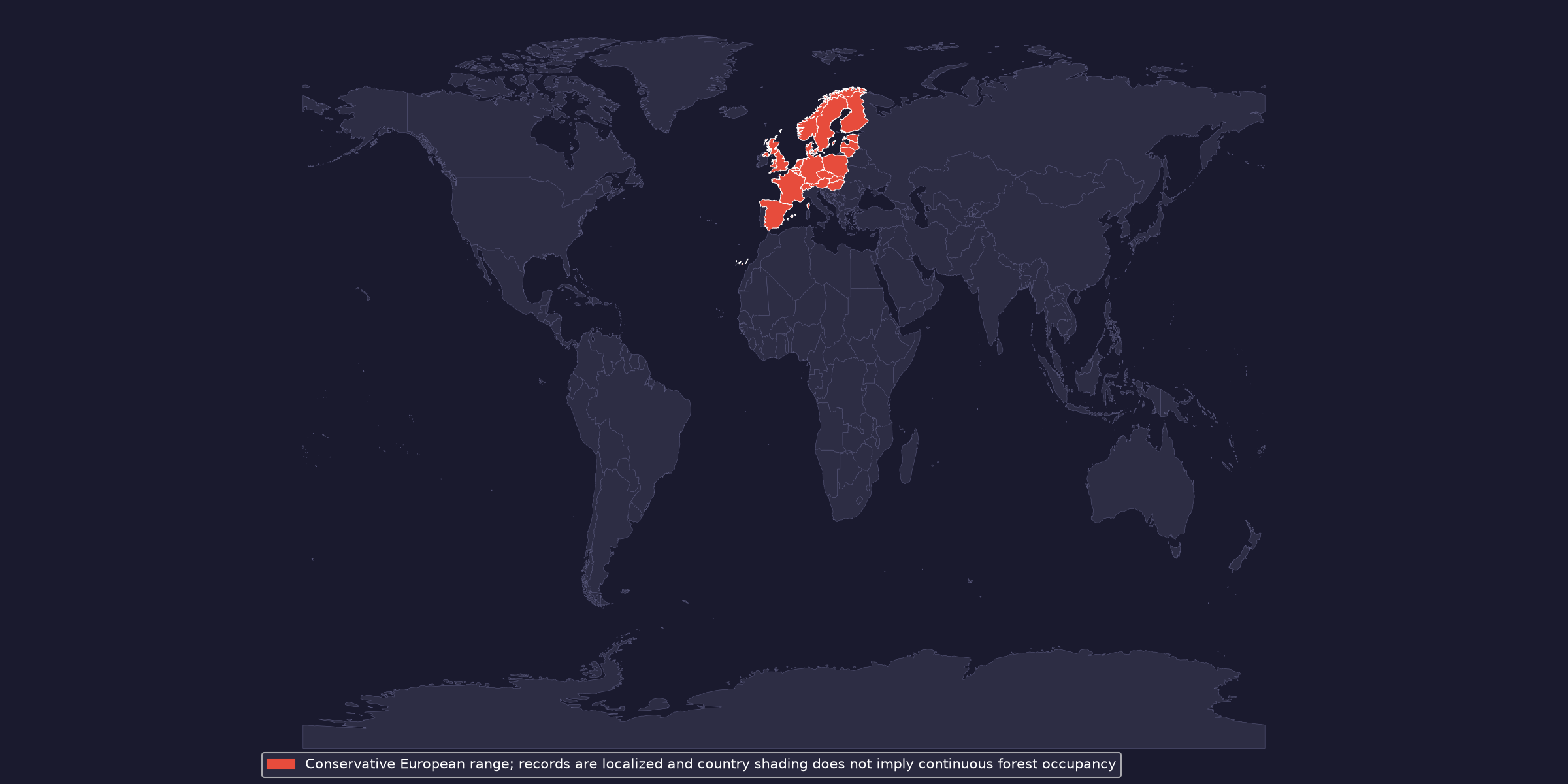
Schmalfuss summarized a European range outside the Mediterranean and southeastern regions. Modern regional accounts extend from northern Spain and the Pyrenees through western and central Europe to Britain, southern Scandinavia, Finland, and the Baltic region. Records are highly localized, often in established woodland; country shading does not indicate continuous occupation.
⚖️ Legal status
Checked on 2026-08-29: A. pictum was not found in the CITES Appendices, EU wildlife-trade Annexes A-D under Regulation (EU) 2026/1383, or Bern Convention Appendices II-III. Local and national rules may protect woodland sites or regulate collection, export, import, transport, possession, and sales even when the species is absent from those international lists.
Use documented captive-bred stock and retain invoices and locality records. Its rarity in parts of its range makes casual collection particularly inappropriate. Never release animals or place living substrate outdoors.
🤌 Husbandry
Use at least 25 × 20 × 15 cm for a starter colony. Provide fine-mesh cross-ventilation without allowing the leaf layer to dry completely. Keep about two-thirds of the substrate evenly moist, leave a smaller merely damp-to-drier zone, and supply multiple bark retreats.
| Parameter | Conservative starting point |
|---|---|
| Adult length | 0.7-0.9 cm |
| Temperature | 14-23 °C |
| Moisture | humid woodland gradient; never saturated |
| Substrate | 6-8 cm leaf soil and decomposed hardwood |
| Staples | abundant deciduous leaves and soft rotten wood |
| Social housing | small, stable colony with several bark retreats |
Quarantine for 60-90 days with dedicated tools. Because juveniles are tiny, inspect vents and lid gaps carefully. Keep different locality cultures separate and do not relabel an animal from pattern alone.
💡 Lighting
No UVB is required. Give 9-12 hours of diffuse seasonal light and maintain deep shade beneath bark and leaves. Direct sun or high-output lamps are inappropriate for an animal associated with shaded woodland microsites.
🌡 Heating and temperature
Maintain about 14-23 °C, with a 10-18 °C cool retreat and similar nights. Avoid prolonged temperatures above 24-25 °C. A naturally cooler winter room can provide mild seasonality to a healthy established colony, but forced chilling is not a substitute for species-specific breeding data.
Heating is rarely necessary. If essential, warm only one side wall at low power with a thermostat and preserve a cool moist refuge. Never use bottom heat.
💧 Humidity and water
An enclosure average near 65-85% RH is secondary to substrate structure. Keep the lower leaf soil moist and springy, with moss and bark retaining humidity, while air moves above it and one zone is less wet. Pour small amounts into the substrate rather than repeatedly fogging the entire box.
No water dish is needed. Standing water, sour odor, widespread fungus, or whole-lid condensation indicate saturation. Failed moults and animals remaining tightly rolled or clustered in one wet corner can indicate drying, heat, or disturbance.
🌿 Enclosure and decoration
Build 6-8 cm of pesticide-free woodland topsoil or leaf soil mixed with decomposed deciduous wood and leaf mould. Cover it deeply with oak, beech, maple, hazel, or other safe hardwood leaves. Use textured bark slabs, moss pockets, and securely seated limestone pieces; habitat studies report animals beneath moss, stones, bark, and decayed timber, sometimes in tree cavities.
Keep cuttlebone, limestone, or plain calcium carbonate available. Avoid treated wood, aromatic conifers, fertilizer, waterlogged compost, and pure coconut fibre. Collect natural material only where lawful and sterilize or quarantine it appropriately.
🪳 Feeding
The primary ration is the decaying leaf layer and soft decomposed hardwood. Every five to seven days add a very small quantity of mushroom, squash, carrot, dried nettle, or balanced isopod food. Offer tiny protein portions such as dried shrimp or fish food no more than weekly at first.
Remove wet leftovers within 24-48 hours. A small woodland species is easily overfed; mold control starts with smaller portions, not with drying the entire enclosure.
🥚 Breeding
Females carry developing young in a ventral marsupium and release mancae. This is viviparous development, with no external egg-incubation stage. Historical ecological literature includes reproduction observations, but a dependable modern captive protocol and quantified brood data were not located.
Start with a legitimate, sufficiently large mixed-sex culture. Maintain cool conditions, mature leaf soil, calcium, and a stable moisture boundary. Search under retreats infrequently and wait for several generations before dividing rare stock.
🩺 Common problems
- Overheating: move the enclosure to a cooler room and verify substrate temperature.
- Saturation and mold: improve airflow, reduce watering, and keep one less-moist zone.
- Drying or bad moults: restore moisture below bark without closing ventilation.
- Escaped juveniles: cover every vent and lid gap with fine mesh.
- No breeding: prioritize mature substrate, seasonally moderate temperatures, and stability rather than speculative parameter changes.
- Misidentification: preserve provenance and use adult diagnostic characters with a specialist key.
📌 Conclusion
A. pictum should be approached as a localized woodland specialist, not as a generic warm pillbug. Cool temperatures, deep deciduous litter, ventilated moisture, bark structure, calcium, restrained feeding, and traceable captive origin are its safest foundations.
📚 Sources and further reading
- World List of Isopoda: Armadillidium pictum
- GBIF species record: Armadillidium pictum
- Schmalfuss (2003), world catalogue of terrestrial isopods
- British Myriapod and Isopod Group, species account
- Gregory and Richards, British Armadillidium comparison
- Alexander, soil drainage and humidity at an A. pictum site
- Belgian habitat and activity synthesis for A. pictum
- ReptiFiles site check; general clean-up-crew reference
- EAZA invertebrate live-food husbandry manual
- Warburg (2012), marsupial development in terrestrial isopods
- CITES Appendices
- EU wildlife-trade Annexes: Regulation (EU) 2026/1383
- Bern Convention appendices