Share

Peracca's Pill Woodlouse
🔤 Taxonomy
Armadillidium peraccae Tua, 1900 is the accepted name. It was described from Italian material and is also recorded in the northern Aegean and around the Sea of Marmara. Trade stock should not be identified from its grey-brown colour alone.
📌 Description
This robust, often granular-looking pill woodlouse reaches about 1.5-2.1 cm. It spends much of the day beneath bark and leaves but becomes conspicuous when feeding. Captive colonies are productive once established.
Its tolerance of moderate room temperatures makes it approachable, although mancae still require a stable damp refuge and fine food.
| Care point | Practical target |
|---|---|
| Adult size | 1.5-2.1 cm |
| Starter colony | 30 x 20 x 15 cm or larger |
| Temperature | 19-24°C |
| Substrate | 6-8 cm with leaves and soft rotten wood |
| Moisture | damp refuge with a ventilated drier side |
| Main failure | disturbance and drying during colony establishment |
🌍 Distribution
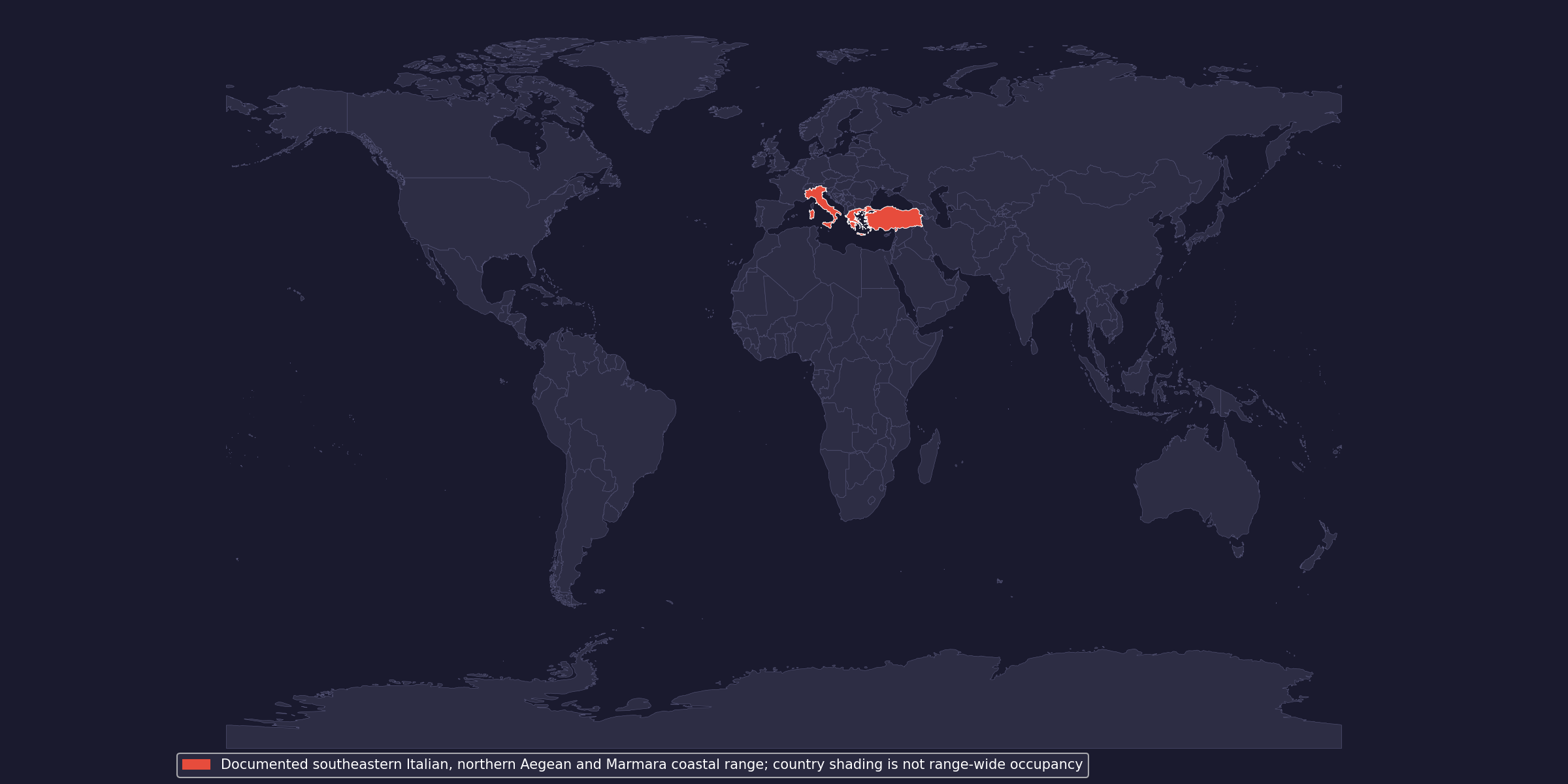
The documented range includes southeastern Italy, the northern Aegean islands of Thasos and Lesvos, and the Sea of Marmara coast in Turkey. Country shading is coarse; it must not be read as presence throughout Italy, Greece and Turkey.
⚖️ Legal status
Checked on 2026-08-23: A. peraccae is absent from the CITES Appendices, EU wildlife-trade Annexes A-D and Bern Convention Appendices II-III. Site protection and national rules may nevertheless restrict collection, import, transport, breeding or sale.
Use captive-established animals, preserve supplier and transfer records, and verify the destination’s live-invertebrate rules. Never release a colony or dispose of live substrate outside.
🤌 Husbandry
Begin with a secure 30 x 20 x 15 cm tub and a mixed-age group. Place fine ventilation on at least two sides, leaving the lower substrate able to retain moisture. A dense leaf layer increases usable space more effectively than height.
Quarantine for 60 days and keep separate utensils. Monitor deaths, mancae and nuisance organisms. Only merge stock when both identification and culture history agree.
💡 Lighting
UVB is not required. Provide a 10-12-hour day through room or plant lighting, deep shade under leaves, and no direct sunlight.
🌡 Heating and temperature
Keep 19-24°C, with a 17-21°C refuge and nights around 16-20°C. Moderately cool conditions may slow reproduction without harming an established colony. Avoid prolonged temperatures above 26-27°C.
When heat is necessary, warm one side from outside and use a thermostat. Preserve a cool, damp option and never heat from beneath.
💧 Humidity and water
Keep roughly one-third of the substrate damp through its depth, grading to a mostly dry surface at the opposite end. Add water to the damp corner when needed rather than spraying the whole enclosure. Cross-ventilation prevents saturated air over the wet zone.
An open water dish adds drowning risk without improving hydration. Look beneath the surface: dry-looking leaves may still cover suitably moist soil.
🌿 Enclosure and decoration
Use 6-8 cm of pesticide-free topsoil, decomposed deciduous litter and soft rotten hardwood. Add cork flats across the gradient, a little moss at the damp end and a thick, replenished leaf cover.
Supply cuttlebone, limestone or clean crushed eggshell. Do not use fertilized soil, resinous or aromatic wood, or leaves from chemically treated areas.
🪳 Feeding
Leaves and rotten wood remain available continuously. Offer small pieces of firm vegetables several times a week and a pinch of protein about weekly. Remove fresh leftovers within 24 hours and scale the ration to actual consumption.
Protein is supplementary, not the culture base. Overfeeding produces mites and fouled soil before it produces faster growth.
🥚 Breeding
“Viviparous” is the nearest repository enum. In precise terms, eggs and embryos develop in the female’s ventral marsupium, and she releases mancae. Do not search the substrate for eggs or isolate a brooding female.
Once settled, colonies reproduce readily. Stable moisture, leaf fragments and calcium near the brooding refuge improve newborn access. Divide colonies by moving substrate, leaves and all visible age classes, not adults alone.
🩺 Common problems
- No young after purchase: minimize disturbance and allow the mixed-age group to establish before changing parameters.
- Mancae disappear: verify moisture beneath leaves and cover large vent openings.
- Incomplete molts: correct the moisture gradient and maintain calcium.
- Fungus gnats or mites: remove excess protein and improve airflow.
- Unexpected colours or body shapes: isolate possible contaminants; do not distribute uncertain stock as A. peraccae.
📌 Conclusion
Peracca’s pill woodlouse is a practical colony species when leaves, calcium and a damp refuge are treated as permanent resources. Its broad country map should never substitute for careful culture identification.
📚 Sources and further reading
- GBIF: Armadillidium peraccae
- WoRMS-sourced taxon record
- Tua 1900: original description
- Schmalfuss 2003: World catalog of terrestrial isopods
- Kight 2008: reproductive ecology of terrestrial isopods
- ReptiFiles — checked; no species-specific care guide was found
- CITES Appendices, valid from 5 March 2026
- Commission Regulation (EU) 2026/1383
- Bern Convention appendices