Share

Pallas's Pill Woodlouse
🔤 Taxonomy
Armadillidium pallasii Brandt, 1833 is the accepted name. Schmalfuss re-examined type material and placed A. frontirostre, A. frontesignum and A. pallasii garganum in synonymy with it.
Captive labels such as “Corfu,” “Croatian Giant,” “Orange” and “cf. frontirostre” describe provenance, appearance or uncertainty; none is a formal subspecies. Preserve those labels and do not merge lines casually.
📌 Description
This is a large, broad pill woodlouse, reaching about 1.7-2.2 cm and conglobating firmly. Scientific material was grey to nearly black with subdued muscle spots and pronounced dorsal tuberculation. Bright orange cultures are captive lines rather than the typical wild colour.
Its tolerance of temperate room conditions makes it approachable, but a large animal still needs deep edible substrate, dependable calcium and enough floor space for the colony.
| Care point | Practical target |
|---|---|
| Adult size | 1.7-2.2 cm |
| Starter colony | 30 x 20 x 15 cm or larger |
| Temperature | 18-25°C |
| Substrate | 6-8 cm with abundant leaves and rotten wood |
| Moisture | damp quarter to third; remainder less wet |
| Main failure | heat or a shallow, food-poor substrate |
🌍 Distribution
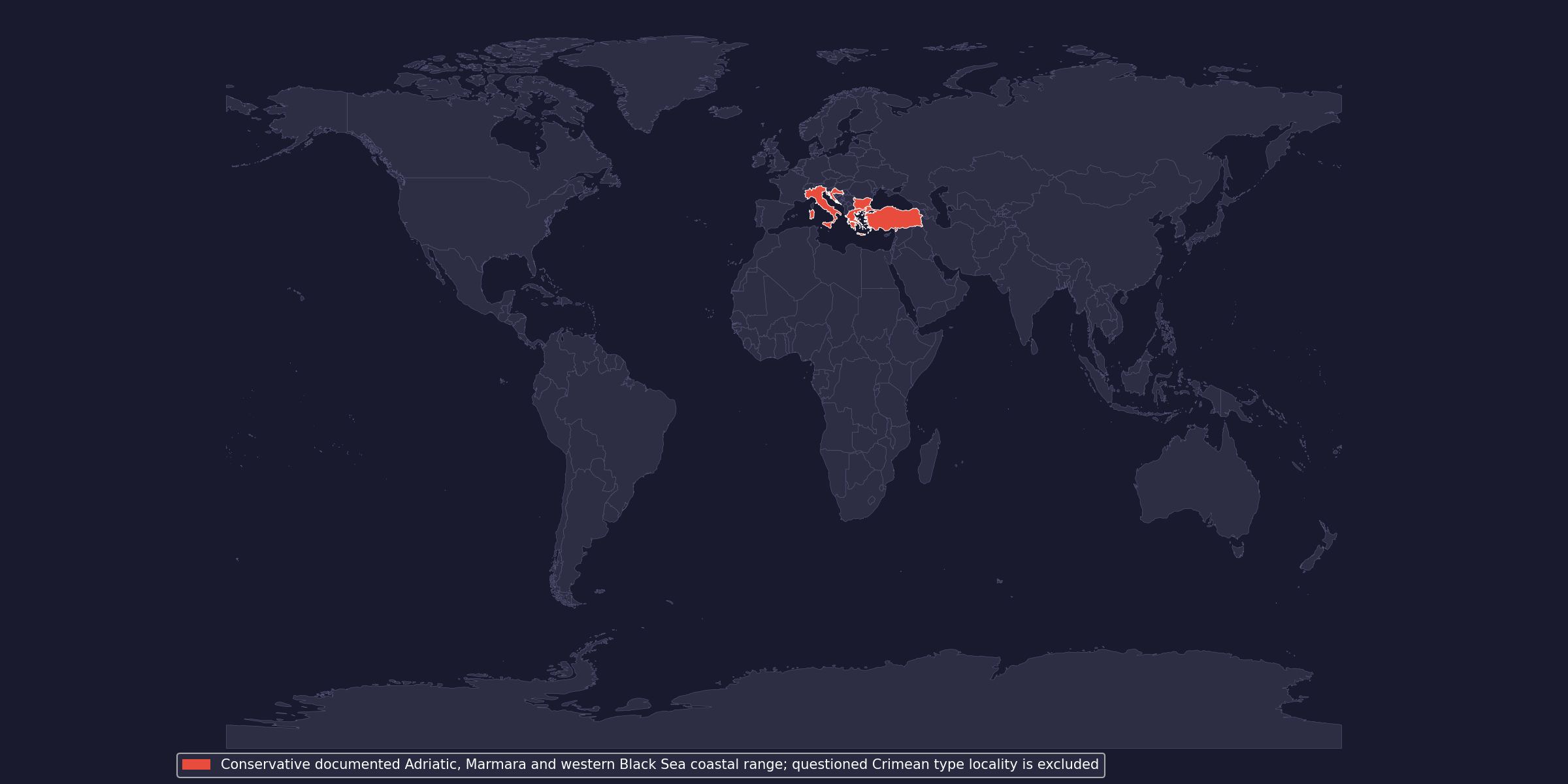
The reviewed range follows the eastern Italian and Dalmatian Adriatic coast south to Corfu, and reappears around the Sea of Marmara and the Turkish and Bulgarian Black Sea coasts. Crimea was the questioned type locality and remained unresolved in the 2011 revision, so it is excluded from this conservative map.
Country shading represents the documented coastal belt, not inland occupation. The map includes Italy, Croatia, Greece, Bulgaria and Türkiye; it deliberately does not convert uncertain trade labels or disputed old records into range claims.
⚖️ Legal status
Checked on 2026-08-29: A. pallasii is not listed in the CITES Appendices, EU wildlife-trade Annexes A-D under Regulation (EU) 2026/1383, or Bern Convention Appendices II-III. Collection, export and movement can nevertheless be restricted nationally or within protected coastal sites.
Buy established cultures, retain invoices and exact line labels, and verify rules in the origin, transit and destination countries. Do not release surplus animals or culture substrate.
🤌 Husbandry
A 30 x 20 x 15 cm tub is a sensible minimum for 10-20 starter animals. Provide fine vents on opposite sides and a secure lid; concentrate airflow over the less-wet half. Broad cork flats and deep leaf cover make the floor usable without encouraging a saturated box.
Quarantine for 45-60 days with separate utensils. Check that “Corfu,” “Croatian Giant,” Orange and other labelled cultures remain distinct, and record any unexplained body-shape differences before distributing offspring.
💡 Lighting
UVB is unnecessary. Use diffuse room or plant light for 10-14 hours seasonally, with deep shaded retreats. Prevent direct sunlight and radiant heating through the lid.
🌡 Heating and temperature
Keep 18-25°C, a cooler 16-21°C refuge, and nights around 15-21°C. Natural room-level fluctuation is preferable to a fixed hot setup. Do not force seasonal cooling on recent arrivals, juveniles or declining colonies.
Avoid prolonged temperatures above 27°C. Warm one external wall only when necessary, using a thermostat, and leave the damp end unheated.
💧 Humidity and water
Keep one-quarter to one-third of the substrate damp through its depth and grade toward a ventilated, less-wet surface. Approximate air humidity of 45-70% is acceptable when a moist lower refuge remains available. Water the substrate corner rather than misting every surface.
No water dish is required. Condensation across the enclosure suggests too much water or too little air; poor moults and constant crowding under the wettest bark signal excessive drying.
🌿 Enclosure and decoration
Use 6-8 cm of pesticide-free topsoil, mature leaf mould and soft rotten hardwood. Cover most of the floor with safe deciduous leaves and add cork flats, a damp moss pocket and permanent cuttlebone or limestone.
Large colonies consume leaf litter quickly. Replenish it before bare soil appears, and avoid fertilized compost, aromatic woods, fresh manure and sterile coir-only substrate.
🪳 Feeding
Leaves and decomposed hardwood are always available. Offer small pieces of carrot, squash, courgette, mushroom, sweet potato or dried greens two or three times weekly. Add a modest protein pinch once a week, divided among several feeding points as the colony grows.
Remove wet remains within 24-48 hours. Large body size does not justify unlimited fish food; excess protein promotes mites and localized ammonia-rich spoilage.
🥚 Breeding
“Viviparous” is the repository enum for marsupial brooding. Females retain developing eggs and embryos in a ventral pouch and release mancae, so there are no exposed eggs or separate incubation temperatures.
Established colonies often breed readily. Stable substrate moisture, calcium and finely broken leaves help juveniles. Split a colony by transferring substrate and several age classes, and maintain the original provenance label on both groups.
🩺 Common problems
- Incomplete moults: check the moist lower layer, calcium and excessive heat.
- Slow juveniles: deepen the edible substrate and place fine leaf fragments near the brood refuge.
- Mites or fungus: reduce protein and improve ventilation above the dry side.
- Line mixing: isolate Orange, Corfu and other provenance lines before identification becomes impossible.
- Overheated colony: lower ambient temperature; repeated misting is not a substitute for a cool retreat.
📌 Conclusion
Pallas’s pill woodlouse is a strong display colony for keepers who give its large body adequate substrate and calcium. Prepare floor space and a real moisture gradient first; the old frontirostre name and modern line labels should never be treated as interchangeable identities.
📚 Sources and further reading
- GBIF: Armadillidium pallasii
- Schmalfuss 2011: redescription and distribution
- Schmalfuss 2000: distributional patterns in Armadillidium
- Schmalfuss 2003: world catalog of terrestrial isopods
- Kight 2008: reproductive ecology of terrestrial isopods
- ReptiFiles — checked; no species-specific care guide was found
- CITES Appendices, valid from 5 March 2026
- Commission Regulation (EU) 2026/1383
- Bern Convention appendices