Share

Armadillidium opacum
🔤 Taxonomy
Armadillidium opacum (C. Koch, 1841) is accepted by the World List of Isopoda and GBIF. Older literature used names including A. alpinum and A. conspersum. Some named forms have uncertain limits, so morphology and provenance matter more than an informal trade label.
📌 Description
Adults are about 6-9 mm long, usually matt grey-brown with pale flecking. They conglobate tightly when disturbed. Small size, subdued pattern, and overlap with related species make identification from a seller photograph unreliable.
This is an advanced cool-woodland isopod. Recent field research links it strongly to ancient forest and cool, moist, base-rich litter, while showing that suitable seepage habitats can also occur outside old woodland. No controlled species-specific captive protocol was located; the numeric values below are deliberately conservative ecological starting points.
🌍 Distribution
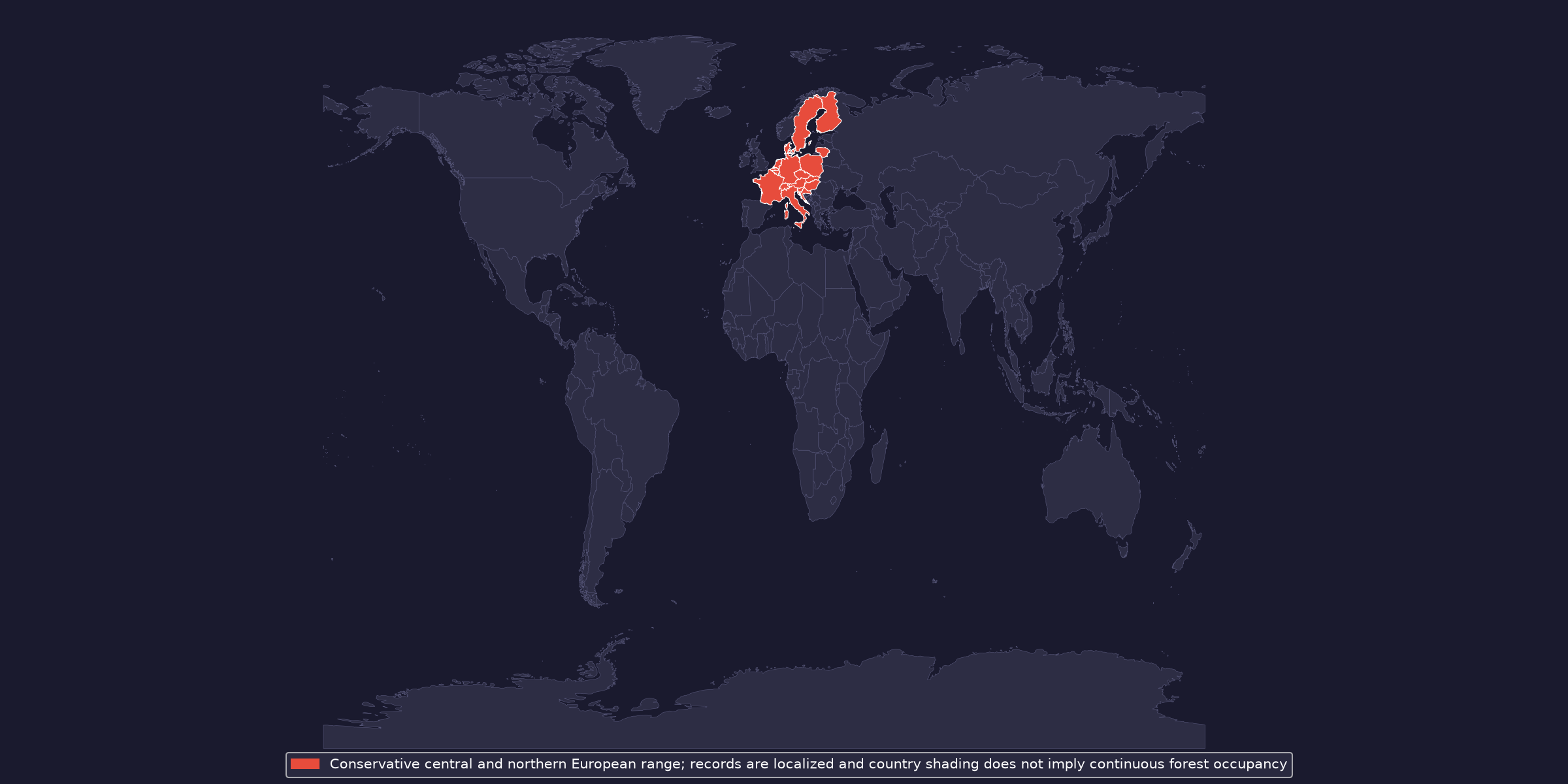
Schmalfuss summarized its central European range from central Sweden to northern Italy and from eastern France to Croatia and Hungary. National records also include Belgium, the Netherlands, Denmark, Finland, Switzerland, Austria, Germany, Poland, and the former Czechoslovakia. Occurrence is patchy and habitat-bound, so the shaded countries greatly overstate occupied area.
⚖️ Legal status
Checked on 2026-08-29: A. opacum was not found in the CITES Appendices, EU wildlife-trade Annexes A-D under Regulation (EU) 2026/1383, or Bern Convention Appendices II-III. Local and national rules may still protect ancient woodland, reserves, and collecting sites or govern export, import, transport, possession, and sales.
Purchase traceable captive-bred animals and retain invoices and locality information. Poor dispersal and localized habitat make removal from the wild difficult to justify. Never release a culture or discard living substrate outside.
🤌 Husbandry
Use at least 25 × 20 × 15 cm for a starter group, with fine mesh over cross-vents. Keep roughly two-thirds to three-quarters of the deep substrate moist but not flooded, leaving a smaller less-moist refuge. Provide several pieces of bark so the colony can choose both moisture and contact density.
| Parameter | Conservative starting point |
|---|---|
| Adult length | 0.6-0.9 cm |
| Temperature | 12-23 °C |
| Moisture | cool, moist litter with aerated upper layers |
| Substrate | 7-9 cm mineral-buffered leaf soil |
| Staples | deciduous leaves and decomposed hardwood |
| Social housing | stable colony with multiple shaded retreats |
Quarantine for 60-90 days with dedicated tools. Fine mesh is essential for mancae. Photograph original labels and keep locality lines separate, especially where identification rests on unverified trade material.
💡 Lighting
UVB is unnecessary. Provide 9-12 hours of diffuse seasonal light and extensive shade beneath bark and litter. Do not place this cool forest species in direct sun or beneath a strong heat-producing lamp.
🌡 Heating and temperature
Maintain 12-23 °C, with an 8-17 °C cool retreat and similar nights. Avoid prolonged warmth above 24-25 °C. A healthy established culture can experience moderate winter room cooling, consistent with its temperate distribution, but untested hard chilling may kill a small colony.
Heating is normally unnecessary. If the room is exceptionally cold, warm only one side wall at low power under thermostat control and retain a cool moist end. Bottom heat dries the deepest refuge and should not be used.
💧 Humidity and water
An average around 65-85% RH is a broad trend only. The habitat model is cool, moist leaf soil with oxygen in the pore spaces: damp lower layers, humid bark and moss, air movement above, and no standing water. Water into one end of the substrate and inspect below the leaves before adding more.
No water dish is needed. Sour smell, anaerobic black patches, whole-lid condensation, and rampant fungus indicate saturation or poor ventilation. Failed moults, long-term tight conglobation, or clustering in the sole wet pocket suggest heat or drying.
🌿 Enclosure and decoration
Provide 7-9 cm of pesticide-free woodland topsoil or leaf soil mixed with rich leaf mould, soft decomposed deciduous wood, and a modest limestone or calcium-rich mineral fraction. Cover it with abundant oak, beech, maple, hazel, or comparable safe leaves. Add bark slabs, moss, and secure stones to create cool crevices.
Keep cuttlebone, limestone, or plain calcium carbonate available. Avoid fertilizer, treated timber, aromatic conifer wood, pure coconut fibre, and soggy compost. Natural material must be collected legally and managed for contaminant risk.
🪳 Feeding
Decaying leaves and decomposed hardwood form the continuous ration. Every five to seven days offer a tiny portion of mushroom, squash, carrot, dried nettle, or balanced isopod feed. A pin-sized amount of dried shrimp or quality fish food once weekly is a cautious protein starting point.
Remove moist residues in 24-48 hours. If mites or mold increase, feed less rather than stripping out the mature litter or drying the enclosure excessively.
🥚 Breeding
Females brood developing young in a ventral marsupium and release mancae. This is viviparous development, with no external egg-incubation stage. A southwest German study documented seasonal reproductive phenology in nature, but those observations do not provide a tested enclosure recipe or universal brood schedule.
Use a sufficiently large, legitimate mixed-sex group. Maintain mature mineral-buffered litter, cool conditions, stable moisture, and calcium, with minimal searching under bark. Delay culture splits until several juvenile cohorts are established.
🩺 Common problems
- Heat stress: relocate to a cooler room and measure the substrate, not only room air.
- Anaerobic substrate: improve drainage and airflow and reduce watering volume.
- Drying or incomplete moults: restore deep moisture while preserving cross-ventilation.
- Juvenile escapes: seal all lid and vent gaps with fine mesh.
- Stalled breeding: allow seasonal stability and mature litter rather than frequently changing the setup.
- Identification doubt: preserve specimens, photographs, and origin data for specialist confirmation.
📌 Conclusion
A. opacum is best maintained as a cool, localized forest specialist. Deep mineral-rich leaf soil, decomposed hardwood, ventilated moisture, shade, restrained food, and traceable captive origin matter more than chasing a single humidity reading.
📚 Sources and further reading
- World List of Isopoda: Armadillidium opacum
- GBIF species record: Armadillidium opacum
- Schmalfuss (2003), world catalogue of terrestrial isopods
- De Smedt et al. (2023), Belgian habitat records outside ancient forest
- Zimmer and Brauckmann (1997), reproductive phenology in southwest Germany
- ReptiFiles site check; general clean-up-crew reference
- EAZA invertebrate live-food husbandry manual
- Warburg (2012), marsupial development in terrestrial isopods
- CITES Appendices
- EU wildlife-trade Annexes: Regulation (EU) 2026/1383
- Bern Convention appendices