Share

Nosy Pill Woodlouse
🔤 Taxonomy
Armadillidium nasatum Budde-Lund, 1885 is the accepted spelling. The frequently submitted A. nasutum is incorrect. The projecting rectangular “nose” between the antennae and the slightly incomplete ball formed during enrollment help distinguish it from A. vulgare.
“Dalmatian” is a spotted captive morph of A. nasatum, not a species or subspecies. Maintain its culture label, but base identification on structure and provenance rather than spots alone.
📌 Description
Adults are relatively long and may reach about 2.1 cm. Wild-type animals are usually grey-brown with longitudinal mottling. They use stone gaps, leaf litter and loose surface soil and are more visible during humid evenings.
This adaptable species breeds well in captivity. Its main husbandry distinction is a preference for warmth and airflow combined with a dependable moist retreat, rather than a uniformly wet enclosure.
| Care point | Practical target |
|---|---|
| Adult size | 1.2-2.1 cm |
| Starter colony | 30 x 20 x 15 cm or larger |
| Temperature | 19-25°C |
| Substrate | 5-8 cm with leaves and decayed wood |
| Moisture | one-third moist, remainder progressively drier |
| Main failure | drying newborns or sealing a wet box |
🌍 Distribution
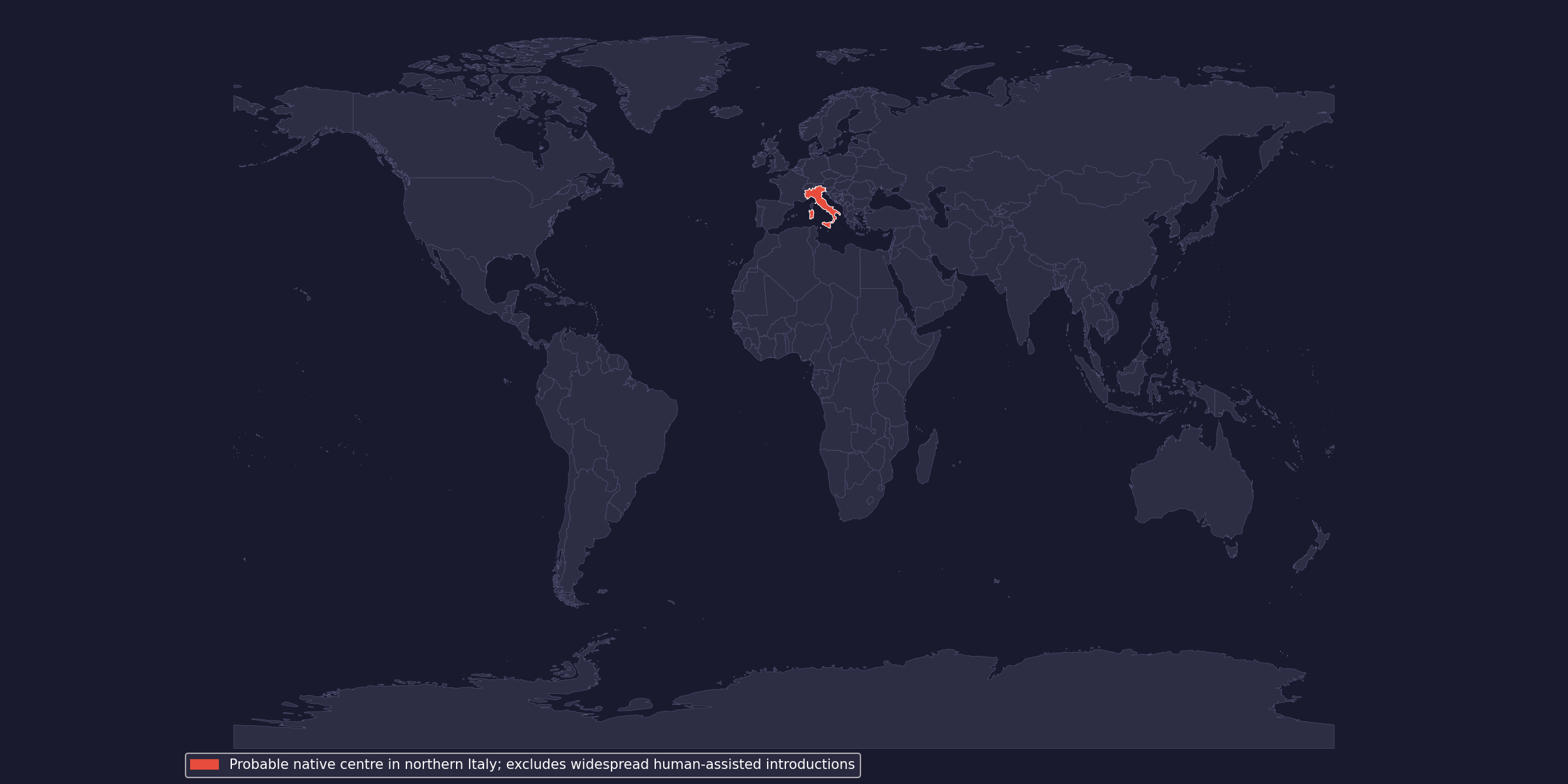
The species’ original centre is reported in northern Italy. Human transport of stones, plants and soil has spread it widely through Europe and to other continents, where it often occupies quarries, cemeteries, gardens and other warm disturbed sites. The map marks the probable native centre rather than introduced populations.
⚖️ Legal status
Checked on 2026-08-23: A. nasatum has no listing in CITES, EU wildlife-trade Annexes A-D or Bern Convention Appendices II-III. National restrictions on collecting, moving soil organisms, imports and commercial sales still require a current local check.
Keep proof of captive origin and the Dalmatian line name. Do not collect on protected land or release surplus animals or used substrate; its history of human-assisted spread makes containment especially important.
🤌 Husbandry
Keep a starter group in a smooth-sided, tightly closed 30 x 20 x 15 cm box with fine cross-ventilation. Add floor space as numbers rise and cover vents securely because mancae can leave through coarse mesh.
Quarantine new cultures for 60 days, with separate tools and no shared leaf-litter containers. Photograph the diagnostic head shape before combining same-labelled stock. Do not house different species together.
💡 Lighting
UVB is unnecessary. A 10-12-hour light cycle from ambient or plant lighting is sufficient. Maintain shaded cover and keep the enclosure out of direct sun.
🌡 Heating and temperature
Use 19-25°C for routine care, retaining a 17-21°C cool end and allowing nights of 16-21°C. This warmth-loving species remains active near the upper part of the range, but sustained temperatures above roughly 27°C sharply increase drying risk.
If supplemental heat is necessary, apply it to one side above substrate level and regulate it with a thermostat. Never heat beneath the moist corner.
💧 Humidity and water
Keep one-third of the substrate moist at depth and let the surface become progressively drier toward the main vents. Pour water into the refuge instead of spraying every surface. The colony must be able to move between moisture levels at all times.
No water dish is needed. Persistent lid condensation, mold over the dry end, or animals climbing the walls en masse call for an immediate check of ventilation, heat and water volume.
🌿 Enclosure and decoration
Make a 5-8 cm layer of pesticide-free topsoil, crushed hardwood leaves and soft rotten wood. Add a patch of moss only on the moist end, then cover the surface generously with safe deciduous litter and cork bark.
Provide cuttlebone, limestone or clean crushed eggshell continuously. Avoid fertilized compost, cedar and other aromatic woods, resinous conifer litter and collected material exposed to pesticides or road pollution.
🪳 Feeding
Maintain leaf litter and decayed hardwood as the core diet. Supply a little carrot, squash or sweet potato two or three times weekly, plus a small protein portion once weekly. Remove moist leftovers after 24 hours.
Dalmatian animals need no special diet to maintain their spots. Do not use carotenoid-rich food as a substitute for genetics and honest culture labelling.
🥚 Breeding
The coarse metadata term is “viviparous.” Biologically, the female carries eggs and embryos inside a fluid-filled ventral marsupium and releases mancae; there are no exposed eggs for the keeper to incubate.
Warmth and steady access to the moist end support breeding. Leave brooding females undisturbed and keep fine leaf particles around the damp shelter for newborns. Transfer all age groups when splitting the colony.
🩺 Common problems
- Young appear, then disappear: expand the damp leaf-covered refuge and check vent placement.
- Animals remain rolled or crowd one corner: measure heat and examine both extremes of the moisture gradient.
- Poor molts: restore moisture and calcium access without flooding the enclosure.
- Flies, mites or mold: reduce rich foods, remove leftovers and improve airflow.
- Questionable Dalmatian identity: isolate the line until the nose, enrollment and provenance can be checked.
📌 Conclusion
The nosy pill woodlouse is a good first Armadillidium when its warmer preference is paired with ventilation. Its diagnostic “nose” and culture history matter more than any trade-pattern label.
📚 Sources and further reading
- GBIF: Armadillidium nasatum
- World List of Isopoda: accepted spelling
- British Myriapod and Isopod Group: identification and distribution
- Boeraeve et al. 2021: habitat and seasonal activity in Belgium
- Kight 2008: reproductive ecology of terrestrial isopods
- ReptiFiles — checked; no species-specific care guide was found
- CITES Appendices, valid from 5 March 2026
- Commission Regulation (EU) 2026/1383
- Bern Convention appendices