Share

Zebra Isopod
🔤 Taxonomy
Armadillidium maculatum (Risso, 1816) is the accepted name in GBIF and the World List of Isopoda. The original combination Armadillo maculatus appears in older literature. Zebra isopod and zebra pillbug are the useful English hobby names.
Chocolate, Yellow, and Perfect Zebra are captive colour or pattern lines, not separate species. Keep line names in stock records, but house and describe them under this single species guide. Do not mix lines if maintaining their phenotype or provenance matters.
📌 Description
Adults usually reach 1.5-1.8 cm. Pale patches often join into bold transverse bands over a dark body, though natural and captive pattern variation is broad. The species can conglobate into a tight ball and is more surface-visible once a colony is established.
Zebras are a suitable first display isopod for a keeper who understands one essential point: “Mediterranean” does not mean keeping the entire enclosure dry. They need a permanent moist refuge and a ventilated, less-wet side.
🌍 Distribution
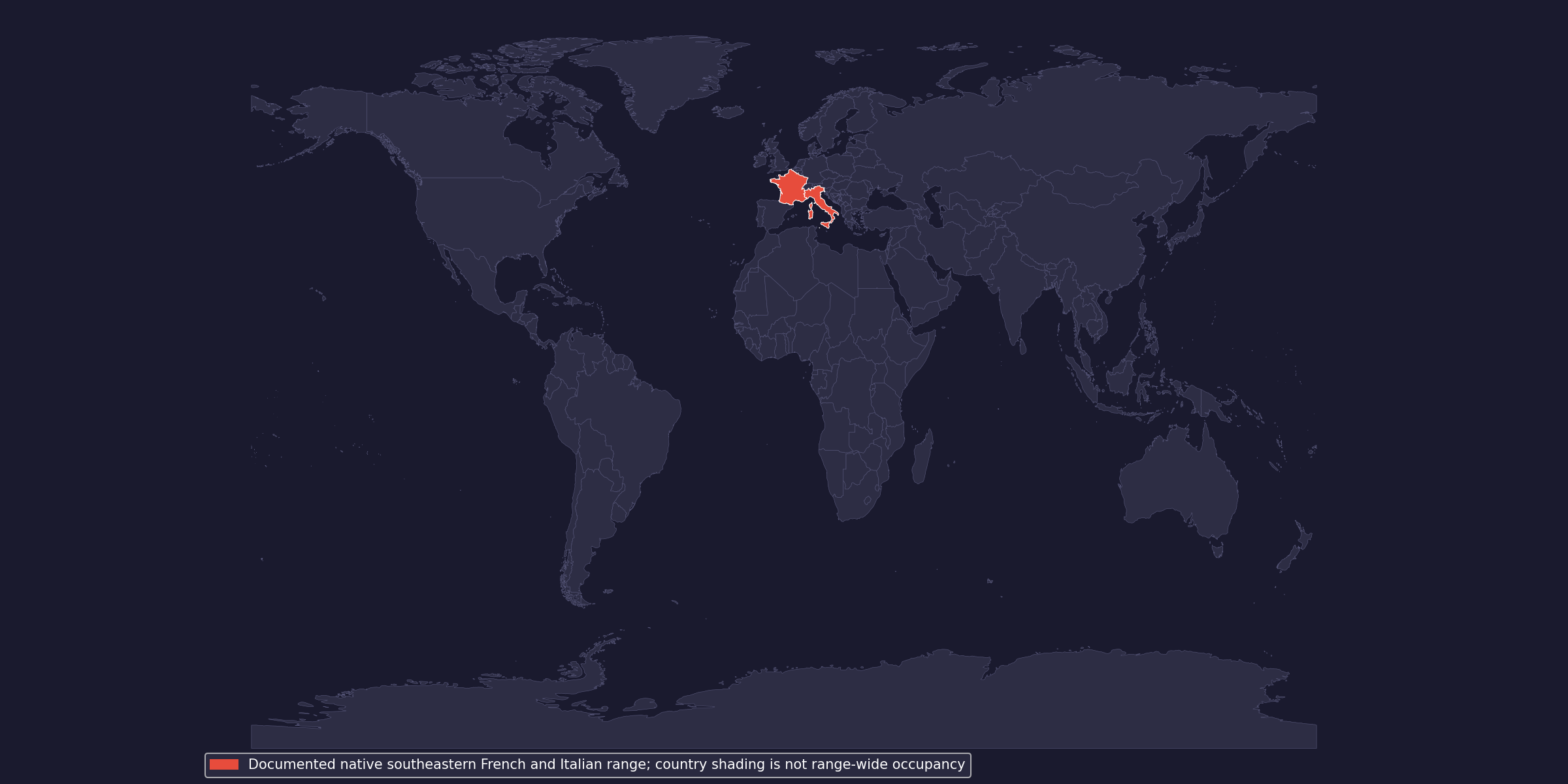
Reliable catalog records place the native species in southeastern France and Italy. Captive colonies and occasional human-assisted occurrences outside that core should not be confused with native range. It inhabits protected pockets beneath stones, bark, leaf litter, and dead wood rather than exposed, uniformly dry ground.
⚖️ Legal status
Checked on 2026-08-23: Armadillidium maculatum is not listed in CITES, EU wildlife-trade Annexes A-D under Regulation (EU) 2026/1383, or Bern Convention Appendices II-III. Local controls on live invertebrate import, transport, sale, or release may still apply.
Keep the invoice and morph name, verify destination rules before shipping, and never release animals, eggs, mancae, or substrate outdoors. Absence from wildlife-trade annexes is not permission to collect on protected land.
🤌 Husbandry
A ventilated 25 × 18 × 15 cm tub suits a starter group of 10-20; use more floor space as numbers grow. Place most ventilation over the drier half and some low cross-flow near the moist end. Fine mesh or small holes retain newborns.
Quarantine new stock for 30-60 days with separate tools. Watch for unexplained deaths, mites, poor molts, and culture labels that do not match the animals. Mixing Chocolate, Yellow, or Perfect Zebra into other lines makes later identification and selective breeding unreliable.
💡 Lighting
UVB is not required. A normal 10-14-hour seasonal room-light cycle is enough. Provide shaded cover throughout and avoid direct sun. Display lighting should add negligible heat.
🌡 Heating and temperature
Keep the colony mainly at 18-25 °C, with a 16-20 °C retreat. Normal indoor night cooling to 16-22 °C is acceptable. Growth slows in cool rooms; deliberate winter dormancy is unnecessary for routine breeding.
Avoid prolonged heat above 27 °C. If heating is necessary, warm one outer side under thermostat control and leave the substrate base unheated. A probe at each end is more useful than a thermometer on the shelf.
💧 Humidity and water
Aim for roughly 50-70% air humidity, but manage the substrate rather than chasing one reading. Keep about one-third damp with moss and deeper moisture, a transitional middle, and a drier, well-ventilated end. The drier end is not allowed to become powdery throughout its depth.
No open water dish is needed. Add water to the damp end when moss begins to lighten; avoid misting all surfaces daily. Failed molts and clustering only in moss suggest excess dryness, while animals continuously climbing and condensation suggest waterlogging or poor airflow.
🌿 Enclosure and decoration
Use 5-7 cm of deciduous leaf mould, rotten hardwood, and pesticide-free topsoil. Cover at least three-quarters of the surface with oak, beech, maple, or other safe hardwood leaves. Add cork flats, white-rotted wood, and a moss pocket at the wet end.
Provide cuttlebone, limestone, or calcium carbonate continuously. Avoid conifer and aromatic wood, fertilizer, fresh manure, chemically treated leaves, and a coir-only base. Heavy stones must rest on the enclosure floor or stable supports, not loose burrowing substrate.
🪳 Feeding
Decayed leaves and rotten hardwood should remain available at all times. Supplement with small pieces of carrot, squash, sweet potato, mushroom, or courgette two or three times weekly. A little dried shrimp, gammarus, or quality fish food once weekly supports breeding, but surplus protein encourages mites.
Keep food on bark and remove wet remains within 24-48 hours. Calcium stays permanent. Do not replace leaf litter with fruit or prepared powder; the colony needs fibrous, decomposing material and its associated microbes.
🥚 Breeding
Males and females can be distinguished from the underside by the shape of the pleopods, but repeated handling is unnecessary. Females carry eggs and embryos in a fluid-filled ventral marsupium and release mancae. This is recorded as “viviparous” in the site’s broad metadata, not as externally incubated eggs.
Warm stable conditions, connected damp litter, calcium, and occasional protein usually produce a growing colony without intervention. Do not isolate gravid females. Young need fine food, safe humidity, and vent holes smaller than their bodies.
🩺 Common problems
- Failed molts: restore the moisture gradient and calcium, then check for sustained heat.
- Slow colony growth: add decomposed leaf and wood rather than relying on fresh vegetables; review protein portions.
- Mites or fungus: remove excess food, improve cross-flow, and replace only sour substrate.
- Mass movement to one end: the temperature or moisture gradient is too extreme.
- Morph drift: maintain separate labelled cultures and select breeding stock without presenting captive lines as taxa.
📌 Conclusion
Zebra isopods reward a simple, well-ventilated enclosure with a permanent damp refuge and an edible forest-floor base. They suit beginners, but uniform wetness is the mistake most likely to undermine an otherwise sound colony.
📚 Sources and further reading
- GBIF: Armadillidium maculatum
- World List of Isopoda: Armadillidium maculatum
- Schmalfuss 2003 world catalog of terrestrial isopods
- ReptiFiles clean-up-crew overview mentioning zebra isopods
- Detailed specialist zebra-isopod husbandry
- Histological study of the terrestrial-isopod marsupium
- CITES Appendices
- Current EU wildlife-trade Annexes: Regulation (EU) 2026/1383
- Bern Convention appendices