Share

Clown Isopod
🔤 Taxonomy
Armadillidium klugii Brandt, 1833 is accepted by GBIF and the World List of Isopoda. “Clown isopod” refers to the contrasting pale and reddish dorsal spots seen in the hobby. The 2013 revision treats A. klugii as a Balkan species group member without currently recognized subspecies.
Slano is a documented captive locality label linked to the coastal settlement in Croatia. Preserve it as provenance, not as a morph or subspecies. The separate seller culture written as Armadillidium cf. kulgii “Omis” is not merged here: “cf.” signals uncertain identity, and “kulgii” is a misspelling of klugii.
📌 Description
Adults are usually 1.5-2.1 cm and can roll into a ball. A dark grey-brown ground colour bears pale longitudinal spot rows, often with red or yellow accents. Pattern intensity varies with locality and individual; colour alone cannot confirm stock identity.
Clown isopods are robust once established but less forgiving of a uniformly wet enclosure than common tropical cultures. They are best for a keeper ready to maintain a strong moisture gradient and keep locality lines separate.
🌍 Distribution
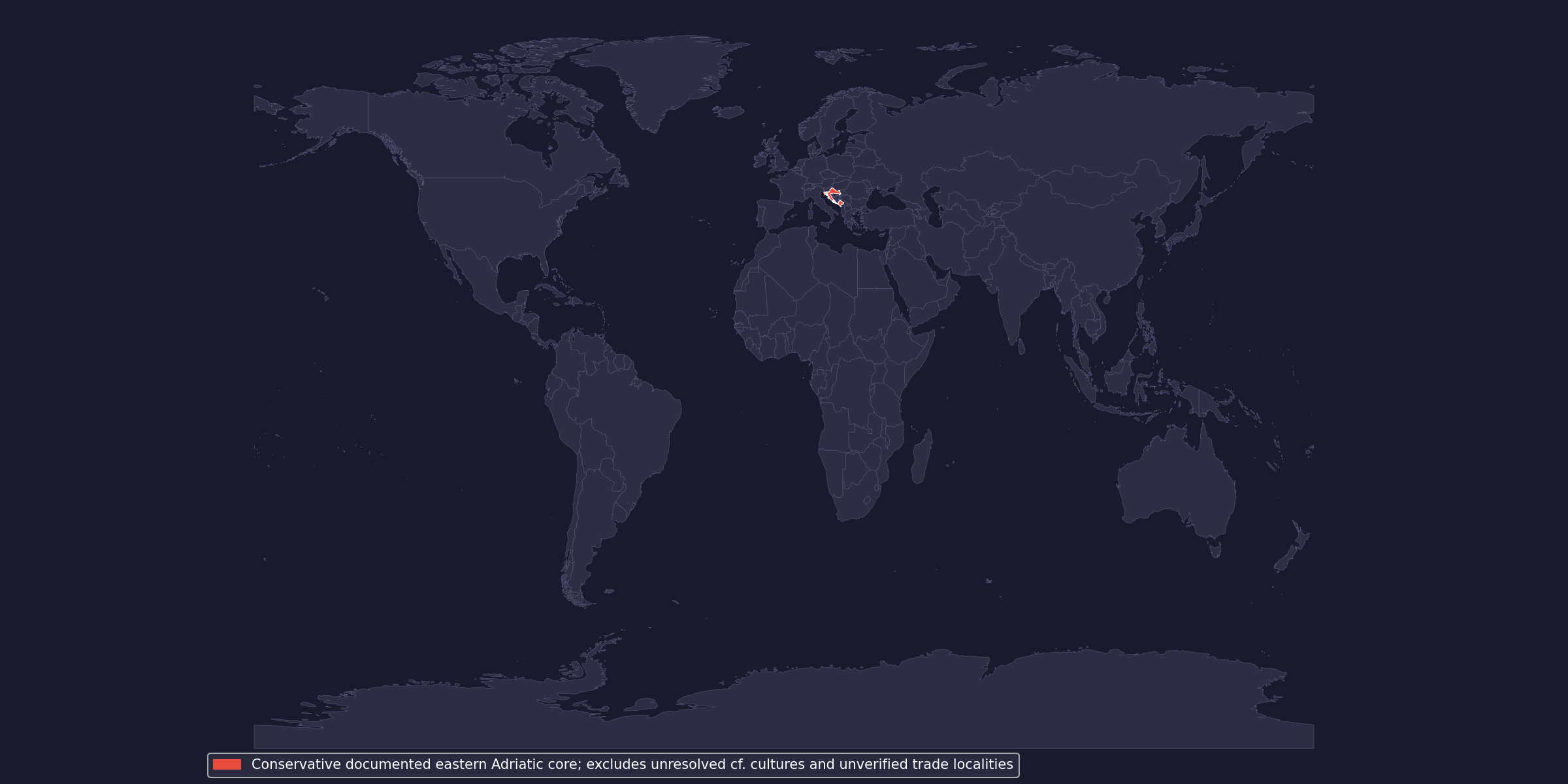
Published records concentrate along the eastern Adriatic, especially coastal Croatia and Montenegro. The map deliberately uses that conservative core. Reports farther south require locality-level reading and do not justify merging every Balkan trade culture.
Slano lies in Dubrovnik-Neretva County, Croatia. A label is useful only when passed intact from source to offspring; it does not by itself document the original collector or collection permit.
⚖️ Legal status
Checked on 2026-08-23: Armadillidium klugii is not listed in CITES, EU wildlife-trade Annexes A-D under Regulation (EU) 2026/1383, or Bern Convention Appendices II-III. Protected-area, collecting, export, transport, and national biodiversity rules may still restrict taking animals from the wild.
Prefer captive-bred cultures, retain invoice and locality chain, and verify rules before moving live stock across borders. Never release surplus animals or substrate, including within countries where the species occurs naturally.
🤌 Husbandry
A 25 × 18 × 15 cm ventilated tub is suitable for 10-20 starters. Provide generous side-to-side cross-flow, particularly above the less-wet half, and fine openings that contain mancae. More floor area is safer than a tall decorative jar because it creates usable moisture choices.
Quarantine new cultures for 30-60 days. Record the full source label and do not mix Slano with Montenegro, Dubrovnik, or unnamed stock. Use separate tools until mites, unexplained mortality, and correct identification have been assessed.
💡 Lighting
UVB is unnecessary. Use a diffuse 10-14-hour cycle, with shorter winter days if room lighting follows the season. Shade most of the enclosure. Direct sun and hot display lamps rapidly erase the moist refuge.
🌡 Heating and temperature
Maintain 18-25 °C, with access to 16-20 °C. Nights of 16-22 °C are acceptable for an established, well-fed colony. Deliberate cold dormancy is not necessary, and it should not be imposed on new, small, or declining groups.
Avoid sustained temperatures above 27 °C. If supplemental heat is essential, place it on one outer wall with a thermostat and measure at substrate level. Never heat the entire base.
💧 Humidity and water
Keep roughly one-quarter to one-third of the substrate damp under moss and the remainder progressively less wet. Approximate air humidity of 50-70% is useful only when interpreted alongside substrate condition and ventilation. Even the “dry” side should retain a little deeper moisture.
Add water to the wet end rather than fogging the whole box. No dish is needed. Constant condensation, surface crowding near vents, or sour odor indicates excessive wetness; tight clustering under the moss may indicate that the gradient has dried too far.
🌿 Enclosure and decoration
Use 5-7 cm of mineral-rich topsoil, deciduous leaf mould, and rotten hardwood. Cover the surface with deep oak, beech, maple, or similar leaves and add cork flats spanning the gradient. A moss pocket anchors the wet end.
Provide cuttlebone, limestone, or calcium carbonate continuously. Avoid coir-only substrate, aromatic woods, fertilizer, pesticides, and heavy rocks resting on loose soil. Retain dry leaf layers above damp material so mancae can choose moisture without exposure.
🪳 Feeding
Dead hardwood leaves and decomposed wood are the staple. Supplement two or three times weekly with small amounts of squash, carrot, sweet potato, mushroom, or balanced isopod food. Offer dried gammarus, shrimp, or fish food about once weekly in a portion the colony clears quickly.
Remove moist leftovers in 24-48 hours and reduce food if mites increase. Maintain calcium permanently. A richly fed surface cannot compensate for poor-quality substrate beneath it.
🥚 Breeding
Sex can be checked from the ventral pleopods, though routine handling causes unnecessary stress. Females brood eggs and embryos in a fluid-filled marsupium, then release mancae; this direct development is represented as “viviparous” in site metadata.
A stable colony breeds without a separate nursery. Leave gravid females in place, maintain connected leaf cover across the gradient, and keep vent openings fine. Development rate varies strongly with temperature and food, so avoid presenting a single trade estimate as a fixed species incubation period.
🩺 Common problems
- Molting deaths: recheck the moist refuge, calcium, and peak temperature before adding more mist everywhere.
- Slow breeding: improve decomposed leaf and wood availability and offer small, regular protein portions.
- Fungal substrate: remove spoiled food, increase cross-flow, and keep only the designated end damp.
- Locality loss: never combine Slano with other lines and preserve breeder records with every transfer.
- Escape during sorting: work over a catch tub and inspect curled leaves before disposal.
📌 Conclusion
The clown isopod is a strong display choice for intermediate keepers who can combine Mediterranean ventilation with a permanent damp refuge. For Slano stock, provenance discipline is as important as pattern; uniformly wet substrate is the main husbandry error.
📚 Sources and further reading
- GBIF: Armadillidium klugii
- World List of Isopoda: Armadillidium klugii
- Schmalfuss 2013 revision of the Armadillidium klugii group
- Specialist record of the Slano captive locality
- ReptiFiles clean-up-crew overview checked before drafting
- Histological study of the terrestrial-isopod marsupium
- CITES Appendices
- Current EU wildlife-trade Annexes: Regulation (EU) 2026/1383
- Bern Convention appendices