Share

Granulated Pill Woodlouse
🔤 Taxonomy
Armadillidium granulatum Brandt, 1833 is the accepted scientific name. The fine dorsal granulation is useful when distinguishing adults, but locality, head and tail structures and a reliable culture history matter more than colour.
“Orange” is a captive colour selection within this species. It belongs in the same guide and must not be used as proof that an unidentified orange pill woodlouse is A. granulatum.
📌 Description
This broad Mediterranean pill woodlouse reaches roughly 1.5-2 cm. Its textured dorsal surface and substantial build make adults conspicuous, while mancae remain tiny and vulnerable to drying. It is best kept as a display colony with restrained handling.
Compared with A. vulgare, this coastal species benefits from a slightly warmer culture but still needs a dry, airy surface beside its moist refuge.
| Care point | Practical target |
|---|---|
| Adult size | 1.5-2 cm |
| Starter colony | 30 x 20 x 15 cm or larger |
| Temperature | 20-25°C, with a cooler retreat |
| Substrate | 5-8 cm, mineral-rich and leaf-rich |
| Moisture | moist quarter to third; mostly dry surface elsewhere |
| Main failure | stagnant wet substrate or prolonged overheating |
🌍 Distribution
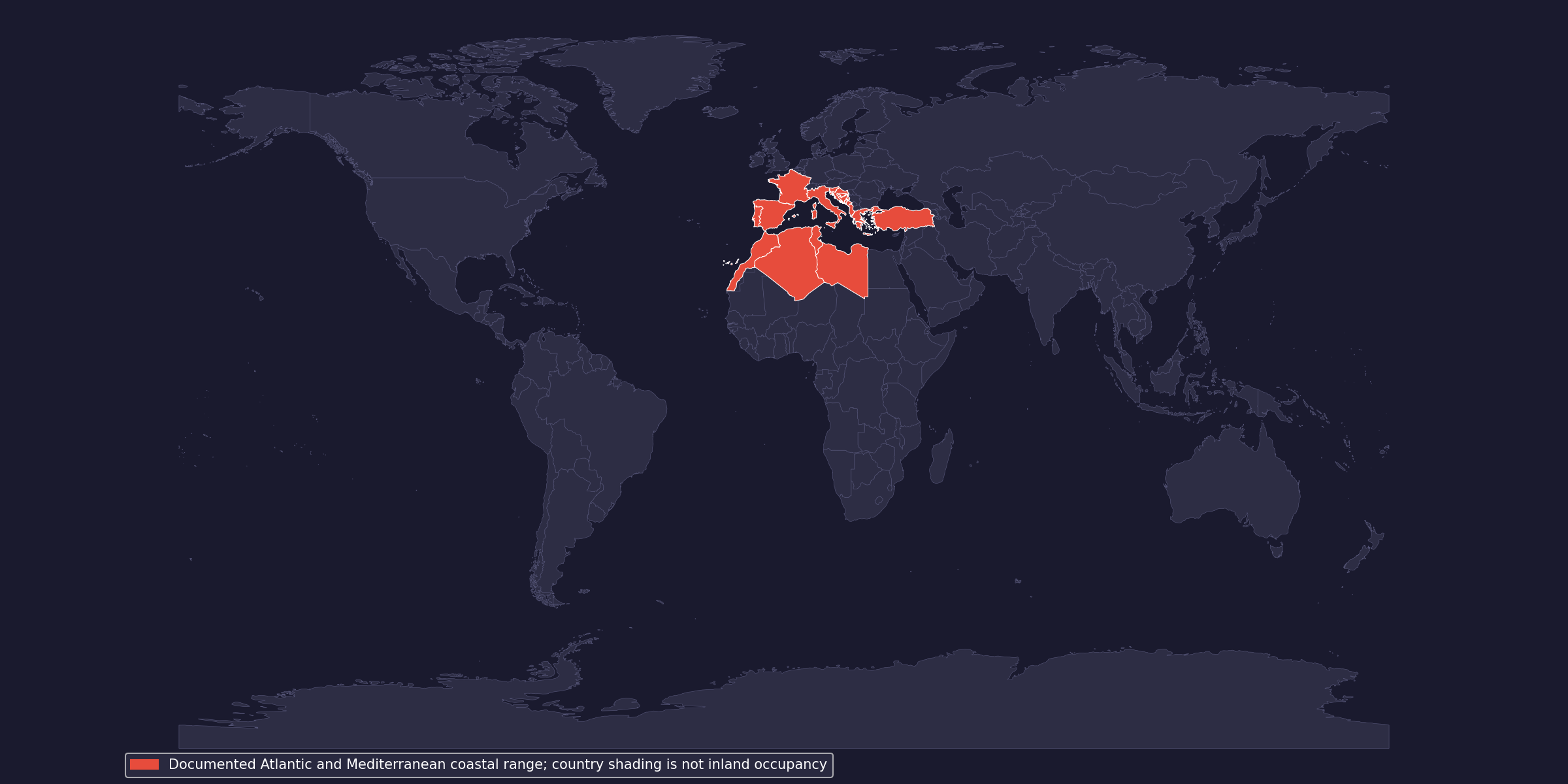
Published records place A. granulatum along Atlantic coasts of Portugal and Brittany and around much of the Mediterranean, including the North African shore, the Aegean and southwestern Black Sea. It is primarily associated with coastal habitats. The country-level map is necessarily broad and omits isolated or uncertain records.
⚖️ Legal status
Checked on 2026-08-23: A. granulatum is not listed by CITES, in EU wildlife-trade Annexes A-D, or in Bern Convention Appendices II-III. Local collection restrictions, protected-site rules and import or sale requirements can still apply.
Prefer captive-established stock and retain its invoice, breeder and morph details. Do not collect from reserves or coastal sites without permission, ship before checking destination rules, or release culture contents outdoors.
🤌 Husbandry
A tightly lidded 30 x 20 x 15 cm box is adequate for a starter colony. Install fine vents on opposing sides, above the substrate, and protect every opening against mancae. Increase floor area and leaf reserves as the colony grows.
Quarantine arrivals for 60 days with separate tools. Confirm that the animals match the supplier’s identification before merging them, especially when Orange stock is involved. Mixed Armadillidium colonies make future identification and responsible distribution difficult.
💡 Lighting
No UVB is needed. Use a 10-12-hour photoperiod and keep the box out of direct sun. Thick leaf litter and cork provide the shaded daytime shelter this mostly nocturnal species uses.
🌡 Heating and temperature
Keep most of the colony at 20-25°C, with an 18-22°C retreat. A normal night drop to 17-21°C is acceptable. Avoid sustained heat above about 27°C: the dry side then becomes hazardous quickly, particularly during a molt.
Heat only one side and control it with a thermostat. Bottom heat is unsuitable because it removes the dependable damp layer beneath the colony.
💧 Humidity and water
Moisten one quarter to one third of the substrate deeply; leave the remaining upper surface dry under abundant leaves. The useful control is substrate moisture, not a single room-humidity reading. Rewater when the moist corner begins drying below the surface.
Do not seal the box to raise humidity. Uniform condensation, fungus and a sour smell mean the wet-air balance has failed. No open water dish is required.
🌿 Enclosure and decoration
Use 5-8 cm of pesticide-free topsoil with crushed limestone or clay, decomposed hardwood leaves and soft rotten hardwood. Add cork pieces spanning both moisture zones and maintain a thick leaf layer.
Supply cuttlebone, limestone or clean crushed eggshell continuously. Avoid resinous conifer wood, fertilized soil, aromatic litter and fresh collected material from treated roadsides or gardens.
🪳 Feeding
Deciduous leaf litter and rotten wood are the staple. Offer small vegetable pieces two or three times weekly and a modest protein feed—fish food, dried crustacean or similar—about once weekly. Remove moist leftovers within 24 hours.
This species is not improved by heavy protein feeding. Mite blooms and mold usually mean the supplemental ration exceeds what the colony can process.
🥚 Breeding
The metadata uses “viviparous” as the closest broad category. More precisely, females brood eggs and embryos in a ventral, fluid-filled marsupium and release mancae after development; keepers should not remove or incubate eggs separately.
Breeding is moderate rather than rapid. Stability matters more than extra heat: retain multiple ages, keep the moist refuge unchanged, and avoid disturbing brooding females. Newborns need fine leaf fragments and access to calcium immediately.
🩺 Common problems
- Mancae vanish: the moist refuge may be too small, too dry or inaccessible beneath compacted substrate.
- Adults cluster at vents: check heat, stagnant air and overwatering.
- Incomplete molts: restore safe moisture choice and calcium; avoid abrupt rehousing.
- Mites and fungus: feed smaller portions and increase cross-ventilation.
- Orange offspring vary: colour expression does not change care or taxonomy; keep provenance records and do not silently relabel the line.
📌 Conclusion
A. granulatum rewards keepers who can combine warmth with air movement and localized moisture. A uniformly humid “Mediterranean” box is less safe than a measured gradient with leaves always available.
📚 Sources and further reading
- GBIF: Armadillidium granulatum
- World List of Isopoda (WoRMS)
- Schmalfuss 2003: World catalog of terrestrial isopods
- Schmalfuss 2000: distribution patterns of Greek Armadillidium
- EAZA Management Guideline Manual for Invertebrate Live Food Species
- Kight 2008: reproductive ecology of terrestrial isopods
- ReptiFiles — checked; no species-specific care guide was found
- CITES Appendices, valid from 5 March 2026
- Commission Regulation (EU) 2026/1383
- Bern Convention appendices