Share

Gestroi's Pill Isopod
🔤 Taxonomy
Armadillidium gestroi Tua, 1900 is accepted by GBIF and the World List of Isopoda. Older records may use the misspelling A. gestri or the synonyms A. quadriseriatum and A. albigauni. Gestroi isopod and Gestroi’s pill isopod are practical English names.
No named colour form in the supplied list requires a separate article. Preserve any genuine locality label, but do not substitute pattern for diagnostic identification.
📌 Description
Adults commonly reach about 1.8-2.3 cm, making this a substantial Armadillidium. The dark grey body carries rows of cream to yellow markings, and the animal conglobates firmly when disturbed. Established groups often feed on the surface after lights dim.
Gestroi isopods are intermediate rather than difficult. They tolerate ordinary indoor temperatures, but a colony kept uniformly wet, poorly ventilated, or on nutritionally empty substrate declines even when supplemental food is abundant.
🌍 Distribution
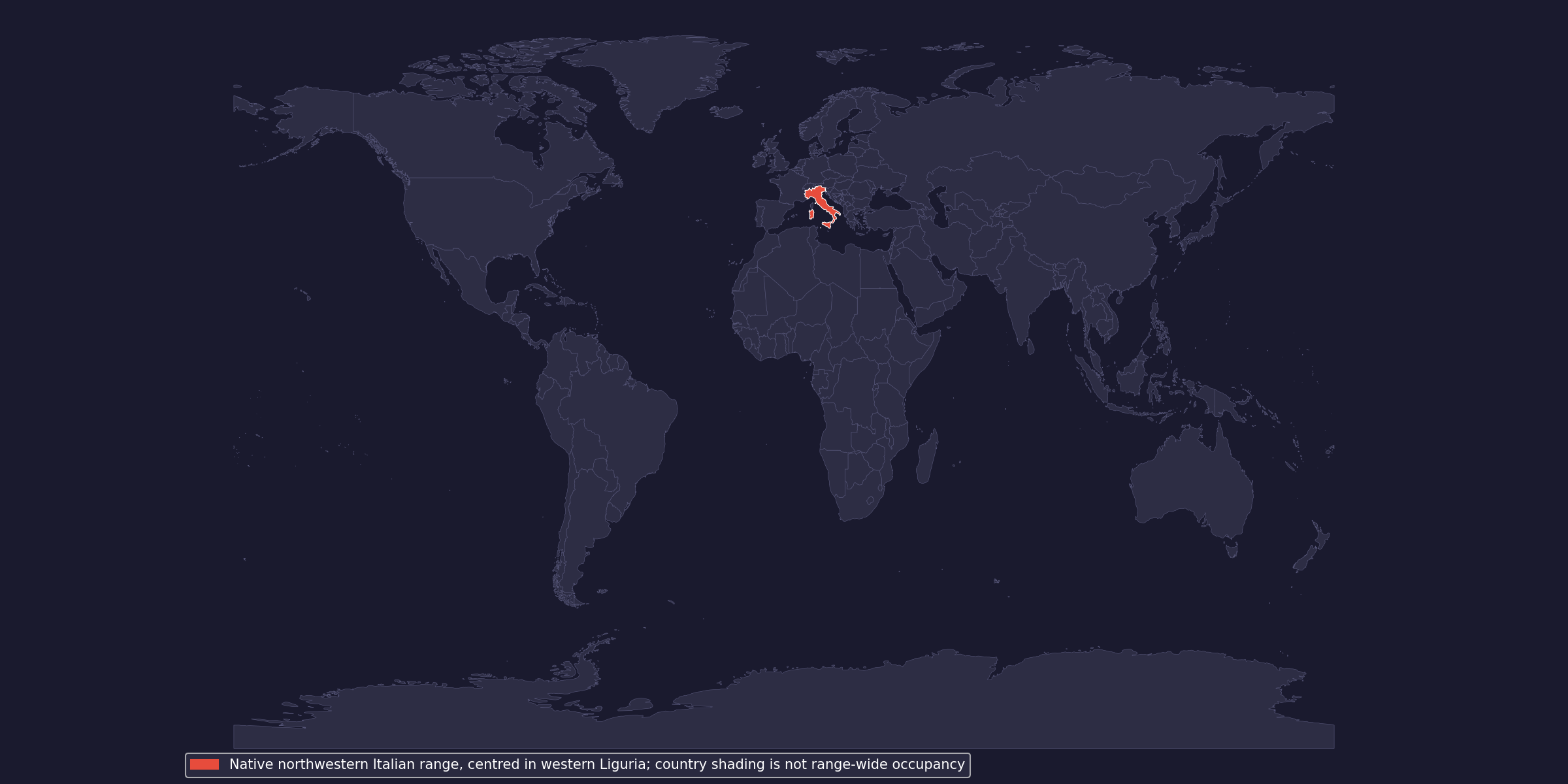
The species is native to northwestern Italy and is especially associated with western Liguria. Recent faunistic work refines its Ligurian records. The country-level map is intentionally conservative and does not imply that it occurs throughout Italy.
⚖️ Legal status
Checked on 2026-08-23: Armadillidium gestroi is not listed in CITES, EU wildlife-trade Annexes A-D under Regulation (EU) 2026/1383, or Bern Convention Appendices II-III. National and protected-area collection rules still apply in Italy, and other countries may regulate import or live-invertebrate transport.
Choose captive-bred stock, retain invoice and locality information, and do not collect without permission. Never release captive animals or used substrate, even within the species’ country of origin.
🤌 Husbandry
A 25 × 18 × 15 cm cross-ventilated container is a useful start for 10-20 animals. Increase space, leaf litter, hides, and feeding points as the colony grows. Fine side vents retain mancae and create a better gradient than a mostly sealed display jar.
Quarantine new stock for 30-60 days. Use separate tools and record activity, mortality, molts, mites, and source. Avoid adding the colony directly to a reptile enclosure: establish and identify it independently first, and remember that predation or overly warm bioactive conditions can eliminate it.
💡 Lighting
UVB is unnecessary. Provide diffuse room or plant light for 10-14 hours and deep shade under leaves and cork. Direct sunlight and hot spotlights are unsafe for small containers.
🌡 Heating and temperature
Maintain 18-25 °C with a 16-20 °C retreat and nights around 16-22 °C. Typical heated homes need no additional warmth. Cooler winter rooms slow feeding and reproduction; forced dormancy is not required.
Avoid sustained conditions above 27 °C. When supplemental heat is unavoidable, warm one outer wall through a thermostat and keep the moist refuge at the opposite end. Check temperatures within the litter layer.
💧 Humidity and water
Keep about one-third of the enclosure damp, the middle lightly moist, and the ventilated end less wet. Approximate air humidity of 55-75% is a guide, not a substitute for touching and inspecting substrate. Deep material should never dry completely.
Pour water into the moss end when needed; do not soak the full surface. No water dish is required. Constant condensation, sour smell, or animals remaining high on cork suggests waterlogging, while repeated clustering in the moss and incomplete molts suggests insufficient moisture.
🌿 Enclosure and decoration
Provide 6-8 cm of deciduous leaf mould, decomposed hardwood, and pesticide-free mineral soil. Add thick hardwood leaf litter, soft rotten wood, cork flats, and a moss station. Keep heavy pieces stable and preserve air gaps beneath bark.
Maintain cuttlebone, limestone, or calcium carbonate. Avoid fertilizer, aromatic wood, chemically treated garden material, and substrate made primarily from coir. Top up leaves before the colony reduces them to fragments and frass.
🪳 Feeding
The staple is decomposing deciduous leaves and white-rotted wood. Offer carrot, squash, sweet potato, mushroom, courgette, or balanced isopod food in small portions two or three times weekly. Add modest dried shrimp, gammarus, or fish food about weekly.
Remove wet remains within 24-48 hours. Permanent calcium and a varied decomposer base matter more than large meals. Multiple feeding spots reduce crowding in a mature colony.
🥚 Breeding
Females brood eggs and embryos inside a ventral, fluid-filled marsupium and release mancae. The site therefore uses the broad enum “viviparous,” with no external incubation fields. Sex is assessed from ventral pleopods, but the colony does not need routine sexing.
Leave gravid females within stable substrate and connected litter. Fine foods, constant calcium, a moist refuge, and manca-proof vents support the young. Temperature changes development rate, so published work on other terrestrial isopods should not be converted into a fixed incubation number for this species.
🩺 Common problems
- Incomplete molt: restore access to moist substrate and calcium and check for excess heat.
- Colony hides and shrinks: inspect edible leaf/wood reserves and substrate moisture below the surface.
- Mold or mites: reduce protein and vegetables, remove spoiled patches, and increase safe cross-flow.
- Slow reproduction: stabilize temperature and moisture before increasing food.
- Escapes during maintenance: open over a catch tub and inspect bark, lid tracks, and waste leaves.
📌 Conclusion
Gestroi isopods suit keepers who want a large, visible Mediterranean pill isopod without tropical heat. Prepare deep edible substrate and a permanent moist-to-dry gradient first; stagnant uniform wetness is the avoidable failure point.
📚 Sources and further reading
- GBIF: Armadillidium gestroi
- World List of Isopoda: Armadillidium gestroi
- Gardini et al. 2026: Oniscidea of Liguria
- Schmalfuss 2003 world catalog of terrestrial isopods
- ReptiFiles clean-up-crew overview checked before drafting
- Specialist A. gestroi husbandry guide
- Histological study of the terrestrial-isopod marsupium
- CITES Appendices
- Current EU wildlife-trade Annexes: Regulation (EU) 2026/1383
- Bern Convention appendices