Share

Yellow-Shield Pill Isopod
🔤 Taxonomy
Armadillidium flavoscutatum Strouhal, 1927 is accepted by GBIF and the World List of Isopoda. A 2013 revision separates it from the related A. klugii group using head, first pereion segment, and telson characters and corrects older claims that extended its range into Montenegro.
Red Head is a captive trade or locality line, not a taxonomic rank. Preserve the label and breeder provenance, but do not publish it as a species, subspecies, or proof of a southern Albanian range without voucher evidence.
📌 Description
Adults reach about 1.4-1.8 cm and can conglobate into a ball. The pattern may include longitudinal rows of pale spots over a darker ground; Red Head animals show warmer colour around the head. Similarity to related Balkan Armadillidium makes origin records more reliable than casual photo identification.
This is a temperate Balkan display species rather than a hot tropical pill isopod. It benefits from fresh air, seasonal room-level cooling, leaf-rich soil, and a permanent moist refuge without uniformly wet conditions.
🌍 Distribution
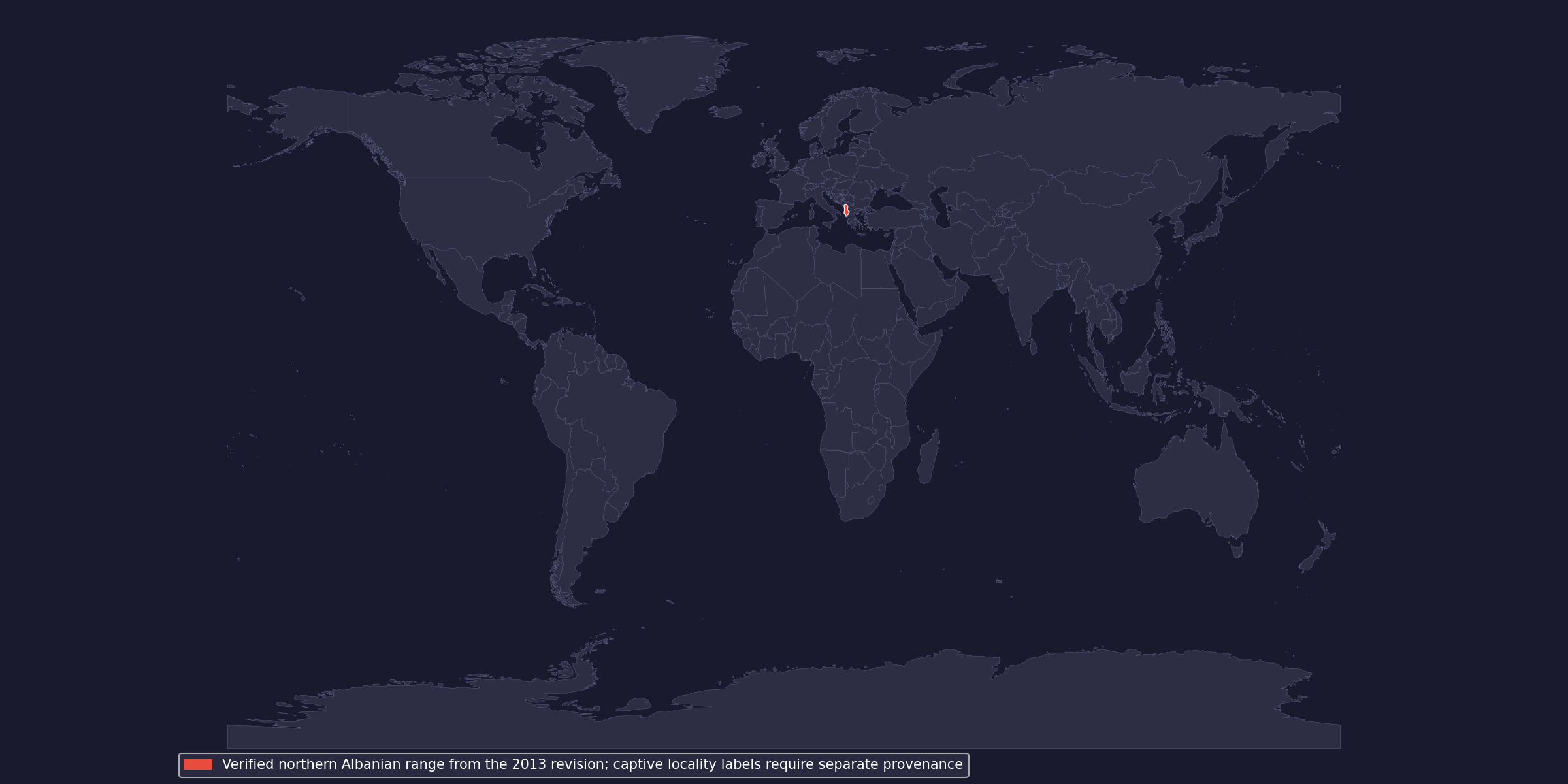
The 2013 revision verified A. flavoscutatum only from northern Albania: the type localities near Shkodër and Mount Maranaj, plus material from Kurbnesh. It specifically rejected an older Montenegro attribution. GBIF occurrences likewise centre on Albania.
Some modern Red Head cultures are sold with different Albanian locality wording. Retain that wording as captive provenance, but keep the mapped natural range conservative until specimens and collection data are traceable.
⚖️ Legal status
Checked on 2026-08-23: Armadillidium flavoscutatum is not listed by CITES, in EU wildlife-trade Annexes A-D under Regulation (EU) 2026/1383, or in Bern Convention Appendices II-III. Its narrow verified range makes lawful and documented origin especially important despite the absence of those listings.
Buy captive-bred animals, retain invoices and the full locality label, and verify Albanian or destination-country collection, export, import, and sale rules. Never release specimens or viable substrate outdoors.
🤌 Husbandry
A ventilated 25 × 18 × 15 cm container suits 10-20 starter animals. Place more ventilation over the less-wet half and retain fine lower cross-flow. Supply overlapping cork and leaves so animals can move between moisture zones without crossing open ground.
Quarantine for 30-60 days using separate tools. Watch for mixed Armadillidium, mites, failed moults, and a mismatch between the invoice and culture label. Do not combine Red Head with unrelated or unproven lines if preserving its phenotype and history matters.
💡 Lighting
UVB is unnecessary. Use a 10-14-hour seasonal room-light cycle with shade beneath cork and leaf litter. Avoid direct sun and heat-producing display lamps.
🌡 Heating and temperature
Maintain 17-24 °C, with a 14-19 °C retreat and nights around 14-20 °C. Normal cool-season room temperatures can slow activity without requiring a forced dormancy. Juveniles, new arrivals, and weak colonies should not be deliberately chilled.
Avoid sustained temperatures above 26-27 °C. If heating is necessary, warm only one outer wall under thermostat control. Leave the damp end and substrate base cooler so animals can regulate their temperature and water balance.
💧 Humidity and water
Keep about one-third of the substrate consistently damp beneath moss and cork, with a transitional middle and ventilated, less-wet end. An approximate 50-70% RH is useful, but the survival of a moist lower refuge is the decisive measure. Add water directly to that zone rather than misting the whole box.
No water dish is required. Persistent condensation and wall climbing suggest waterlogging or stale air; incomplete moults and continuous crowding in the last damp crevice indicate excessive drying.
🌿 Enclosure and decoration
Use 5-7 cm of pesticide-free topsoil, deciduous leaf mould, and rotten hardwood. Cover at least three-quarters of the surface with oak, beech, maple, or similar safe leaves. Add cork flats, a moss pocket at the wet end, and stable limestone or cuttlebone.
Keep calcium carbonate available continuously. Avoid fertilizer, pesticide-contaminated garden material, aromatic conifer wood, fresh manure, and sterile coir-only substrate. Edible leaves and decomposed wood must remain a major part of the enclosure.
🪳 Feeding
Decayed hardwood leaves and white-rotted wood are the staple. Offer small pieces of carrot, squash, sweet potato, mushroom, courgette, or dried nettle two or three times a week. Add a small amount of dried shrimp, gammarus, or quality fish food about weekly, especially when females and juveniles are present.
Remove wet leftovers within 24-48 hours and use more than one feeding point in established colonies. Too much protein encourages mites; too little fibrous detritus and calcium causes slow growth and moulting trouble.
🥚 Breeding
Females carry developing eggs and embryos in a fluid-filled marsupium and release mancae. The repository classifies marsupial brooding as “viviparous”; there are no exposed eggs and no incubation instructions.
Breeding is usually steady rather than extremely fast. Stable moderate temperatures, a connected damp zone, calcium, and small protein portions support recruitment. Do not isolate gravid females, and wait for several age classes before dividing a Red Head colony.
🩺 Common problems
- Failed moults: restore lower-layer moisture, calcium, and a cooler refuge.
- Poor recruitment: reduce disturbance and check leaf quality, protein, and prolonged heat.
- Mites or fungus: remove excess food and strengthen airflow over the less-wet end.
- Misidentification: retain source records and avoid relying on head colour or spot rows alone.
- Line mixing: keep Red Head and other provenance lines in separately labelled enclosures.
📌 Conclusion
Armadillidium flavoscutatum rewards careful temperate husbandry and disciplined provenance records. Prepare the cool retreat and moisture gradient before purchase; treating Red Head as a colour label without origin data loses much of the line’s value.
📚 Sources and further reading
- GBIF: Armadillidium flavoscutatum
- World List of Isopoda: Armadillidium flavoscutatum
- Schmalfuss 2013 revision of the Armadillidium klugii group
- ITIS record and Albanian type locality
- ReptiFiles site check; general clean-up-crew reference
- CITES Appendices
- Current EU wildlife-trade Annexes: Regulation (EU) 2026/1383
- Bern Convention appendices