Share

Southern Pill Woodlouse
🔤 Taxonomy
Armadillidium depressum Brandt, 1833 is the accepted name. Adults have a broad, somewhat splayed rear outline and do not close into the same seamless sphere as A. vulgare; reliable identification should use several adult characters.
The submitted label “A. depressum Magic Potion” needs explicit caution. Magic Potion is also widely used for unrelated-looking captive lines of A. vulgare. A patterned animal, photograph or seller label alone cannot establish A. depressum. Keep such stock isolated until adult morphology and an unbroken supplier provenance support the identification; never merge it with A. vulgare Magic Potion lines.
📌 Description
Adults reach about 1.5-2 cm and are usually dark grey to black. They occupy stone walls, quarries, rocky crevices and human-modified sites, emerging when surface conditions are humid.
The species tolerates cool temperate rooms but depends on access to damp cracks. In captivity that means mineral-rich structure, localized moisture and strong airflow rather than tropical humidity.
| Care point | Practical target |
|---|---|
| Adult size | 1.5-2 cm |
| Starter colony | 30 x 20 x 15 cm or larger |
| Temperature | 17-23°C |
| Substrate | 6-8 cm with mineral particles and leaves |
| Moisture | stable damp crevice beside a dry, airy surface |
| Main risk | heat and unverified Magic Potion identity |
🌍 Distribution
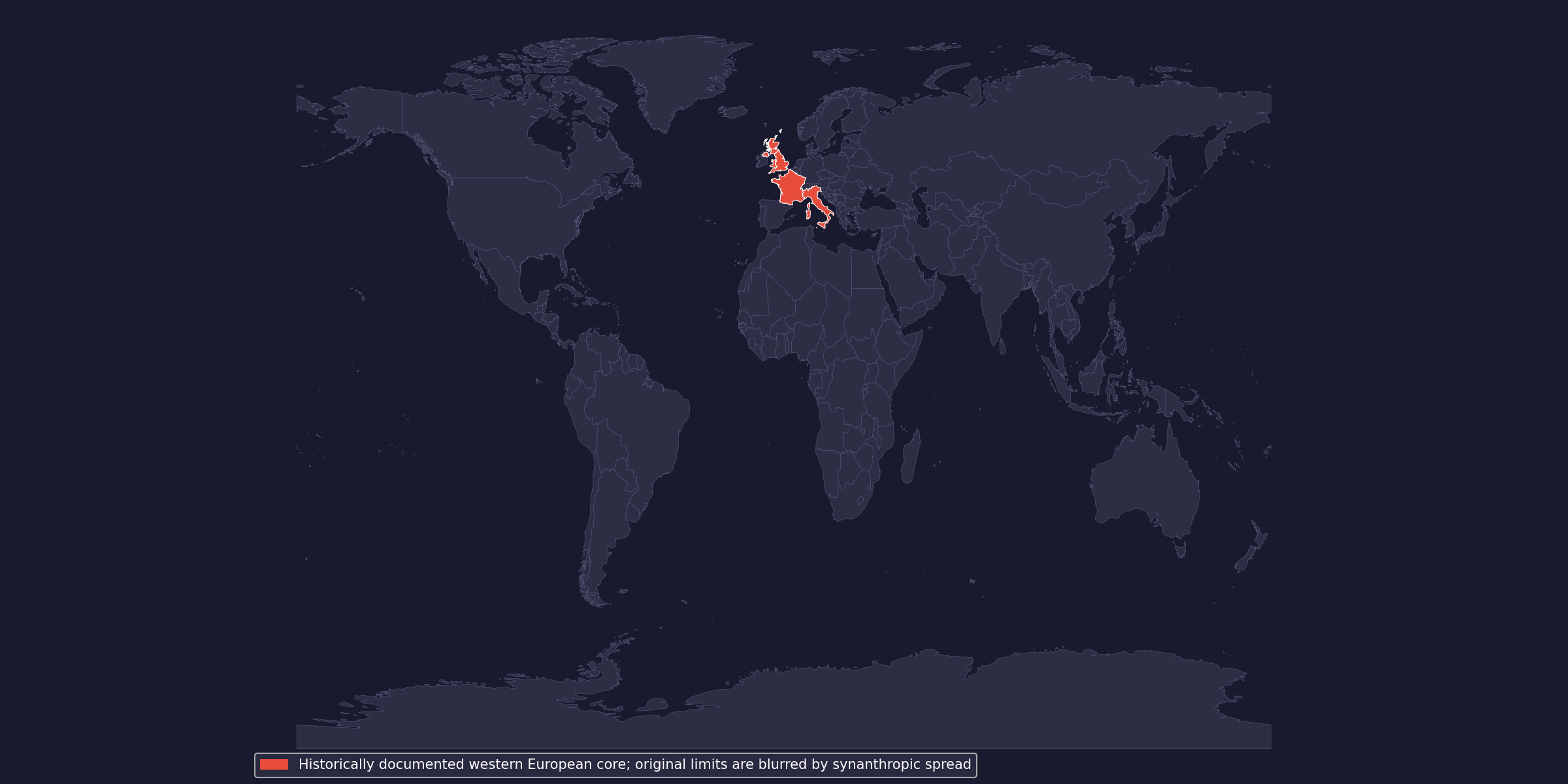
Historical sources document the species in Britain, France and Italy; newer records also extend through parts of central Europe. In Britain it remains strongly associated with the south and west but has spread in walls, towns and transport corridors. Because its original limits are blurred by human movement, the map shows the historically documented core and states that uncertainty.
⚖️ Legal status
Checked on 2026-08-23: A. depressum is not listed by CITES, in Annexes A-D of the current EU wildlife-trade regulation, or in Bern Convention Appendices II-III. Protected-site collection rules and national controls on live soil fauna may still apply.
Obtain captive-established stock with an invoice and traceable culture name. For any “Magic Potion” offering, record the breeder chain and identification evidence. Never release animals or discard live substrate outdoors.
🤌 Husbandry
Use a 30 x 20 x 15 cm or larger smooth-sided box with a secure lid and cross-ventilation. Provide several low limestone, cork or bark crevices over the moisture boundary. Fine mesh must exclude mancae without stopping air exchange.
Quarantine new arrivals for at least 60 days with separate tools. Do not combine similar pill woodlice to save space. For the questioned Magic Potion culture, permanent separation is the responsible default unless identification and provenance are resolved.
💡 Lighting
UVB is not necessary. Give 10-12 hours of diffuse room light, abundant shaded cover and no direct sun. Bright light is useful only for plants and inspection, not as a basking requirement.
🌡 Heating and temperature
Keep 17-23°C, with a 15-19°C cool choice and nights of 14-19°C. A stable colony can slow seasonally in a cool room. Do not manufacture a cold season for new, thin or declining stock, and avoid sustained temperatures above 25-26°C.
Supplemental heat is rarely required. If used, place thermostated heat along one side, never beneath the damp retreat.
💧 Humidity and water
Maintain one deep damp corner and a mostly dry, ventilated surface elsewhere. Pour a small amount of water beneath moss or bark at the moist end when the deeper layer begins to dry. Leave limestone or cork spanning both zones.
No water dish is required. Whole-lid condensation, mold between mineral pieces and animals climbing away from the substrate indicate too much water, too much heat or too little airflow.
🌿 Enclosure and decoration
Use 6-8 cm of pesticide-free topsoil with crushed safe limestone or clay, decomposed hardwood leaves and soft rotten wood. Add cork, flat stones that cannot collapse, a small moist moss patch and deep leaf litter.
Keep cuttlebone, limestone or clean crushed eggshell accessible. Avoid fertilized compost, aromatic timber, resinous conifer litter and unstable rock stacks that can crush animals during maintenance.
🪳 Feeding
Dead deciduous leaves and rotten hardwood form the permanent diet. Offer small vegetable pieces two or three times weekly and limited fish food or dried invertebrate protein about once weekly. Remove moist leftovers within 24 hours.
Do not attempt to “bring out” a Magic Potion pattern through additives. Pattern does not prove species identity, and excessive rich feed only destabilizes the substrate.
🥚 Breeding
The structured field says “viviparous” because that is the repository’s nearest coarse option. Females actually brood eggs and embryos in a fluid-filled ventral marsupium and release mancae; there is no external incubation stage.
Breeding is moderate under stable cool-temperate care. Keep the moist crevice undisturbed, ensure fine leaf material and calcium are close to it, and split colonies by moving several age classes. Never cross or mix uncertain patterned cultures to test a trade label.
🩺 Common problems
- Heat losses: move the colony to a cooler room and correct the gradient without sudden chilling.
- Failed molts: check the damp retreat, calcium and unsafe disturbance of soft animals.
- Mites, mold or odor: reduce rich food, remove the fouled patch and increase cross-ventilation.
- No mancae: allow establishment time and avoid lifting brooding females or every shelter at each check.
- Magic Potion identity conflict: stop distribution under a species name, isolate the stock and document the uncertainty.
📌 Conclusion
The southern pill woodlouse is straightforward only when cool ventilation and a damp crevice coexist. A questionable Magic Potion label is a provenance problem, not a reason to create a new species article or mix cultures.
📚 Sources and further reading
- GBIF: Armadillidium depressum
- World List of Isopoda (WoRMS): current nomenclature
- British Myriapod and Isopod Group: identification, habitat and current distribution
- Gregory 2024: updated British and Irish distribution
- Kight 2008: reproductive ecology of terrestrial isopods
- ReptiFiles — checked; no species-specific care guide was found
- CITES Appendices, valid from 5 March 2026
- Commission Regulation (EU) 2026/1383
- Bern Convention appendices