Share

Badium Pill Woodlouse
🔤 Taxonomy
Armadillidium badium Budde-Lund, 1885 is an accepted species from the central Mediterranean. Armadillidium degneri appears in older literature as a synonym.
The White/albino animals sold in the hobby are a captive colour line, not a separate taxon. Some “Casteldaccia” stock has also circulated with uncertain identification, so keep a supplier’s locality and breeding records and do not identify an animal from pattern alone.
📌 Description
Adults are normally about 1-1.5 cm and conglobate fully. Wild populations can be brown to red-brown; selected cultures may show pale, yellow or contrasting markings. The guide covers verified A. badium and its White/albino line together.
This is a moderate-care Mediterranean roller. It needs a damp refuge for respiration, molts and mancae, but its open-grassland ecology argues against a sealed, uniformly wet enclosure.
| Care point | Practical target |
|---|---|
| Adult size | 1-1.5 cm |
| Starter colony | 30 x 20 x 15 cm or larger |
| Temperature | 18-24°C |
| Moisture | approximately one-third moist, remainder progressively drier |
| Staple food | decayed hardwood leaves and soft rotten wood |
| Main failure | stagnant wet substrate or loss of the moist refuge |
🌍 Distribution
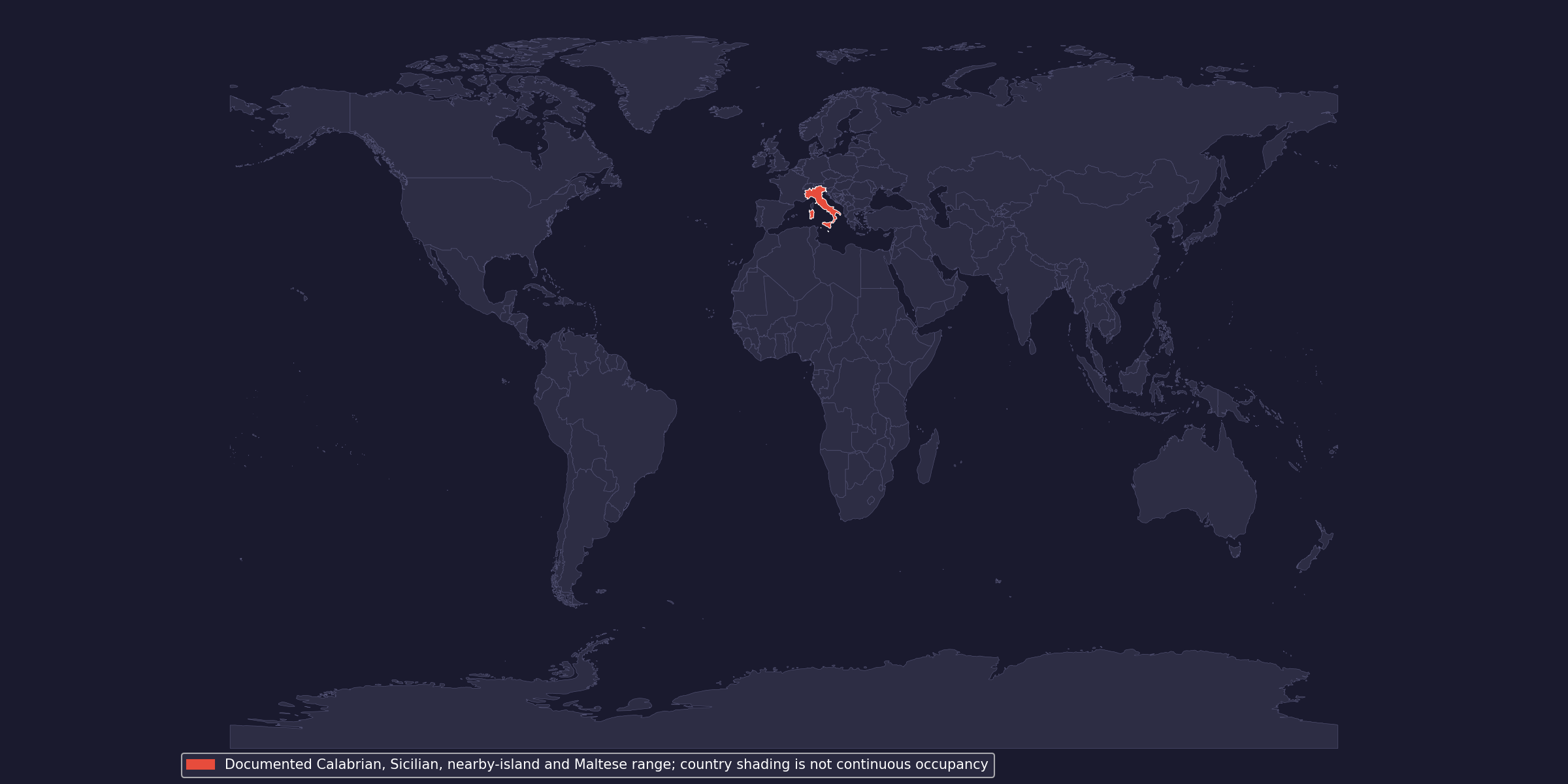
Published records place A. badium in southern Italy, especially Calabria, Sicily and nearby islands, and in the Maltese Islands. Sicilian ecological work found it in open grassland from the coast to higher ground and reported reduced surface activity during the driest months.
The map represents Italy and Malta at country scale. Captive locality names should not be used to expand the scientific range without voucher-backed records.
⚖️ Legal status
Checked on 2026-08-23: A. badium is not listed in the CITES Appendices, Annexes A-D of Commission Regulation (EU) 2026/1383, or Appendices II-III of the Bern Convention. Collection from reserves, caves or other protected sites can still be restricted, and national import, transport and sale rules remain applicable.
Buy captive-bred stock, keep the invoice and line information, and verify both endpoints before shipping. Never release the colony or discard live animals and substrate outdoors.
🤌 Husbandry
House a starter group in a tight 30 x 20 x 15 cm container with fine ventilation across two sides and part of the lid. Give a broad cork hide spanning the moisture boundary so animals can choose humidity without remaining exposed.
Quarantine new animals for 60 days with separate tools. Record survival, molts and offspring, and inspect for mites, gnats and foreign isopods before combining cultures. Keep White/albino stock separate from other colour lines if preserving its appearance matters.
💡 Lighting
UVB is not required. A 10-12 hour indirect light cycle is sufficient. Provide dense leaf and bark cover and keep the container away from direct sun; clear boxes overheat quickly.
🌡 Heating and temperature
Maintain 18-24°C, with 18-21°C at the cool side and normal night temperatures of 16-21°C. Short seasonal slowing is acceptable. Sustained heat above 26°C increases dehydration risk and is not needed for breeding.
When supplemental heat is unavoidable, warm only one outside wall using a thermostat. Do not place a mat beneath the enclosure, where it dries the dampest and most important substrate first.
💧 Humidity and water
Keep the lower substrate in about one-third of the box continuously moist. Let the upper layer become progressively drier toward the ventilated end, while never allowing the entire depth to turn dusty. Water the moss corner directly instead of misting every surface.
Do not add an open water dish. Whole-box condensation, foul odor and persistent vent-climbing indicate too much water or too little air; animals packed into the damp corner indicate that the gradient has become too dry.
🌿 Enclosure and decoration
Provide 6-8 cm of unfertilized topsoil blended with crushed deciduous leaves, crumbly rotten hardwood and a modest amount of moisture-retaining material. Cover the surface generously with safe leaf litter and add cork, bark and a damp moss refuge.
Supply cuttlebone, limestone chips or baked crushed eggshell at all times. Avoid coir-only substrate, resinous conifers, fresh hard wood, chemically treated garden material and soil containing fertilizer or wetting agents.
🪳 Feeding
The colony should always have edible hardwood leaves and soft rotten wood. Supplement twice weekly with a small slice of squash, carrot or sweet potato and once weekly with a restrained pinch of dried shrimp or quality fish food. Remove moist food before it molds.
Leave calcium separate and continuously accessible. Excess protein and fruit do not accelerate a new colony safely; they primarily feed mites and microbial blooms.
🥚 Breeding
Reproduction is entered as “viviparous” in the site’s broad metadata. Biologically, females brood eggs and embryos in a fluid-filled ventral marsupium and release mancae; no external clutch is available for incubation.
Colonies usually establish gradually. Stable moisture, mature animals of both sexes and uninterrupted leaf food matter more than extra heat. When splitting a colony, transfer substrate and leaves containing small juveniles as well as adults.
🩺 Common problems
- Molting deaths: review the damp refuge, calcium source and ventilation together.
- Slow establishment: avoid repeated digging; confirm the temperature and lower-layer moisture, then wait through a full breeding cycle.
- Mites and mold: reduce protein and fresh vegetables, remove spoiled food and increase dry-side airflow.
- White/albino line darkens over generations: verify that cultures were not mixed and keep the seller’s line label separate from the species name.
- Uncertain identification: do not sell offspring as pure A. badium without traceable stock.
📌 Conclusion
A. badium works well as a dedicated display colony when the enclosure reflects open Mediterranean ground: ventilated and partly dry above, with a reliable moist reserve below. The White/albino line changes colour, not care or taxonomy.
📚 Sources and further reading
- GBIF: Armadillidium badium
- World List of Isopoda (WoRMS): A. badium
- Schmalfuss: World catalog of terrestrial isopods
- Terrestrial isopods of the Saline di Trapani e Paceco reserve
- EAZA Management Guideline Manual for Invertebrate Live Food Species
- ReptiFiles — checked; no species-specific care guide was found
- CITES Appendices, valid from 5 March 2026
- Commission Regulation (EU) 2026/1383
- Bern Convention appendices