Share

Black Fat-tailed Scorpion
🔤 Taxonomy
Androctonus crassicauda is the accepted name, but the old sensu-lato concept covered much of the Middle East. Work published in 2023–2025 separated Turkish, Iraqi, Caucasian and several Iranian populations as other species, including A. turkiyensis, A. kunti, A. sumericus, A. ishtar, A. orientalis and additional Iranian taxa. A broad ‘Arabian fat-tail’ label is therefore not a modern identification.
📌 Description
True A. crassicauda is a robust black to dark-brown buthid, about 7–9 cm in the post-revision Iranian material. Its venom is medically significant and systemic envenomation can be life-threatening. This is not a private-pet recommendation: lawful work is limited to expert or professional display with redundant locked barriers and no direct handling.
☠️ Venom
This species is venomous. Venom exposure can cause pain, swelling or other systemic effects, and severity varies with species, locality, bite site and the amount delivered. A small wound or apparently dry bite is not proof of safety; every bite or sting requires urgent medical assessment.
If an incident occurs, move away, call emergency services or a poison centre, keep the patient still, remove rings and other constricting items, and follow dispatcher instructions. Do not use a tourniquet, cut or suck the wound, apply ice or electricity, give alcohol or medicines as a home treatment, or attempt to catch the animal. Antivenom choice and dosing are hospital decisions; verify the relevant product and local availability in advance. Sources: WHO snakebite guidance and appropriate species-specific toxinology or medical references listed below.
🌍 Distribution
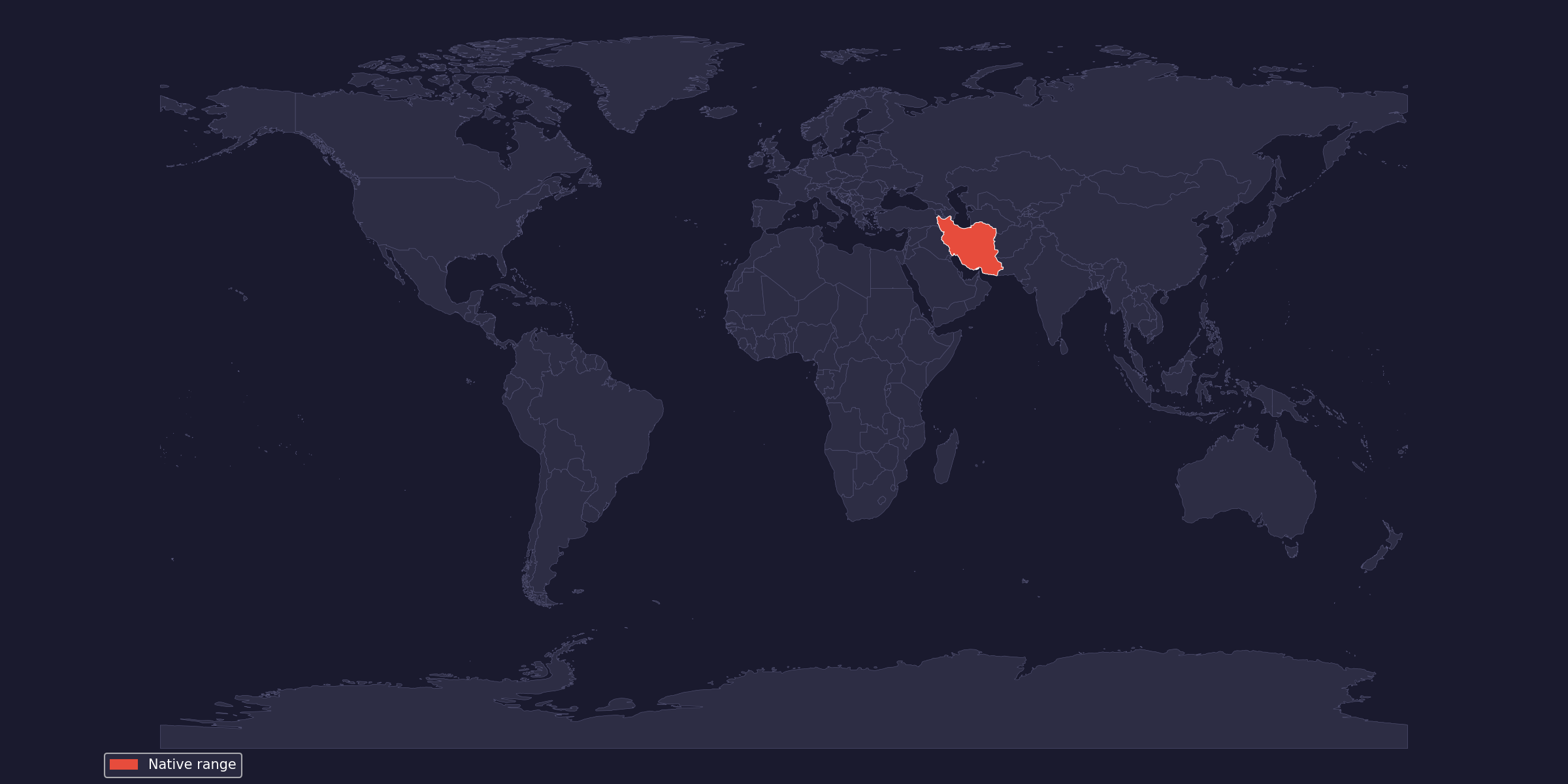
The conservative post-revision country range used here is Iran, centred on the type region around Kashan and supported central Iranian records. Older reports from Sinai, the Levant, Arabia, Iraq, Turkey and the Caucasus require reassessment and are excluded from this map. The species uses arid stony plains and firm soil shelters that buffer large daily temperature swings.
🌡 Climate across the native range
Monthly climate normals from a reviewed GBIF occurrence within the post-revision Iranian range:
Esfahan Province — Iran (reviewed occurrence east of Kashan)
| Month | Min °C | Mean °C | Max °C | RH % |
|---|---|---|---|---|
| January | -0.2 | 5.1 | 10.5 | 65 |
| February | 1.6 | 7.5 | 13.4 | 57 |
| March | 5.6 | 11.8 | 18.1 | 49 |
| April | 11.3 | 18.2 | 25.1 | 39 |
| May | 15.3 | 22.9 | 30.5 | 34 |
| June | 20.4 | 28.4 | 36.3 | 26 |
| July | 23.9 | 31.7 | 39.5 | 25 |
| August | 22.7 | 30.6 | 38.4 | 26 |
| September | 18.2 | 26.3 | 34.4 | 28 |
| October | 12.2 | 19.8 | 27.3 | 38 |
| November | 6.3 | 12.8 | 19.3 | 50 |
| December | 1.4 | 6.9 | 12.4 | 64 |
Weather data by WorldClim v2.1 · Monthly normals queried by Herpeton Academy from raster values; relative humidity is derived from vapor pressure and mean temperature.
Location references use GBIF.org occurrence data where available; original occurrence records retain their source dataset licenses.
⚖️ Legal status
Checked on 2026-08-17 against the official CITES Appendices and EU wildlife-trade annex framework: Androctonus crassicauda is not specifically listed. The Bern Convention is not relevant to this non-European native species. Non-listing is not permission to own it. Dangerously venomous-animal laws, licensing, insurance, transport, workplace and exhibition rules may prohibit or condition possession. Local and national rules must still be checked before acquisition or transfer. Obtain written confirmation before acquisition and retain invoice, breeder identity, origin and import documents.
🤌 Husbandry
Keep a single, provenance-confirmed Iranian A. crassicauda in a mechanically latched primary enclosure inside a second locked cabinet or dedicated room. Use a sparse layout and secured metal vents so the dark animal can be counted without opening an opaque chamber; the permanent label and inventory must both state the Iranian lineage, not a broad ‘Arabian fat-tail’ name. A separate 90-day quarantine with dedicated tools is also an identity check: retain the breeder, locality and import records with the animal.
| Parameter | Conservative target |
|---|---|
| Adult enclosure | 30 × 30 × 25 cm |
| Day air | 26–31 °C |
| Warm area | 31–34 °C |
| Night | 19–23 °C |
| Relative humidity | 25–40%; 40–55% in the protected premoult refuge |
| Substrate | at least 10 cm |
| Feeding | one suitable invertebrate every 10–14 days |
Before any move, confirm that the specimen really belongs to the post-revision Iranian lineage and record its enclosure number. Work over a bare smooth tub with two closed catch cups and a second trained observer. A dark, heavy-tailed animal can pivot rapidly after a defensive pause; guide it from behind and never use the metasoma as a handle. After transfer, update the provenance log and confirm the enclosure and room counts before unlocking the room.
💡 Lighting
Provide 10–12 hours of low, diffuse light and full darkness at night; UVB has no established role. Position fixtures outside both barriers so neither direct sun nor a display beam heats the dark substrate or closed cabinet. The useful lighting goal is a clear view of the inspection strip and refuge entrance without creating glare that conceals the black scorpion during a count.
🌡 Heating and temperature
Maintain 26–31 °C daytime air, a limited warm area of 31–34 °C and a 22–25 °C cool shelter; nights can fall to 19–23 °C. Heat one outer side wall through a thermostat and use fixed probes at both ends. Never heat under the shelter: true Iranian A. crassicauda needs the cooler depth available in firm ground, and a locked secondary cabinet can remain hot after the room begins to cool.
💧 Humidity and water
Keep the general range around 25–40% RH with cross-ventilation and a protected retreat around 40–55% during premoult or for small juveniles. Add water to one deep corner rather than spraying the animal or saturating the whole floor. Supply a shallow stable water dish. Condensation, mould or flies mean moisture and airflow are out of balance.
🌿 Enclosure and decoration
Provide at least 10 cm of compact mineral substrate: roughly equal parts washed sand and pesticide-free loam with enough clay to hold a shallow scrape. Seat one flat stone and a cork shelter on the base, leaving a clear inspection strip around them. Most of the floor stays dry; one protected deep corner receives measured water. Avoid stacked rockwork and enclosed ornaments that prevent confirmation of the single animal.
🪳 Feeding
Offer one appropriately sized captive-bred roach, cricket or locust every 10–14 days on the open inspection strip, not deep inside a refuge that then has to be dismantled. Keep the abdomen firm rather than distended and lengthen the interval when the animal refuses food or enters premoult. Retrieve leftovers with long forceps within 24 hours; no hand, wild insect or feeder container enters the locked setup without the animal first being located.
🦂 Breeding and young
The species is viviparous and a litter may contain roughly 20–40 young, but reproduction is appropriate only in authorised professional work. Pairing records must prove that both adults belong to the post-revision Iranian concept; never mix animals carrying old Iraqi, Arabian or Turkish A. crassicauda labels. Prepare numbered escape-proof juvenile units, document the lineage of each offspring and remove prey while the brood remains on the female.
🩺 Common problems
- Sensu-lato misidentification: an old Arabian, Turkish or Iraqi label may refer to a newly separated Androctonus, changing range and medical context.
- Uncountable shelter: opaque chambers defeat the signed enclosure count.
- Severe envenomation: treat every sting as an emergency and provide the Iranian provenance, not only the common name.
- Heat accumulation: a locked cabinet can remain hot after room temperature falls.
- Moult failure: an entirely dry enclosure or prey left during premoult adds avoidable risk.
📌 Conclusion
True Iranian A. crassicauda is not the catch-all ‘Arabian fat-tail’ of older care sheets. Its modern identification and provenance are part of safe custody, alongside double locks, a simple countable dry enclosure and rehearsed emergency response. It belongs only in lawful expert or professional facilities with no direct contact.
📚 Sources and further reading
- GBIF species backbone: Androctonus crassicauda
- Yağmur et al. (2025): review and redescription of Iranian Androctonus
- Medical and molecular review of A. crassicauda
- The Scorpion Files: medically important scorpions
- Amateur Entomologists’ Society: scorpion husbandry and safety
- CITES Appendices
- European Commission: EU wildlife trade
- Council of Europe: Bern Convention