Share

Egyptian Black Fat-tailed Scorpion
🔤 Taxonomy
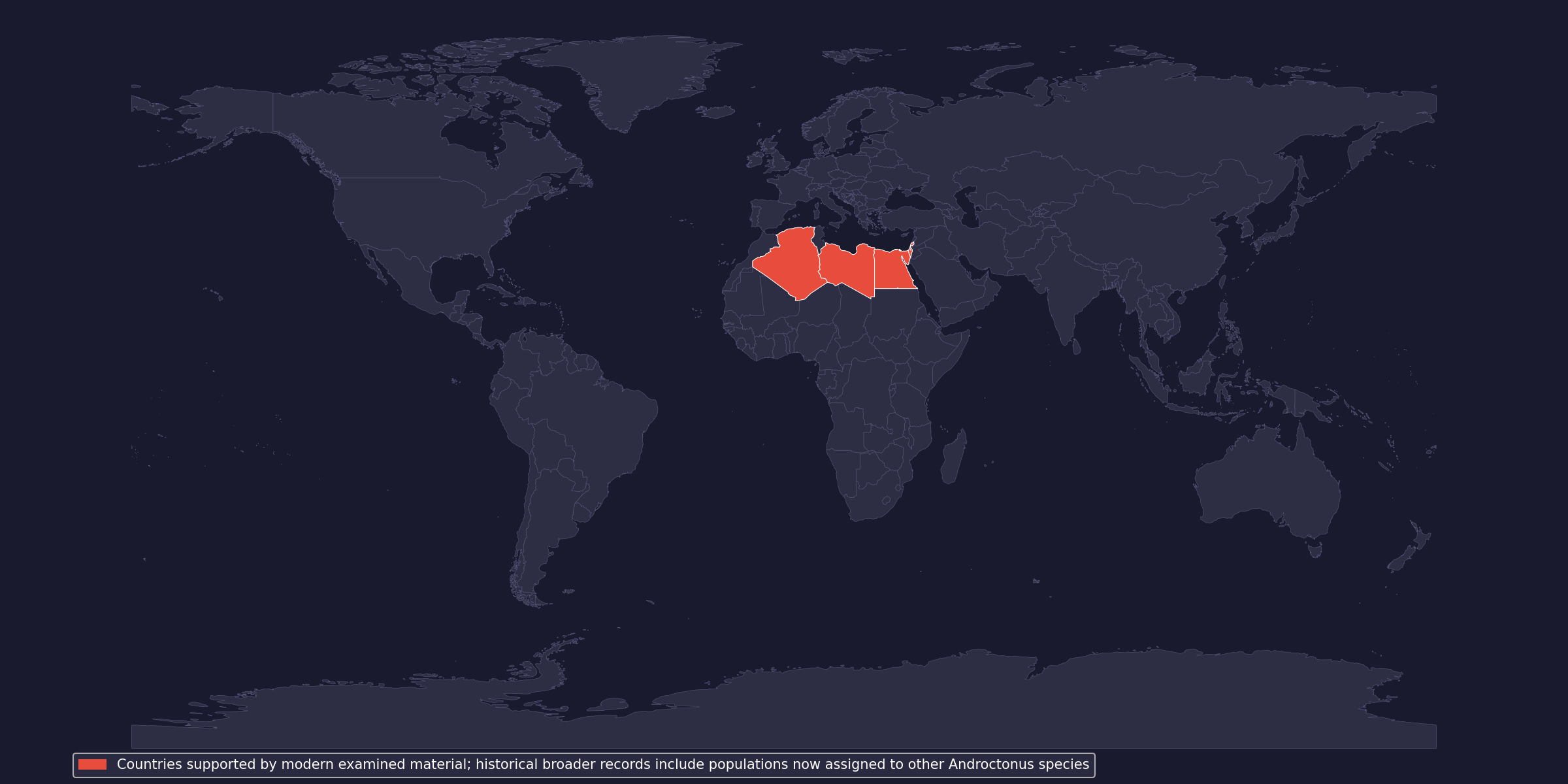
Androctonus bicolor is the accepted name. “Black fat-tail” is not a diagnosis: several Androctonus are dark, and recent redescriptions have separated populations formerly placed under a broad A. bicolor concept. The nominal species is anchored to Egypt; verified comparative material also exists from Algeria, Libya and Israel. Locality, adult morphology and source documentation must agree before the label is used.
📌 Description
Adults commonly measure 6–9 cm and are usually glossy black with relatively slender pedipalps and a powerful metasoma. They are fast, defensive and equipped with medically significant neurotoxic venom. Colour alone cannot distinguish them from A. crassicauda, A. aeneas or recently described regional relatives.
This is a lawful expert or professional display species only. Direct handling and tail holding are never acceptable. The enclosure must sit behind a second locked barrier, with emergency and escape procedures rehearsed before the animal arrives.
☠️ Venom
This species is venomous. Venom exposure can cause pain, swelling or other systemic effects, and severity varies with species, locality, bite site and the amount delivered. A small wound or apparently dry bite is not proof of safety; every bite or sting requires urgent medical assessment.
If an incident occurs, move away, call emergency services or a poison centre, keep the patient still, remove rings and other constricting items, and follow dispatcher instructions. Do not use a tourniquet, cut or suck the wound, apply ice or electricity, give alcohol or medicines as a home treatment, or attempt to catch the animal. Antivenom choice and dosing are hospital decisions; verify the relevant product and local availability in advance. Sources: WHO snakebite guidance and appropriate species-specific toxinology or medical references listed below.
🌍 Distribution
Modern examined material supports Egypt, Libya, Algeria and Israel, while older literature gives a much broader North African and Middle Eastern range that includes records now attributable to other taxa. The species uses arid plains, firm sandy-clay ground, stone refuges and building edges. Captive care should reproduce the sheltered gradient, not exposed desert surface heat.
⚖️ Legal status
Checked on 2026-08-29 against the official CITES Appendices and EU wildlife-trade annex framework: A. bicolor is not specifically listed. The Bern Convention is not relevant to its native range. Non-listing is not permission to possess a dangerously venomous animal.
National and local licensing, import, transport, tenancy, insurance and public-display requirements may prohibit or condition possession. Obtain written confirmation before acquisition. Retain the invoice, exact origin, exporter or breeder details, import documents and identification record; an unlocalised “black fat-tail” should not be traded as this species.
🤌 Husbandry
House one adult in a bolted or mechanically latched 30 × 30 × 25 cm primary enclosure inside a locked cabinet or dedicated escape-resistant room. Use fine metal vents, captive fasteners, tamper-evident closures and permanent species and count labels. Keep the interior simple enough to locate the animal without touching a refuge.
| Parameter | Conservative target |
|---|---|
| Adult enclosure | at least 30 × 30 × 25 cm |
| Day air | 26–31 °C |
| Warm area | 31–34 °C |
| Night | 19–23 °C |
| Relative humidity | 25–40%; one 40–55% deep premoult refuge |
| Substrate | at least 10 cm of packed sandy clay |
| Feeding | one suitable invertebrate every 10–14 days |
Quarantine for at least 90 days with dedicated tools. Imported specimens may be dehydrated, parasitized, gravid or wrongly identified. Record weight, feeding, moults and photographs without opening more than necessary.
Every transfer occurs in the locked room with the enclosure inside a large smooth-sided tub. Prepare two rigid locking catch cups. Coax the animal with a soft guide and long tools; never pin, grasp, tail-hold or work alone. Close the primary enclosure, inspect tools and tub, recount, then secure the outer barrier.
Post the scientific name, count, address, emergency and poison-centre contacts, responsible person and access route outside the secure area. A sting requires immediate emergency assessment. Keep the person still, remove constricting items and give clinicians the species and time; do not cut, suck, chill aggressively or use a tourniquet.
💡 Lighting
UVB is not required. Use diffuse light for a 10–12-hour photoperiod and full darkness at night. Mount every fixture outside both barriers. Direct sunlight and strong lamps can create a lethal hot spot in this compact enclosure.
🌡 Heating and temperature
Maintain 26–31 °C daytime air, a restricted 31–34 °C warm area and a 22–25 °C cool retreat. Nights may fall to 19–23 °C. Use an external side heater on a reliable thermostat and fixed digital probes.
Never heat under a burrowing scorpion. Measure at the warm surface and inside the cool refuge, and verify that the locked cabinet itself remains ventilated. Exposed desert temperatures are not enclosure targets.
💧 Humidity and water
Maintain 25–40% general humidity with strong airflow. Lightly moisten one deep corner to roughly 40–55% during premoult and for juveniles, then allow the surface to dry. Persistent dampness and condensation are inappropriate.
Provide a shallow stable water dish. Refill through a small protected service opening with a long pipette where possible. Mould, flies or a collapsing burrow indicate excessive water; incomplete moults may follow an entirely dry refuge.
🌿 Enclosure and decoration
Use at least 10 cm of packed sand, pesticide-free soil and clay that holds a shallow scrape. Seat flat stones or cork on the base before filling around them. Keep heavy decor stable and avoid hollow pieces that prevent a count.
Door seams and vents must retain juveniles. Test the empty enclosure, service it only inside the secondary tub and replace worn latches or mesh before they fail.
🪳 Feeding
Offer one appropriately sized captive-bred cricket, roach or locust every 10–14 days. Deliver prey with long tools through the smallest practical opening and remove it within 24 hours. Remove all prey before a moult or birth.
Routine supplement dust is unnecessary. Adjust frequency to abdomen condition and temperature. Wild insects and unsecured feeder containers introduce avoidable pesticide, parasite and escape risks.
🦂 Breeding and young
A. bicolor is viviparous; the young ride on the female until after their first moult. Captive breeding should plan for a substantial brood, approximately 20–40 secure juvenile units, rather than relying on an exact average.
Breeding medically important Androctonus belongs only in licensed, purpose-led programmes. Pair under continuous observation in a secure container, separate promptly and document locality. Do not disturb or feed a female carrying young.
🩺 Common problems
- Misidentification: black colour is shared by several Androctonus with revised ranges.
- Sting or escape: both activate the written emergency procedure immediately.
- Overheating: a dark enclosure and locked cabinet can accumulate heat rapidly.
- Excess moisture: constant dampness promotes mould and poor moults.
- Unsafe servicing: lifting decor before both exits are controlled creates an escape route.
📌 Conclusion
The Egyptian black fat-tailed scorpion is not defined by colour alone and cannot be managed safely by confidence or quick forceps work. Traceable identification, a dry measured gradient, redundant locked containment and immediate medical access are the minimum system. If any element is unavailable, the responsible decision is not to acquire it.
📚 Sources and further reading
- GBIF species backbone: Androctonus bicolor
- Redescription of A. bicolor and a related Tunisian species
- A related species from north-western Egypt and comparative A. bicolor material
- The Scorpion Files: Buthidae
- CITES Appendices
- EU wildlife trade