Share

Agabiformius lentus
🔤 Taxonomy
Agabiformius lentus (Budde-Lund, 1885) is accepted by the World List of Isopoda and GBIF. Its long synonymy includes Leptotrichus lentus, Agabiformius corcyraeus, and several names originally placed in Porcellio or Porcellionides. Adult male characters may be needed for confident identification.
📌 Description
Adults are only about 0.5-0.8 cm long; the British Myriapod and Isopod Group gives 6 mm as typical. The pale brown, highly arched body has weak tubercles and three indistinct darker stripes. It can resemble a juvenile Porcellio scaber.
The species is established in hobby cultures and heated glasshouses, but controlled species-specific husbandry trials were not located. The values below combine its thermophilic, litter-dwelling ecology with general Agabiformius and terrestrial-isopod practice.
🌍 Distribution
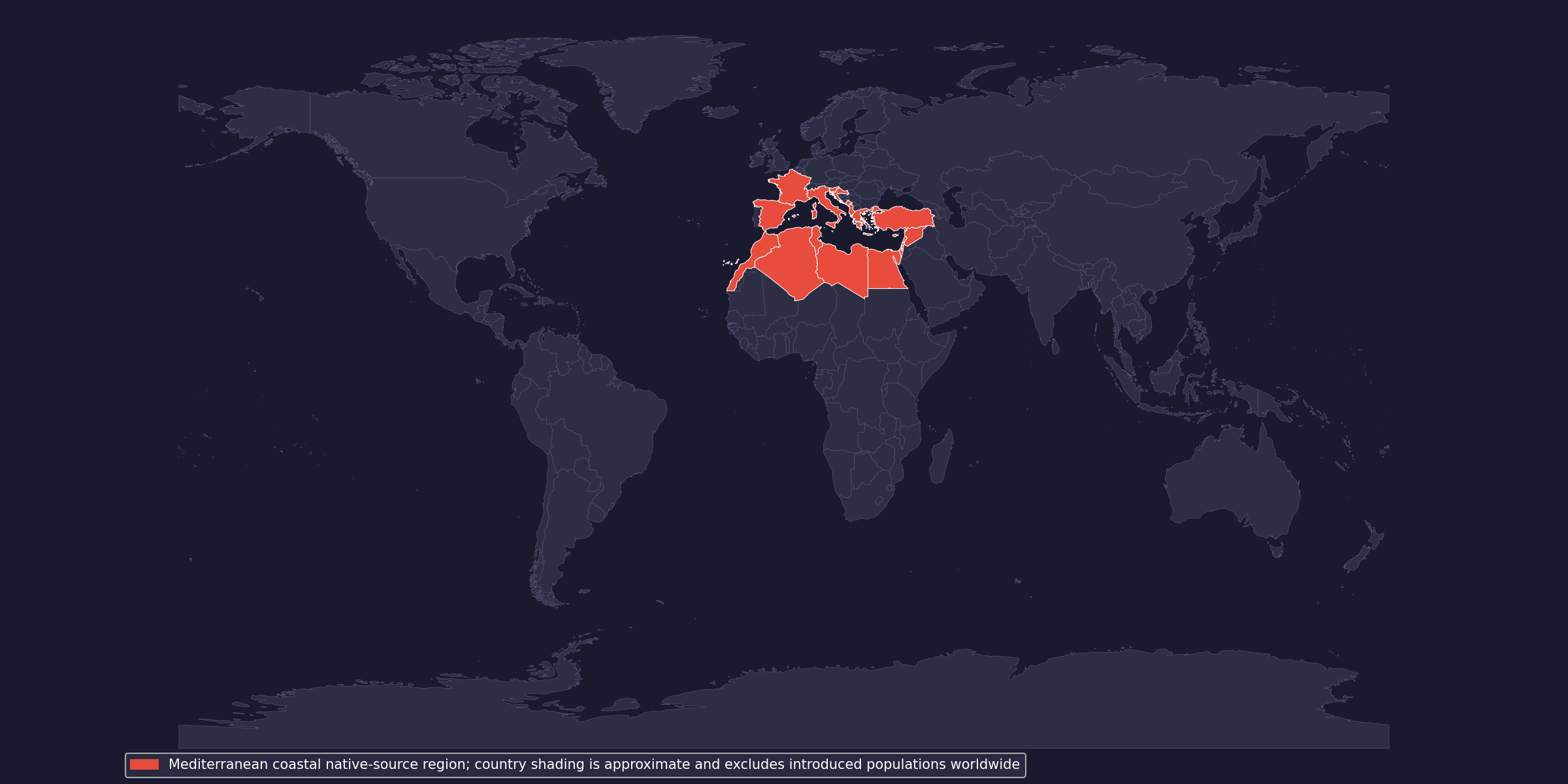
It originates from Mediterranean coasts and has been transported widely with plants and soil. Records now span glasshouses and outdoor sites on several continents. The map shows the broad native-source region, not every introduction, and country shading greatly overstates coastal occupancy.
⚖️ Legal status
Local and national rules may still apply.
Checked on 2026-08-29: A. lentus was not found in the CITES Appendices, EU wildlife-trade Annexes A-D under Regulation (EU) 2026/1383, or Bern Convention Appendices II-III. Plant-health, soil movement, invasive-species, protected-area, and import rules may still apply even when the animal is unnamed in those lists.
Buy captive stock, keep the source record, and sterilize discarded culture material. Never release a culture or place live substrate in garden waste: this species has a documented history of human-assisted spread.
🤌 Husbandry
Start a colony in at least 20 × 15 × 12 cm. Use very fine cross-ventilation and a tight lid. Keep about half the lower substrate damp, while leaves at the opposite end can dry between watering.
| Parameter | Conservative starting target |
|---|---|
| Adult length | 0.5-0.8 cm |
| Temperature | 20-27 °C |
| Moisture | damp lower layer plus ventilated drier leaf surface |
| Substrate | 5-6 cm leaf-rich soil and rotten hardwood |
| Staples | leaves, decayed wood, calcium |
| Evidence level | ecology-informed; few formal captive data |
Quarantine for 60 days and inspect cultures over a pale tray. Its size makes contamination, escape, and mistaken identity more important than enclosure volume.
💡 Lighting
UVB is not required. Provide 10-12 hours of diffuse light with deep shade. Keep tubs away from direct sunlight and lamps that can heat the lid.
🌡 Heating and temperature
Maintain 20-27 °C, with access to an 18-22 °C retreat. Glasshouse records support warmth, not constant extreme heat. Warm only one side wall with a thermostat if the room is cool; do not heat the base or allow prolonged temperatures above 29 °C.
💧 Humidity and water
Keep the bottom layer and a moss patch damp at one end. Preserve a drier surface and steady airflow elsewhere. An overall 60-80% RH trend is useful, but the condition under bark is the meaningful check.
Add water directly to the substrate rather than spraying the whole box. A dish is unnecessary. Condensation and sour odour indicate excess water; repeated moulting problems or aggregation on the wettest point indicate the refuge is too dry.
🌿 Enclosure and decoration
Use pesticide-free topsoil or leaf soil mixed with leaf mould, soft rotten hardwood, and a small mineral fraction. Cover it heavily with deciduous leaves and thin bark. Supply cuttlebone or calcium carbonate continuously.
Avoid pure coconut fibre, aromatic conifer products, fertilizer, and coarse mesh. Springtails help control fungal growth without competing for large food pieces.
🪳 Feeding
Maintain leaves and rotten hardwood as the main diet. Every four to seven days provide a very small amount of vegetable, mushroom, dried greens, or complete isopod food. Add a pinhead protein portion once weekly at most.
Remove damp remains after 24-48 hours. A mature edible substrate can support the colony during missed supplements; oversized rich meals can collapse it through mold and mites.
🥚 Breeding
Females retain eggs and embryos in a marsupium and release mancae, so the repository records the mode as viviparous. Hobby cultures are reported to reproduce, but robust species-level clutch, maturity, and lifespan values were not located.
Maintain stable warmth, moisture, calcium, and a mixed-age group. Divide only after juveniles of several sizes appear, transferring substrate as well as adults to preserve microbial food and hidden mancae.
🩺 Common problems
- No visible animals: examine the underside of leaves before assuming a crash.
- Failed moults: stabilize deep moisture and leave calcium permanently.
- Mold and mites: reduce supplementary food and improve cross-ventilation.
- Escapees: cover every vent with fine mesh and open over a tray.
- Mixed culture: quarantine arrivals and never rely on juvenile colour for identification.
📌 Conclusion
A. lentus is a useful but easily underestimated micro-isopod. Warmth, a genuine moisture gradient, edible litter, tiny portions, and containment make a better foundation than copying parameters from a larger cleanup-crew species.
📚 Sources and further reading
- World List of Isopoda: Agabiformius lentus
- GBIF species record: Agabiformius lentus
- British Myriapod and Isopod Group species account
- Schmalfuss (2003), synonymy and Mediterranean origin
- Séchet & Noël (2015), thermophilic French record
- ReptiFiles site check; general clean-up-crew reference
- Warburg (2012), marsupial development in terrestrial isopods
- CITES Appendices
- EU wildlife-trade Annexes: Regulation (EU) 2026/1383
- Bern Convention appendices