Share

Agabiformius excavatus
🔤 Taxonomy
Agabiformius excavatus Verhoeff, 1941 is currently accepted by the World List of Isopoda, WoRMS and GBIF. Schmalfuss’s world catalogue nevertheless considered it very probably identical to A. lentus. Keep the full source label and do not merge or relabel a culture without adult morphological or molecular evidence.
📌 Description
This is a small brown porcellionid that does not roll into a ball. Published captive measurements were not located; the 0.6-0.9 cm working range is a deliberately broad genus-level estimate, not a diagnostic character. A retail name or photograph is inadequate for separating it from A. lentus.
The species is advanced because almost every care value below is inferred from Mediterranean records, small-bodied Agabiformius ecology, and general terrestrial-isopod biology. Treat the enclosure as an observation trial and record changes one at a time.
🌍 Distribution
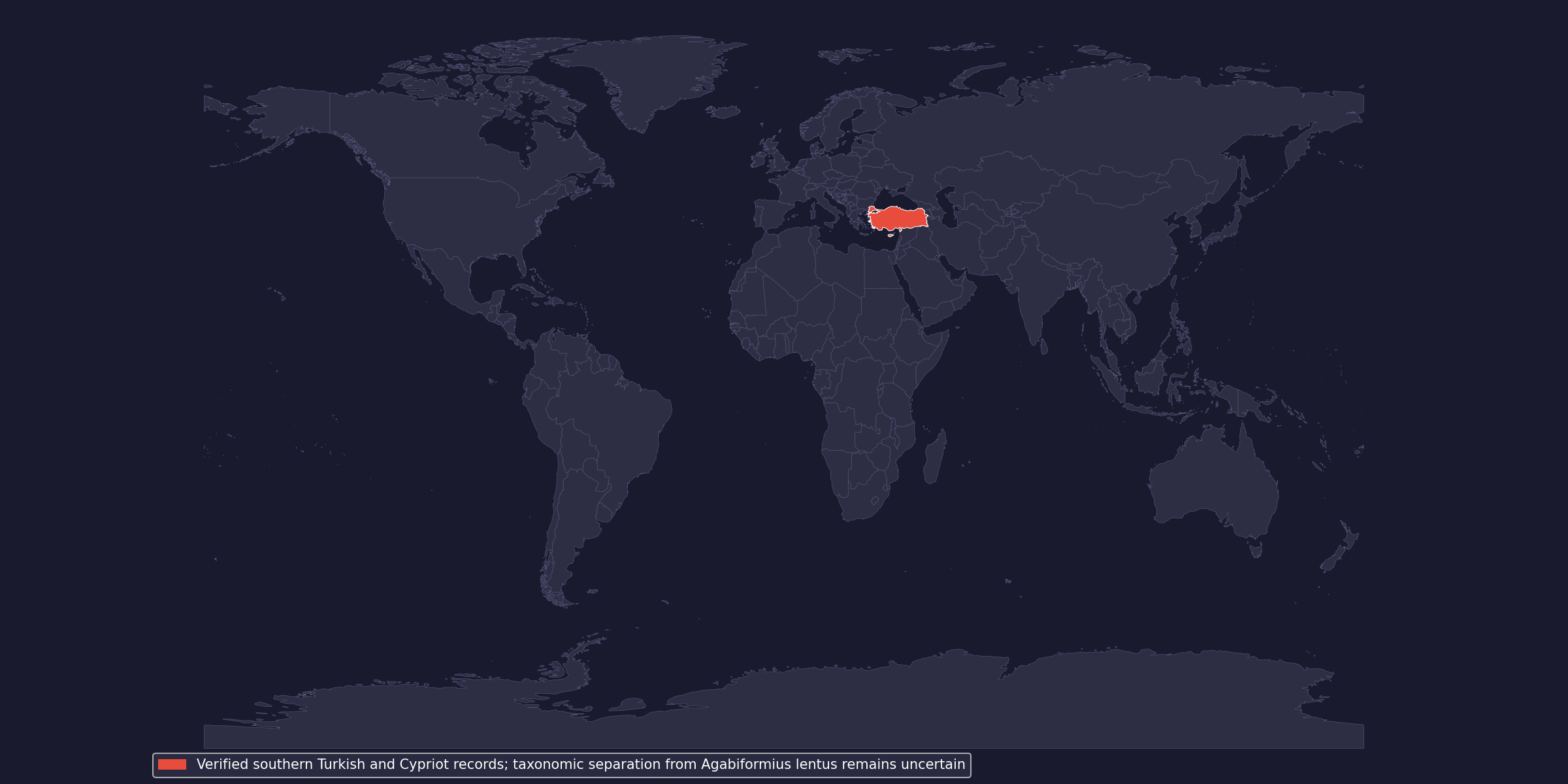
The original record is from Antalya in southern Turkey. Current World Isopoda data also record Cyprus, where molecular studies sampled it around Paphos. Country shading cannot show those small, discontinuous localities.
⚖️ Legal status
Checked on 2026-08-29: A. excavatus was not found in the CITES Appendices, EU wildlife-trade Annexes A-D under Regulation (EU) 2026/1383, or Bern Convention Appendices II-III. That does not override Turkish or Cypriot rules governing collecting, protected areas, soil transport, sale, or export.
Obtain documented captive stock, retain invoices and locality data, and never release animals or used substrate outdoors. Wild collection is scientifically damaging where the species boundary and range remain unresolved.
🤌 Husbandry
Start 15-30 animals in at least 20 × 15 × 12 cm with a close lid and fine cross-ventilation. Keep roughly one-third to one-half of the substrate damp while the opposite leaf surface can dry. Provide bark spanning the gradient.
| Parameter | Conservative starting target |
|---|---|
| Adult length | about 0.6-0.9 cm; genus-level estimate |
| Temperature | 18-26 °C |
| Moisture | stable damp refuge plus drier, ventilated surface |
| Substrate | 5-6 cm leaf-rich soil with rotten hardwood |
| Staples | deciduous leaves, rotten wood, calcium |
| Evidence level | no species-specific captive study located |
Quarantine for 60 days with separate tools. Fine mesh and a smooth upper wall are essential because juveniles are extremely small.
💡 Lighting
UVB is unnecessary. Use 10-12 hours of diffuse room light, deep shade under bark, and no direct sun. Transparent boxes can overheat within minutes.
🌡 Heating and temperature
Use 18-26 °C as a cautious working range, with access to 16-21 °C and cooler nights. If heat is necessary, warm one side wall under thermostat control; never heat the entire base. Slow activity during a cool spell is safer than sustained heat above 28 °C.
💧 Humidity and water
Maintain damp lower soil and a small moss refuge at one end, but preserve air exchange and a visibly drier surface elsewhere. The 55-75% RH field is only a monitoring guide; substrate condition matters more than room humidity.
Pour water into one corner instead of misting every surface. No water dish is needed. Condensation, sour smell, mass surface climbing, or a sudden decline after watering require immediate review of moisture and ventilation.
🌿 Enclosure and decoration
Use pesticide-free topsoil or leaf soil with deciduous leaf mould, crumbly rotten hardwood, and a little sand or fine mineral material. Add a thick leaf layer, thin cork, damp moss, and calcium carbonate or cuttlebone.
Avoid pure coconut fibre, aromatic conifer material, fertilizers, treated wood, and heavy stones that can shift. Inspect vents and lid seams over a white tray before every transfer.
🪳 Feeding
Leaves and soft rotten hardwood remain available continuously. Every four to seven days offer a pinhead portion of squash, carrot, mushroom, dried greens, or complete isopod food. Give only a tiny protein portion every 7-10 days.
Feed on a dry leaf or bark and remove wet remains within 24-48 hours. Overfeeding is a larger risk than shortage in a mature edible substrate.
🥚 Breeding
As a terrestrial isopod, the female retains eggs and embryos in a ventral marsupium and releases mancae; the repository records this as viviparous. Species-specific clutch size, maturity, seasonality, and generation time were not located.
Do not split a culture until several juvenile size classes are visible. Stable moisture, calcium, mature leaf substrate, and minimal disturbance are more defensible than attempting an unverified seasonal trigger.
🩺 Common problems
- Culture disappears: search within damp leaf layers before changing conditions; these animals are minute and cryptic.
- Failed moults: restore a permanent deep-moisture refuge and continuous calcium.
- Mold or mites: remove rich food, improve cross-ventilation, and add springtails.
- Escapees: reduce vent aperture and open the box only over a tray.
- Identity drift: preserve the original label and seek adult taxonomic examination.
📌 Conclusion
A. excavatus is best maintained as a documented research-style colony. A modest warm range, a true moisture gradient, edible substrate, escape control, and honest uncertainty are safer than precise care claims unsupported by species-level trials.
📚 Sources and further reading
- World List of Isopoda: Agabiformius excavatus
- GBIF species record: Agabiformius excavatus
- Schmalfuss (2003), catalogue, Antalya record and taxonomic remark
- Dimitriou et al. (2019), Cyprus molecular sample
- ReptiFiles site check; general clean-up-crew reference
- Warburg (2012), marsupial development in terrestrial isopods
- CITES Appendices
- EU wildlife-trade Annexes: Regulation (EU) 2026/1383
- Bern Convention appendices