Share

Bangui Afrostylopyga Cockroach
🔤 Taxonomy
“Afrostylopyga sp. ‘Bangui’” is a culture label, not a formally described species name. GBIF currently recognizes the genus Afrostylopyga Anisyutkin, 2014; its described type species is A. angolensis. Reports from the hobby indicate that the Bangui stock does not match that species, but no published determination was found. The culture must therefore remain at genus level.
Labels such as “Bangui” and the more detailed “Gbazabangui, Bangui, Central African Republic” preserve claimed provenance. They must follow every transfer and must not be shortened into A. angolensis without examination and a published taxonomic basis.
📌 Description
This is a small, dark brown to nearly black, functionally wingless blattid. Captive reports describe adults around 1.5-2 cm with tiny lateral wing pads in both sexes. All stages climb smooth surfaces, and newborns pass through ventilation intended for larger roaches.
Published biological data for this exact culture are absent. The values below are conservative working ranges derived from the documented culture label, the morphology of Afrostylopyga, and transparent specialist observations. Keep records and change one variable at a time rather than treating estimates as species limits.
🌍 Distribution
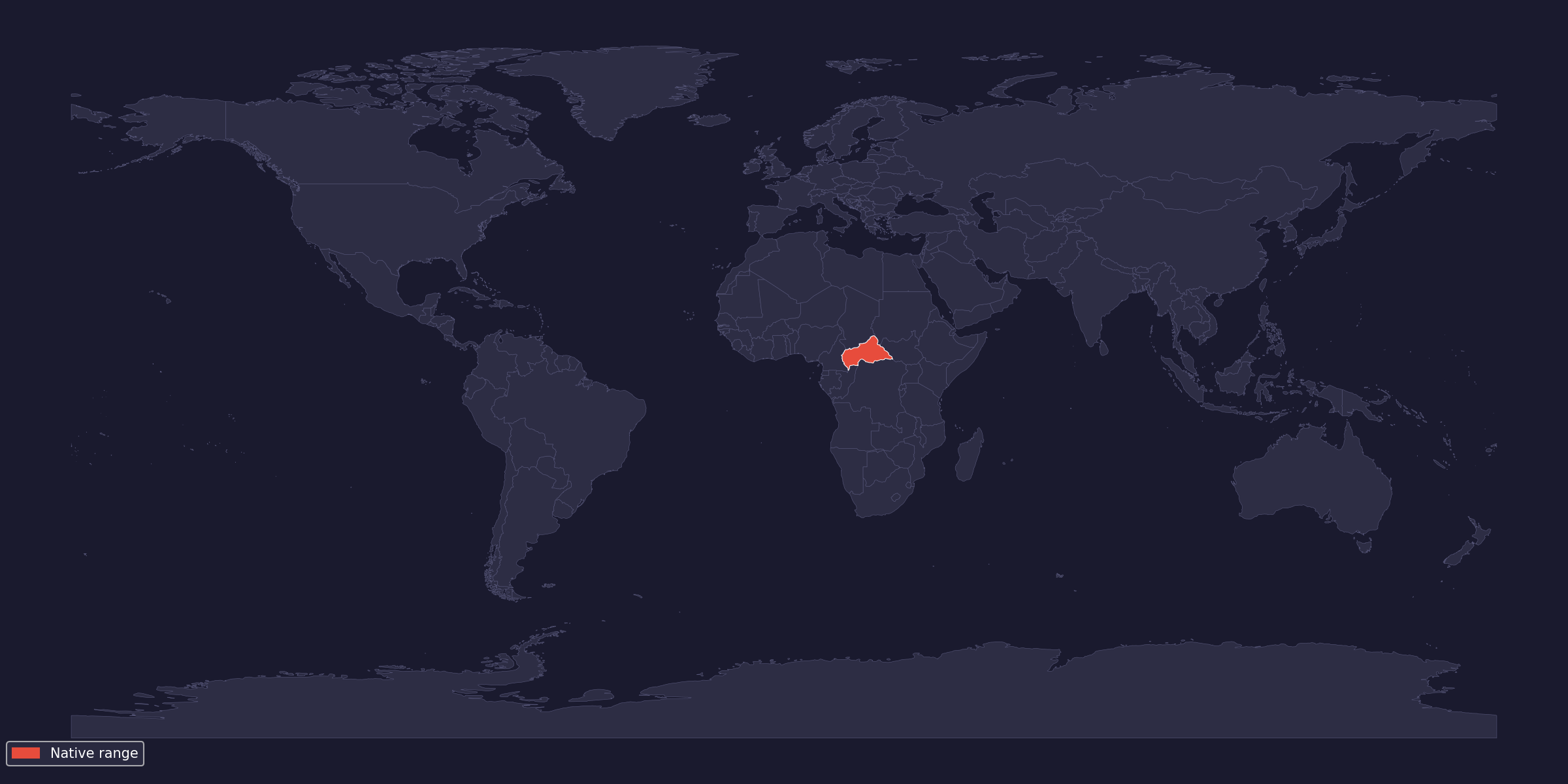
The culture label points to Gbazabangui in Bangui, Central African Republic. It is not a verified description of the wild range, and the stock’s exact species identity has not been published. The map highlights only the claimed country of origin; it does not imply that the genus or culture occurs throughout it.
⚖️ Legal status
Local and national rules may still apply.
Checked on 2026-08-22: neither Afrostylopyga nor the “Bangui” culture was found in the current CITES Appendices or EU wildlife-trade Annexes A-D. The Bern Convention is not relevant to a Central African culture. Genus-level identity can nevertheless complicate import declarations, and plant-health or live-invertebrate rules may be stricter than wildlife-trade law.
Keep the original seller label, invoice, breeder contact, dates, and transfer history. Ask the importing authority which scientific-name format it accepts before shipment. Never release stock, oothecae, substrate, or cleanup organisms outdoors.
🤌 Husbandry
Use a gasketed 20 × 20 × 20 cm container for a starter group. Seal vents with very fine stainless mesh, avoid sliding-lid tracks, and open the box only inside a large smooth-sided catch tub. A larger enclosure is useful only if every seam remains nymph-proof.
| Parameter | Conservative working range |
|---|---|
| Reported adult size | about 1.5-2 cm |
| Day air | 24-28 °C |
| Night | 20-24 °C |
| Moisture | half the substrate lightly moist, half nearly dry |
| Substrate | 3-5 cm leaf-rich soil/coir |
| Feeding | tiny dry staple; fresh food 2-3 times weekly |
Quarantine for at least 90 days because mislabeling and hitchhiking mites or roaches are plausible. Photograph adults dorsally and ventrally, record measurements, and never combine locality lines. Direct handling is inappropriate: use bark pieces and small cups to move animals.
💡 Lighting
UVB is not required. Use subdued room light on a 10-12-hour cycle and keep hides dark. Direct sun and display lamps can overheat this small volume quickly. Red observation light after dusk causes less disturbance.
🌡 Heating and temperature
Start at 24-28 °C, with a small cooler area around 21-24 °C and a maximum warm edge of 28-30 °C. Published thermal limits for the culture do not exist. If reproduction stalls, verify food, age, ventilation, and moisture before increasing heat.
Heat one side externally through a thermostat. Never heat the whole floor, and measure inside the container: small boxes can be several degrees warmer than the room or heating shelf.
💧 Humidity and water
Maintain a 50:50 moisture gradient. One half should hold moisture below the leaf litter; the other should be allowed to approach dry at the surface. This gives molting nymphs humid shelter without turning the entire culture anaerobic.
Supply moisture through vegetables and a minute shallow water source filled with fine gravel or polymer-free sponge. Good cross-ventilation is essential. Condensation on all walls, fermenting odor, and dense mites mean the culture is too wet or overfed.
🌿 Enclosure and decoration
Provide 3-5 cm of pesticide-free soil/coir mixed with crushed hardwood leaves, plus thin bark flakes and rotten hardwood. Small pieces create more usable crevices than one heavy slab. Bake or freeze collected material according to local biosecurity practice and ensure it is free of pesticides.
Avoid deep water dishes, coarse vent holes, glued mesh with loose edges, and mixed-species bioactive displays. Springtails can help with mold, but introduce only a known culture and watch that their numbers do not obscure tiny oothecae or hatchlings.
🪳 Feeding
Offer finely ground roach diet, oats, or a grain-legume staple in a dry cap. Add very small pieces of squash, carrot, apple, leafy greens, or mushroom two or three times weekly. Leaf litter and rotten hardwood should remain available as detrital foods.
Remove fresh food within a day and reduce portion size until little remains. A protein food such as fish flakes can be offered sparingly; heavy protein feeding is neither documented nor necessary and rapidly degrades a humid microculture.
🥚 Breeding
The culture is treated as oviparous because it belongs to Blattidae and is reported as producing oothecae, but exact clutch and development data have not been published. Leave deposited oothecae in the moist-side litter unless mold threatens. A working incubation range is 24-28 °C; do not discard an intact ootheca before 120 days.
The structured estimate of 8-20 eggs and 45-120 days is deliberately broad and must not be cited as formal species biology. Maintain at least two independent groups, avoid selecting only the fastest breeders, and exchange stock with recorded line provenance to limit inbreeding.
🩺 Common problems
- Culture crash: first check overheating, a dried moist zone, spoiled food, and pesticide exposure.
- Failed molts: increase local moisture and textured retreats, not whole-box saturation.
- Missing hatchlings: inspect mesh, lid tracks, and feeding caps; newborns are exceptionally easy to overlook.
- Mites or mold: remove excess food, increase airflow, and replace only the fouled portion of substrate.
- Identity drift: never merge this stock with A. angolensis or another unnamed African blattid.
📌 Conclusion
This culture belongs with experienced keepers who value provenance as much as appearance. A nymph-proof box, stable moisture gradient, duplicate colonies, and exact labels must be ready first. The greatest risk is not difficult feeding but losing an undocumented lineage through escape, mixing, or an unjustified species name.
📚 Sources and further reading
- GBIF genus record: Afrostylopyga
- Anisyutkin (2014), original description of Afrostylopyga and A. angolensis
- Specialist culture account for Afrostylopyga sp. “Gbazabangui, Bangui”
- CITES Appendices
- EU wildlife-trade Annexes, Regulation (EU) 2023/966
- Bern Convention documents and appendices