Share

Giant Leaf-tailed Gecko
🔤 Taxonomy
Uroplatus fimbriatus is the currently accepted scientific name in GBIF-backed taxonomy. Trade listings may use the broader label Uroplatus spp. because the whole genus is regulated under CITES.
English common names used in the hobby:
- Giant leaf-tailed gecko
- Common flat-tail gecko
- Common leaf-tailed gecko
German common names used in the hobby:
- Plattschwanzgecko
- Riesen-Blattschwanzgecko
📌 Description
This is one of the large bark-mimicking Uroplatus geckos. It needs height, thick trunks, calm nights, and careful humidity control; it is impressive to observe but unsuitable for routine handling. Adults can reach 25-33 cm total length. Their size makes enclosure stability easier than with very small leaf-tails, but the animal still dehydrates and overheats more easily than many common pet geckos.
🌍 Distribution
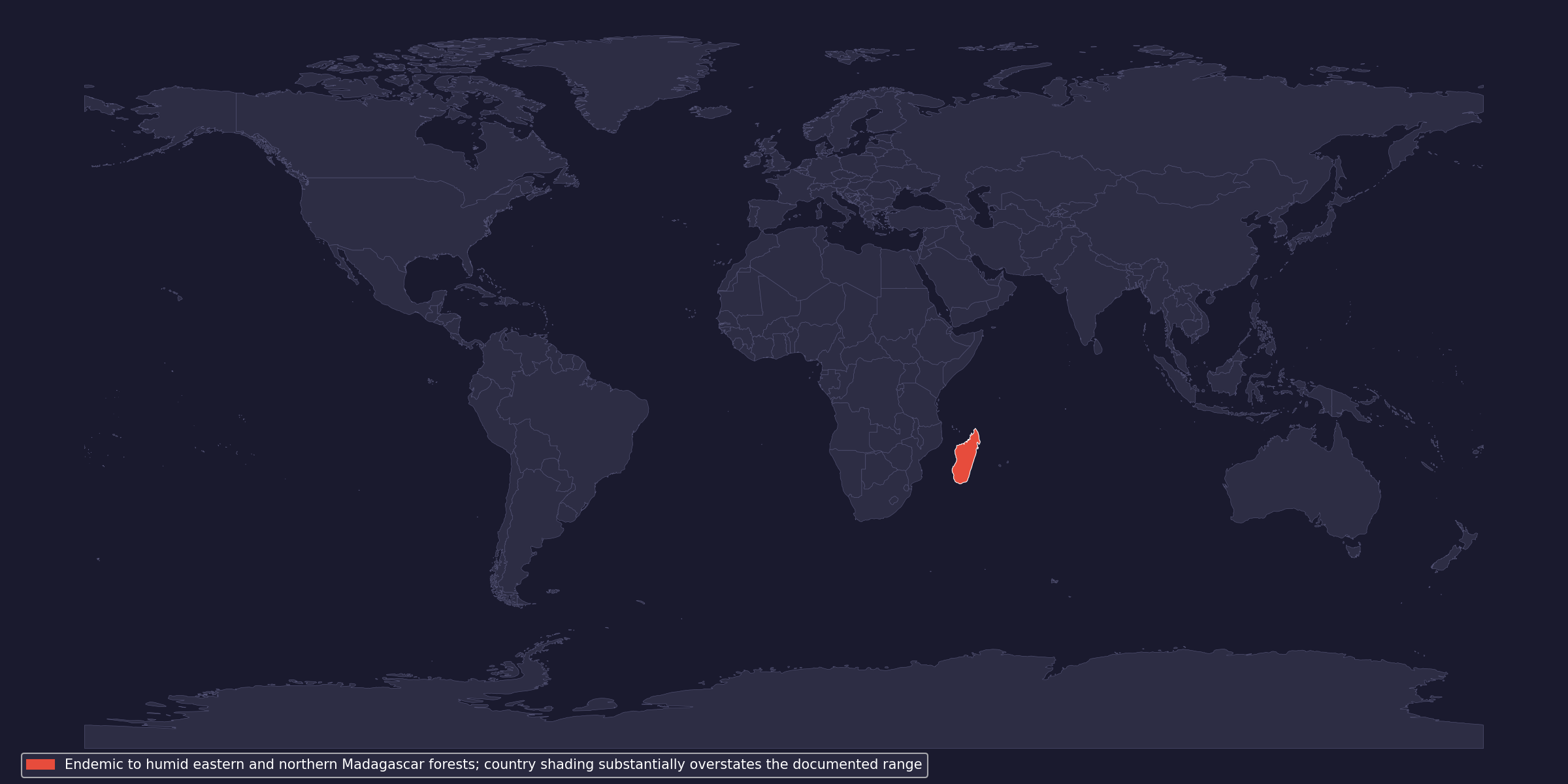
Uroplatus fimbriatus is endemic to Madagascar and is associated mainly with humid eastern and northern forests, including coastal islands such as Nosy Mangabe. Its range is broad on a country map but still tied to forest structure.
⚖️ Legal status
All Uroplatus species are listed by CITES in Appendix II, and the EU implements the listing as Annex B. International movement requires the correct CITES export paperwork and, for EU import, the relevant EU import process; within-EU transfers should retain invoice, breeder, source-code, and import-or-origin documentation. Madagascar-origin animals deserve extra scrutiny: check that the export year, quota, source code, and seller paperwork match each other, and avoid undocumented wild-caught animals.
No Bern Convention listing was found for this Madagascar endemic. Local keeping, transport, sale, and breeding rules can still apply, especially for Annex B documentation and animal-welfare standards.
🤌 Husbandry
- Minimum adult enclosure: 90 x 45 x 90 cm, taller is better when ventilation remains stable
- Day gradient: 22-27 °C with only a small 28-30 °C basking area
- Night drop: 20-22 °C; sustained warm nights are a common failure point
- Humidity: 60-85% with misting peaks and daily drying airflow
- Housing: solitary by default; pair housing only for planned breeding and close monitoring
Quarantine every new animal for at least 60-90 days in a simple planted or semi-natural setup with separate tools. Record weight, feeding, droppings, hydration, and sheds; imported or thin animals should have veterinary parasite screening before joining a collection.
💡 Lighting
- Use a visible day-night cycle and low-output UVB, roughly Ferguson Zone 1, across a shaded part of the canopy.
- Provide plant-safe LED lighting separately from heat so the enclosure can stay bright without becoming hot.
- Photoperiod of 11-13 hours works well; avoid colored night bulbs and bright after-dark viewing lights.
🌡 Heating and temperature
Basking spot: 28-30 °C
Warm zone: 24-27 °C
Cool zone: 22-24 °C
Night: 20-22 °C
Use a thermostat-controlled low-wattage heat source only if the room cannot hold the range.
Measure surfaces and shaded air; these geckos can die from heat stress before they show obvious distress.
Avoid heat rocks, unguarded lamps, and placing the enclosure in direct sun.
💧 Humidity and water
- Keep baseline humidity around 60-85%, with higher peaks after misting and visible drying by day.
- Mist after lights-out so the gecko can drink from leaves and glass; provide a small clean water dish as backup.
- Ventilation matters as much as moisture. Stale wet air causes skin, eye, and respiratory problems.
🌿 Enclosure and decoration
- Use a secure glass or hybrid vivarium with cross-ventilation and fine escape-proof gaps.
- Build vertical cover with cork tubes, branches, bark slabs, live or sturdy artificial plants, and leaf litter.
- Use a drainage layer and 6-10 cm of organic soil/coco/fine bark mix that holds moisture without becoming sour.
- Avoid screen-only cages for the smaller species, sharp decor, sticky tape, resin-heavy woods, and constantly saturated substrate.
🪳 Feeding
- Feed at night with appropriately sized crickets, roaches, locusts, silkworms, and moths when available.
- Juveniles can eat smaller meals most nights; adults usually do well every 2-3 days, adjusted by body condition.
- Use prey no wider than the gecko’s head for the small species and safely swallowable prey for the large species.
- Gut-load feeders and dust lightly with calcium; use multivitamin and D3 sparingly according to UVB strength and product label.
- Avoid wild-caught insects, oversized hard prey, uneaten crickets left overnight, and fruit diets as a staple.
🩺 Common problems
- Dehydration → sunken eyes, wrinkled skin, weak grip, poor shedding
- Heat stress → open-mouth breathing, panic movement, collapse, sudden death risk
- Dysecdysis → retained shed on toes, eyes, or tail from poor humidity rhythm
- Respiratory disease → stale wet air, chilling, or dirty substrate
- Parasites and wasting → common concern in imported or poorly quarantined animals
- Egg binding → females kept too warm, too thin, calcium-deficient, or without safe laying cover
Consult a reptile-experienced veterinarian for severe weakness, injury, swelling, breathing signs, repeated regurgitation, or prolonged refusal to eat.
📌 Conclusion
Keep Uroplatus fimbriatus only when you can provide a cool, humid, well-ventilated forest enclosure before purchase and can prove legal origin afterward. Captive-bred animals with traceable paperwork are the responsible choice; undocumented Madagascar-origin imports are a conservation and legal risk.
📚 Sources and further reading
- GBIF species match API / GBIF species match API
- CITES Appendices and CITES export quotas
- EU Wildlife Trade Regulations, Commission Regulation (EU) 2026/1383
- Council of Europe Bern Convention appendices
- ReptiFiles Uroplatus care guide
- Ratsoavina et al. 2013, Salamandra 49(3):115-148, overview of Madagascar leaf-tailed geckos