Share

Tokay Gecko
🔤 Taxonomy
Gekko gecko is the currently accepted scientific name. In the hobby and in trade, the species is usually sold under the same name or under its common-name equivalents.
English common names used in the hobby:
- Tokay gecko
German common names used in the hobby:
- Tokeh
- Tokee
📌 Description
The tokay gecko (Gekko gecko) is a large, nocturnal, arboreal gecko from South and Southeast Asia. It is famous for its loud call, bright blue-gray body with orange or red spots, strong jaws, and bold defensive behavior.
Adults usually reach 25-30 cm, and large individuals can be longer. Tokays have adhesive toe pads, lidless eyes, strong claws, and a muscular body built for climbing tree trunks, walls, branches, and rock faces. With good care, they can live 15-20 years.
This is not a soft beginner gecko. Many tokays are defensive, territorial, and quick to bite if grabbed. That does not make them “mean”; it means they are powerful display animals that need space, cover, patient routine, and respect.
🌍 Distribution
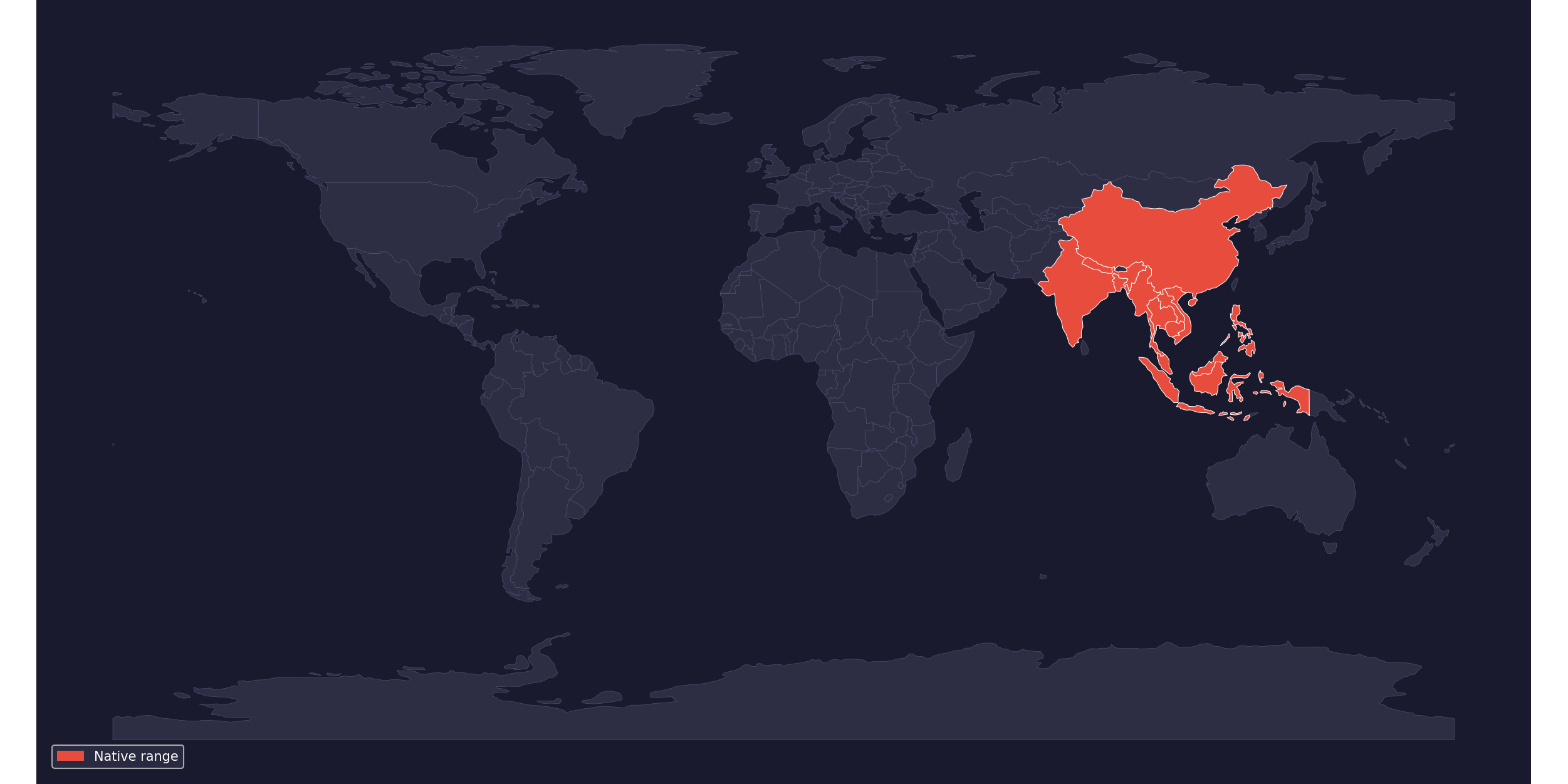
Tokay geckos are widespread across parts of India, Bangladesh, Nepal, southern China, mainland Southeast Asia, Indonesia, the Philippines, and nearby regions. They have also become established outside their native range in some places, including parts of Florida and several tropical islands.
They live in tropical forests, forest edges, limestone areas, plantations, villages, and buildings where insects are abundant. In the wild they spend most of their time above the ground, hiding in crevices by day and hunting at night.
Important habitat features include:
- Vertical structure and high retreats
- Warm, humid nights
- Bark, walls, rock cracks, and tree hollows
- Dense cover and shaded resting sites
- Abundant insects
In captivity, the enclosure must be tall, warm, humid, and full of climbing routes. A tokay kept in a small bare tank will usually become more stressed and more defensive.
🌡 Climate across the native range
Monthly climate normals from reviewed GBIF occurrence locations:
Trang — Thailand
| Month | Min °C | Mean °C | Max °C | RH % |
|---|---|---|---|---|
| January | 22.9 | 26 | 30.1 | 78 |
| February | 23.2 | 26.9 | 31.9 | 73 |
| March | 23.8 | 27.6 | 32.7 | 75 |
| April | 24.5 | 27.5 | 31.9 | 81 |
| May | 24.6 | 27 | 30.5 | 86 |
| June | 24.4 | 26.7 | 29.8 | 87 |
| July | 24.2 | 26.4 | 29.4 | 87 |
| August | 24 | 26.2 | 29.2 | 87 |
| September | 23.8 | 25.8 | 28.9 | 89 |
| October | 23.5 | 25.5 | 28.7 | 90 |
| November | 23.4 | 25.5 | 28.7 | 88 |
| December | 23 | 25.4 | 28.8 | 84 |
Siemréab — Cambodia
| Month | Min °C | Mean °C | Max °C | RH % |
|---|---|---|---|---|
| January | 21.5 | 26.3 | 31.2 | 61 |
| February | 23.2 | 27.9 | 32.8 | 60 |
| March | 25.1 | 29.4 | 34 | 64 |
| April | 25.9 | 29.8 | 34.1 | 70 |
| May | 25.9 | 29.1 | 33 | 77 |
| June | 25.6 | 28.3 | 32 | 79 |
| July | 25.2 | 27.8 | 31.3 | 80 |
| August | 25 | 27.4 | 31 | 82 |
| September | 24.4 | 26.8 | 30.3 | 86 |
| October | 23.6 | 26.4 | 30 | 85 |
| November | 22.6 | 26.2 | 30.1 | 76 |
| December | 21.2 | 25.6 | 30.1 | 66 |
Đồng Nai — Viet Nam
| Month | Min °C | Mean °C | Max °C | RH % |
|---|---|---|---|---|
| January | 19.5 | 25.1 | 31.1 | 71 |
| February | 20.5 | 26.4 | 33.1 | 65 |
| March | 22.1 | 27.4 | 33.9 | 68 |
| April | 23.4 | 27.7 | 33.3 | 75 |
| May | 23.7 | 26.9 | 31.6 | 83 |
| June | 23.3 | 25.7 | 29.6 | 89 |
| July | 22.9 | 25.2 | 29 | 90 |
| August | 22.9 | 25.2 | 29 | 91 |
| September | 22.6 | 25 | 28.7 | 91 |
| October | 21.8 | 24.8 | 28.9 | 90 |
| November | 20.8 | 24.7 | 29.5 | 86 |
| December | 19.9 | 24.5 | 29.7 | 79 |
Weather data by Open-Meteo.com · CC BY 4.0 · Monthly normals calculated by Herpeton Academy from daily archive values.
Location references use GBIF.org occurrence data where available; original occurrence records retain their source dataset licenses.
⚖️ Legal status
Gekko gecko is listed in CITES Appendix II. This means international trade is controlled and normally requires the correct CITES export, re-export, or import documentation depending on the country and movement involved.
In the European Union, CITES Appendix II reptile species are generally treated under the EU wildlife trade framework, commonly as Annex B unless a stricter listing applies. Keep proof of legal origin, especially for sale, transport, import, export, or breeding records.
Tokays are also invasive or non-native in some regions, so local ownership and release rules can be strict. Never release a captive tokay. Buy captive-bred animals whenever possible; wild-caught tokays are more likely to carry parasites, arrive stressed, and contribute to damaging trade pressure.
The Bern Convention is not usually relevant unless a species is native to Europe or covered by local conservation rules; check current national guidance for the country where the animal is kept.
🤌 Husbandry
An adult tokay gecko needs a vertical enclosure. A practical minimum for one adult is about 60 × 60 × 120 cm, and large adults benefit from 90 × 60 × 120 cm or larger.
The enclosure should have:
- Vertical cork tubes, bark slabs, branches, and vines
- Dense foliage at several heights
- Warm basking branches near the top
- Cooler shaded areas lower down
- Several tight retreats, not only one hide
- A water bowl placed on a ledge or secure shelf
- Strong ventilation with high humidity
Tokays should normally be kept singly. Males fight, and pairs can injure each other or create chronic stress. Only experienced keepers should attempt breeding groups, and only with a plan to separate animals quickly.
💡 Lighting
Tokay geckos are nocturnal, but they still need a clear day-night cycle. Provide about 12 hours of daylight. Brightness should be strongest near the top and broken by shade and foliage.
Low to moderate UVB can be beneficial when installed correctly. The animal must be able to move away from the UVB into shade, and the basking branch should be placed at a safe distance from the lamp. A target around low UVI at the upper basking zone is appropriate for a shaded nocturnal gecko.
If UVB is not used, supplementation must provide vitamin D3 carefully. If UVB is used, adjust supplements so D3 is not excessive.
For UV planning, treat this species as Ferguson Zone 1. Aim for about UVI 0.5-1.0 in the upper exposed area, while leaving retreats and a gradient down to shaded areas near zero UVI. This usually points to a low-output UVB tube such as a ShadeDweller-style or 2-7% T5, chosen for the enclosure height; measure with a Solarmeter 6.5 when possible, because reflector, mesh, distance, and lamp age change the real exposure.
🌡 Heating and temperature and temperature
Heat should come from above, using a halogen basking lamp or other safe overhead heat source controlled by a thermostat or dimmer. The warmest area should be high in the enclosure, with cooler areas toward the lower and shaded parts.
Recommended ranges:
- Basking branch: 32-38°C
- Warm upper area: about 29-32°C
- Cooler lower area: 26-29°C
- Night: 24-26°C
Cold nights are not suitable for this tropical species. If the room drops too low, use a lightless heat source such as a ceramic heat emitter or radiant heat panel controlled by a thermostat.
Measure the basking branch with a probe or infrared thermometer, and measure ambient temperatures at both upper and lower levels. Protect all lamps so the gecko cannot burn itself.
💧 Humidity and water and water
Tokay geckos need a humid but ventilated enclosure. A good target is 60-80% humidity, with natural rises at night and lower humidity near the warm basking area during the day.
Mist the enclosure in the evening and again in the morning if needed. Automated misting can help, but it must not leave the enclosure wet and stagnant all day. Good ventilation is just as important as moisture.
Tokays often drink droplets from leaves, glass, and branches, but a clean water bowl should still be available. Dehydration can lead to poor shedding, sunken eyes, lethargy, and appetite loss.
🌿 Enclosure and decoration
Tokays use height. The enclosure should let the gecko move from warm to cool, exposed to hidden, and dry to humid without going to the floor.
Good decoration includes:
- Cork tubes and bark flats
- Thick branches and vines
- Live or artificial tropical plants
- Magnetic ledges or feeding platforms
- Background texture for climbing
- Leaf litter and moisture-holding substrate
Use a tropical or forest-style substrate such as organic topsoil mixed with coconut fiber, or a prepared tropical reptile substrate. A bioactive setup can work well if ventilation, drainage, and clean-up crew are established.
Avoid small loose decorations that can fall, sharp edges, and unstable branches. Tokays are strong, and heavy decor must be secured.
🪳 Feeding
Tokay geckos are primarily insectivores. In captivity, insects should form the normal diet.
Suitable feeders include:
- Crickets
- Dubia or discoid roaches
- Red runner roaches
- Locusts
- Silkworms
- Hornworms
- Black soldier fly larvae
Juveniles usually eat daily or almost daily. Adults often do well with feeding every other day or several times per week, adjusted to body condition. Offer appropriately sized prey no larger than the gecko’s head.
Gut-load feeders before feeding and dust them with calcium and multivitamins according to the lighting setup. Occasional gecko diet or vertebrate treats are sometimes used by keepers, but they should not replace a varied insect diet and can easily lead to obesity or husbandry shortcuts.
🥚 Breeding
Breeding tokays should be left to keepers who can manage aggression, CITES paperwork, egg care, and offspring placement. A breeding pair may still need separation if the male harasses the female or if either animal is injured.
Mature males are usually larger, with a broader head, visible hemipenal bulges at the tail base, and more pronounced preanal or femoral pores. Females are usually smaller, lack strong bulges, and have much less obvious pores. Juvenile sexing is unreliable.
Sexual maturity is often reached around 12-18 months, but females should not be bred until they are fully grown, strongly feeding, and in excellent condition. Tokays lay hard-shelled eggs that are often glued to bark, glass, or other surfaces; removing them can break them.
Plan incubation, hatchling enclosures, tiny feeder insects, records, and legal documentation before allowing breeding. Do not let a pair produce repeated clutches without recovery time for the female.
🩺 Common problems
Common problems usually come from small enclosures, dry air, poor ventilation, burns, stress, wild-caught parasites, and unsafe handling.
Watch for:
- Stuck shed on toes, tail, or eyes
- Dehydration or sunken eyes
- Nose rub from trying to escape
- Burns from unguarded lamps
- Weight loss or refusal to feed
- Loose or foul droppings
- Mouth wounds after biting hard objects
- Lethargy or staying on the floor
Check temperatures, humidity, ventilation, diet, and security first. A tokay that is losing weight, has mouth swelling, burns, chronic bad sheds, or abnormal droppings should see a reptile veterinarian.
📌 Conclusion
The tokay gecko is impressive, vocal, intelligent, and intense. It rewards keepers who enjoy natural behavior more than handling.
Give it height, heat, humidity, cover, clean water, varied insects, and patience. Treat it like a strong arboreal predator rather than a cuddly pet, and it can become one of the most striking reptiles in a collection.
📚 Sources and further reading
- CITES Appendices and Species+ trade database, checked April 2026
- EU wildlife trade regulations and annex references, checked April 2026
- GBIF species backbone and occurrence data for taxonomy and distribution context
- IUCN Red List and specialist husbandry references where applicable