Share

Northern Spiny-tailed Gecko
🔤 Taxonomy
Strophurus ciliaris is the accepted scientific name. Older literature often uses Diplodactylus ciliaris. The named forms S. c. ciliaris and S. c. aberrans appear in collections and older husbandry material, but research notes unresolved variation within the broad complex; retain locality data with captive lines.
English names include northern spiny-tailed gecko, spiny-tail, and eyelash gecko. The German name Australischer Stachelschwanzgecko is common in European collections.
📌 Description
This slender Australian gecko usually reaches 13-17 cm including the tail. Enlarged scales above the eyes and rows of spines along the tail give it a distinctive outline. Colour varies from grey and brown to warm orange tones, and the mouth lining can be brightly coloured.
When threatened, Strophurus can discharge a sticky, strong-smelling secretion from caudal glands. It is not venom, but contact with eyes or mucous membranes should be avoided. Frequent handling provokes escape, tail loss, biting, or spraying, so this is an observation animal.
🌍 Distribution
The species complex occupies a very broad arc across northern and inland Australia, from Western Australia through the Northern Territory into Queensland, New South Wales, and South Australia. Museum and Atlas records span tropical woodland, shrubland, arid scrub, spinifex country, and cooler inland plains.
Unlike the more ground-bound knob-tails, these geckos use exposed shrubs and small trees, hiding in bark fissures, hollows, and dense vegetation by day. The broad climate range argues for behavioural choice in the enclosure, not one uniformly warm and dry setting.
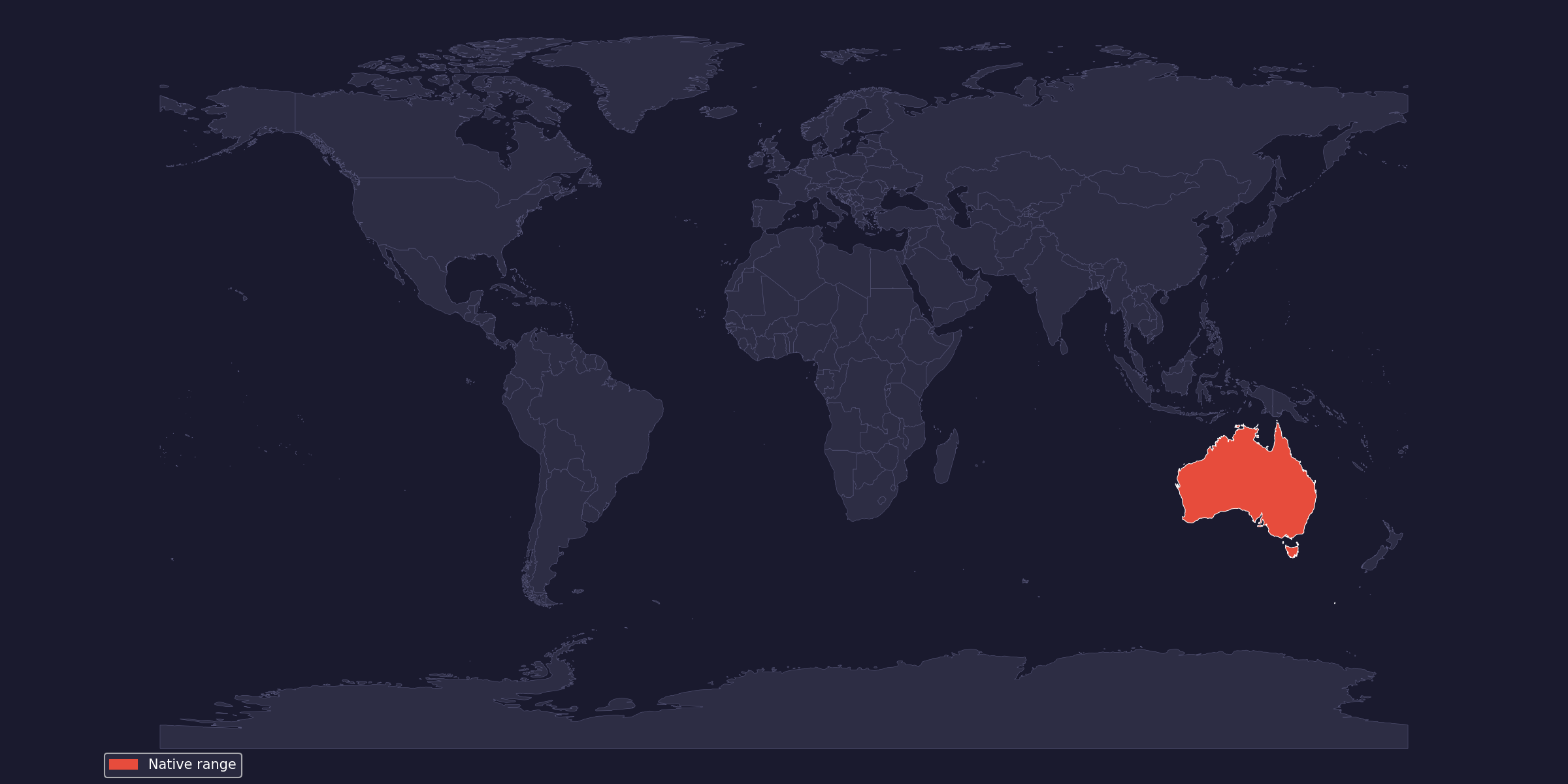
🌡 Climate across the native range
Monthly normals from reviewed occurrences spanning the tropical north, arid centre, and cooler southeastern part of this broad range:
Kakadu region — Northern Territory (reviewed S. ciliaris occurrence)
| Month | Min °C | Mean °C | Max °C | RH % |
|---|---|---|---|---|
| January | 24.8 | 27.6 | 31.9 | 82 |
| February | 24.6 | 27.4 | 31.7 | 83 |
| March | 24.2 | 27.7 | 32.4 | 78 |
| April | 23.4 | 28.1 | 33.5 | 65 |
| May | 21.9 | 27.3 | 33.1 | 53 |
| June | 19.7 | 25.6 | 31.8 | 48 |
| July | 18.7 | 25.3 | 32 | 45 |
| August | 19.1 | 26.3 | 33.4 | 44 |
| September | 21.6 | 28.7 | 36 | 50 |
| October | 23.8 | 30.1 | 37.1 | 55 |
| November | 25.2 | 30.1 | 36.1 | 64 |
| December | 25.2 | 28.6 | 33.5 | 77 |
Uluṟu region — Northern Territory (reviewed S. ciliaris occurrence)
| Month | Min °C | Mean °C | Max °C | RH % |
|---|---|---|---|---|
| January | 24.4 | 31.2 | 37.4 | 29 |
| February | 23.6 | 30.1 | 36.2 | 32 |
| March | 21 | 27.5 | 33.7 | 31 |
| April | 16.4 | 23 | 29.2 | 35 |
| May | 11.1 | 17.2 | 23.3 | 45 |
| June | 7.3 | 13.1 | 19.1 | 53 |
| July | 6.5 | 12.9 | 19.5 | 48 |
| August | 8.4 | 15.6 | 22.7 | 37 |
| September | 13.4 | 21 | 28.1 | 29 |
| October | 17.1 | 24.7 | 31.8 | 28 |
| November | 20.2 | 27.5 | 34.3 | 29 |
| December | 22.4 | 29.2 | 35.5 | 32 |
Thurloo Downs — New South Wales (verified S. ciliaris occurrence)
| Month | Min °C | Mean °C | Max °C | RH % |
|---|---|---|---|---|
| January | 24.7 | 30.9 | 36.7 | 33 |
| February | 23.5 | 29.4 | 35 | 38 |
| March | 20.4 | 26.4 | 32.1 | 38 |
| April | 16 | 21.9 | 27.5 | 41 |
| May | 11.3 | 16.5 | 21.9 | 54 |
| June | 8.4 | 13.1 | 18.2 | 63 |
| July | 7.3 | 12.4 | 17.9 | 58 |
| August | 8.6 | 14.6 | 20.5 | 47 |
| September | 12.6 | 19.1 | 25.2 | 38 |
| October | 16.2 | 23 | 29.1 | 34 |
| November | 19.8 | 26.2 | 32.2 | 33 |
| December | 22.6 | 29 | 34.8 | 30 |
Weather data by Open-Meteo.com · CC BY 4.0 · Monthly normals calculated by Herpeton Academy from daily archive values.
Location references use GBIF.org occurrence data where available; original occurrence records retain their source dataset licenses.
⚖️ Legal status
Checked on 2026-08-30: Strophurus ciliaris was not found in the current CITES Appendices or EU wildlife-trade Annexes. It is not native to Europe, so the Bern Convention is not relevant.
Australia regulates native reptile keeping and generally prohibits ordinary commercial export of live native wildlife. Licence classes differ between Australian jurisdictions. Outside Australia, buy documented captive-bred animals and retain invoices, breeder and locality details, photographs, and any transfer or import history.
🤌 Husbandry
Provide one adult with at least 45 x 45 x 60 cm, and use a larger enclosure for a particularly large animal. Fill it with fine branches and bark retreats while retaining an open feeding route and a measurable warm-to-cool gradient. Solitary housing prevents hidden competition and breeding exhaustion.
Quarantine for 60-90 days with paper substrate, washable perches, separate tools, and a secure elevated hide. Record weight, feeding, droppings, and sheds. Test abnormal faeces and investigate persistent weight loss or regurgitation with a reptile veterinarian. Use a catch cup or removable tube for transfers and wear eye protection if the animal is already displaying defensively.
| Parameter | Practical target |
|---|---|
| Adult enclosure | at least 45 x 45 x 60 cm |
| Warm perch | 31-33°C |
| Daytime air | 24-29°C |
| Cool zone | 21-24°C |
| Night | 18-22°C |
| Humidity | about 35-55%, temporarily higher after light misting |
| UVB | optional but recommended, UVI 1-2 on part of the upper route |
| Adult feeding | appropriately sized insects 2-3 times weekly |
💡 Lighting
Give 11 hours of daylight in winter and up to 13 in summer, adjusted gradually. Although most activity occurs after dusk, low UVB is recommended. Aim for UVI 1-2 on part of an upper exposed branch, with dense shade and dark bark hollows at every height.
Use a short linear lamp rather than a strong point source and check its output or replacement date. Moderate visible daylight helps create a clear rhythm; coloured or bright night lamps disturb normal nocturnal behaviour.
🌡 Heating and temperature
Provide a 31-33°C warm perch, daytime air of 24-29°C, a 21-24°C cool retreat, and nights around 18-22°C. A guarded overhead lamp on a dimming thermostat produces a natural surface gradient. Check perch temperature with an infrared thermometer and air at two heights with digital probes.
The species’ huge native range includes hot tropical nights and cold desert winters, but no single captive animal should be forced through those extremes. Cooling to 16-18°C is only for healthy adults in a planned breeding cycle, with locality and breeder history considered. Do not cool juveniles, thin or sick animals, or recent arrivals.
💧 Humidity and water
Maintain good ventilation and a general 35-55% RH, allowing a brief rise after light evening misting. Let branches and leaves dry. Provide one localized humid bark retreat for shedding rather than saturating the whole enclosure.
Keep a small shallow water dish or elevated cup clean and available. Many animals lick spray droplets. Repeated retained shed, wrinkled skin, sunken eyes, or excessive drinking point to a hydration or health problem.
🌿 Enclosure and decoration
Use a dense network of thin and medium branches, cork bark, upright hollow tubes, and hardy plants or dry scrub-like foliage. Include horizontal, diagonal, and vertical routes, and make at least two day refuges tight enough for body contact. Anchor everything and close tiny cable and door gaps.
A 5-8 cm compactable sandy soil or sand/clay/soil mix supports humidity buffering and egg laying. Leaf litter may cover the cooler area. Avoid calcium sand, sharp wire, resinous or pesticide-treated branches, sticky tape, unstable rockwork, and a bare enclosure with nowhere to escape view.
🪳 Feeding
Feed adults two or three evenings weekly; juveniles need smaller meals more often. Rotate crickets, roach nymphs, small locusts where legal, silkworms, flies, and black soldier fly larvae. Prey should be no wider than the space between the gecko’s eyes.
Gut-load for 24-48 hours and dust lightly with calcium at most feeds. Add multivitamin and D3 according to the product label and measured UVB access. Do not leave crickets in the enclosure by day, and restrict fatty larvae. A feeding cup or soft tongs makes intake easier to monitor without handling.
🥚 Breeding notes
Females normally lay two soft-shelled eggs in moist soil and can use communal nests in the wild. In captivity, provide an accessible deep laying box and separate the sexes outside controlled introductions. Repeated clutches require close monitoring of weight and calcium reserves.
Keeper protocols commonly incubate at 26-28°C for roughly 60-90 days. Keep the medium moist rather than wet and do not rotate eggs. Hatchlings should be raised separately on simple secure setups. Straining, prolonged digging, hind-limb weakness, or a retained clutch needs veterinary care.
🩺 Common problems
Preventable problems include dehydration, dysecdysis, metabolic bone disease, obesity, burns, respiratory disease from cold stagnant dampness, feeder bites, territorial injuries, egg binding, and tail loss. Sticky discharge is a defence, not a disease, but repeated spraying signals excessive disturbance.
Seek a reptile veterinarian for weight loss, tremors, weak grip, a soft jaw, abnormal droppings, swollen joints, skin lesions, breathing noise, persistent refusal to feed, or retained eggs. If secretion reaches the eyes, rinse promptly with clean lukewarm water and seek medical advice if irritation persists.
📌 Conclusion
The northern spiny-tail rewards quiet evening observation rather than interaction. A branch-filled enclosure with real shade, a broad temperature gradient, localized moisture, and minimal disturbance is more important than its modest body size suggests.
📚 Sources and further reading
- GBIF Backbone Taxonomy: Strophurus ciliaris
- Atlas of Living Australia: Strophurus ciliaris
- Nielsen et al. 2016: evolution and ecology of chemical defence in Strophurus
- Sadlier et al. 2023: review of the Strophurus ciliaris group
- NSW Government: Code of Practice for the Private Keeping of Reptiles
- Baines et al. 2016: UV-Tool
- CITES Appendices, checked 2026-08-30
- Commission Regulation (EU) 2026/1383, checked 2026-08-30
- Australian Government: commercial trade of wildlife, checked 2026-08-30