Share

Leachianus Gecko
📌 Description
The leachianus gecko (Rhacodactylus leachianus), often called a leachie or New Caledonian giant gecko, is the largest living gecko species. It is a nocturnal, arboreal gecko from New Caledonia with a heavy body, broad head, powerful jaws, and a loud defensive voice.
Adults vary greatly by locality. Small island forms can stay much more compact, while large Grande Terre animals may become extremely robust. Many adults reach roughly 28-36 cm, and the largest animals are impressively heavy compared with other New Caledonian geckos.
This is not a casual handling gecko. Some individuals become calm and tolerant, but many are territorial, vocal, and willing to bite. With good care they can live 20 years or more.
🌍 Distribution
Rhacodactylus leachianus is endemic to New Caledonia, including Grande Terre and several surrounding islands. Different localities and insular forms can differ noticeably in size, color, temperament, and value, so locality data should be preserved when known.
Important habitat features include:
- Humid forest and wooded habitat
- Strong trunks, heavy branches, and hollows
- Moderate temperatures without extreme heat
- Humid nights and drier daytime periods
- Fruit, nectar, and animal prey
In captivity, the enclosure should be tall, sturdy, secure, and built for a powerful climbing gecko rather than a delicate lightweight species.
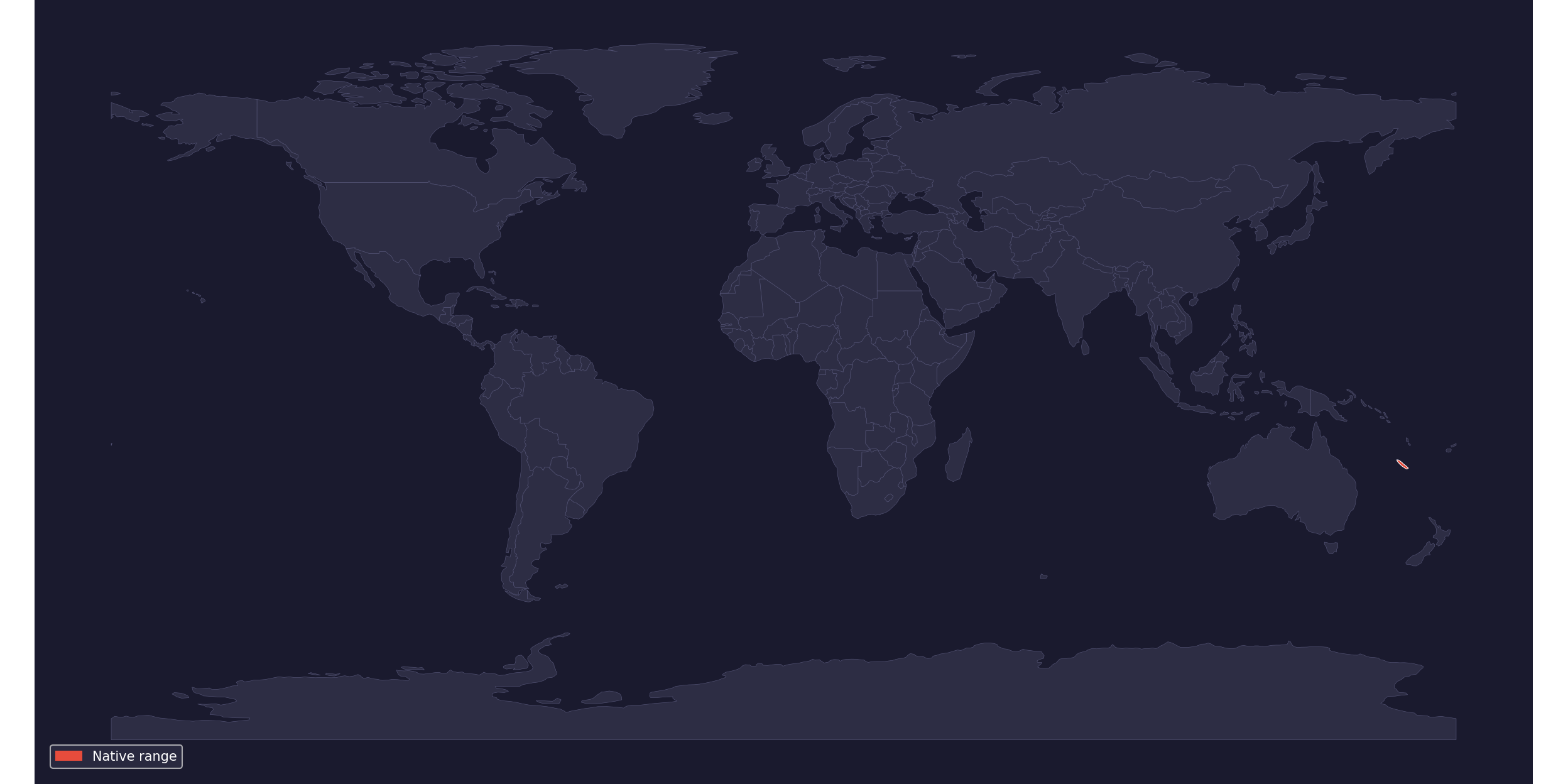
🌡 Climate across the native range
Monthly climate normals from reviewed GBIF occurrence locations:
Sud — New Caledonia
| Month | Min °C | Mean °C | Max °C | RH % |
|---|---|---|---|---|
| January | 22 | 24.4 | 27.4 | 84 |
| February | 22.7 | 24.8 | 27.8 | 86 |
| March | 22.3 | 24.2 | 27 | 87 |
| April | 20.8 | 22.7 | 25.4 | 85 |
| May | 18.9 | 20.9 | 23.6 | 83 |
| June | 17.5 | 19.5 | 22.2 | 82 |
| July | 16.1 | 18.4 | 21.3 | 80 |
| August | 15.8 | 18.3 | 21.3 | 79 |
| September | 16.5 | 19.3 | 22.7 | 79 |
| October | 18 | 20.7 | 24.2 | 78 |
| November | 19.3 | 22.1 | 25.6 | 78 |
| December | 21 | 23.6 | 26.9 | 81 |
Nord — New Caledonia
| Month | Min °C | Mean °C | Max °C | RH % |
|---|---|---|---|---|
| January | 24.2 | 26.2 | 28.6 | 81 |
| February | 24.7 | 26.6 | 28.9 | 83 |
| March | 24.3 | 26.2 | 28.5 | 84 |
| April | 22.9 | 24.9 | 27.2 | 82 |
| May | 21.2 | 23.2 | 25.7 | 80 |
| June | 19.9 | 21.9 | 24.4 | 79 |
| July | 18.7 | 20.8 | 23.5 | 77 |
| August | 18.5 | 20.8 | 23.6 | 76 |
| September | 19.3 | 21.8 | 24.8 | 75 |
| October | 20.6 | 23.1 | 26 | 76 |
| November | 21.9 | 24.3 | 27.1 | 77 |
| December | 23.3 | 25.5 | 28.1 | 80 |
Weather data by Open-Meteo.com · CC BY 4.0 · Monthly normals calculated by Herpeton Academy from daily archive values.
Location references use GBIF.org occurrence data where available; original occurrence records retain their source dataset licenses.
⚖️ Legal status
As checked on April 21, 2026, Rhacodactylus leachianus was not found in the CITES Appendices or in the local EU Wildlife Trade Annex text check used for this project. However, the species is listed as Vulnerable by IUCN and is endemic to New Caledonia, where export of native wildlife is restricted.
National and local rules may still apply to keeping, sale, transport, breeding, and proof of origin. Keep invoices, breeder information, transfer records, and locality data.
Buy captive-bred animals only. Wild-caught or unclear-origin giant geckos are ethically risky and undermine responsible captive breeding.
The Bern Convention is not usually relevant unless a species is native to Europe or covered by local conservation rules; check current national guidance for the country where the animal is kept.
🤌 Husbandry
An adult leachianus gecko needs a large vertical enclosure. A practical minimum for a smaller locality animal is about 60 × 45 × 90 cm, but large adults benefit from 60 × 60 × 120 cm or more. Big Grande Terre animals often need even more room and much sturdier furnishings.
The enclosure should have:
- Thick branches and large cork tubes
- Strong bark retreats and elevated hides
- Dense foliage and shaded resting areas
- A stable feeding ledge or bowl holder
- A shallow water dish
- Good ventilation with humidity retention
Solitary housing is the safest default. Males should not be kept together. Mixed pairs can fight or stress each other, and even breeding pairs may need separation.
💡 Lighting
Leachianus geckos are nocturnal and crepuscular, but they benefit from a clear day-night cycle. Provide 10-14 hours of light depending on season, or a simple 12-hour cycle.
Low-output UVB can be beneficial if installed over part of the enclosure with shaded retreats available. The gecko should always be able to choose darkness and cover.
If UVB is not used, use a complete gecko diet and supplements that provide vitamin D3 safely. If UVB is used, avoid excessive extra D3.
For UV planning, treat this species as Ferguson Zone 1. Aim for about UVI 0.5-1.0 in the upper exposed area, while leaving retreats and a gradient down to shaded areas near zero UVI. This usually points to a low-output UVB tube such as a ShadeDweller-style or 2-7% T5, chosen for the enclosure height; measure with a Solarmeter 6.5 when possible, because reflector, mesh, distance, and lamp age change the real exposure.
🌡 Heating and temperature
Leachianus geckos need moderate temperatures and can overheat easily. Many homes provide acceptable temperatures, but a gentle warm zone can still help activity and digestion.
Useful ranges:
- Gentle warm area: 25-28°C
- General daytime range: 21-25°C
- Night: 18-22°C
- Avoid sustained temperatures above 28-29°C
Use a thermostat for any heat source. Low-wattage overhead heat or a deep heat projector can work if it creates a mild gradient without drying the enclosure excessively. Do not use heat rocks.
Measure temperatures at the top, middle, and lower enclosure. In warm weather, cooling and ventilation can matter more than heating.
💧 Humidity and water
Leachianus geckos need a humidity cycle rather than constant wetness. A practical target is around 50-60% during the drier part of the day, rising to 70-85% after misting.
Mist in the evening and lightly in the morning if needed. The enclosure should dry partially between mistings so surfaces do not remain stale and wet all day.
Most leachianus geckos drink droplets from bark, leaves, and glass, but a clean water dish should still be available. Good hydration supports shedding, digestion, and breeding condition.
🌿 Enclosure and decoration
The enclosure must be sturdy. This species is heavy, strong, and capable of shifting poorly secured decor.
Suitable substrate options include:
- Coconut fiber mixed with organic topsoil
- Tropical forest reptile substrate
- Sphagnum moss in selected humid areas
- Leaf litter for cover
- Paper towel for quarantine or medical monitoring
Bioactive setups can work well if drainage, plants, clean-up organisms, and airflow are established. Use durable plants and hardscape that can tolerate a heavy gecko climbing over them.
Secure every branch, cork tube, and background piece properly. Falling decor can seriously injure a large animal.
🪳 Feeding
Leachianus geckos are omnivorous. In captivity, the staple diet should be a high-quality complete gecko diet formulated for New Caledonian species, mixed with water according to the instructions.
Offer fresh prepared diet two or three times per week for adults, and more often for juveniles. Remove old food before it spoils.
Live insects add enrichment and protein:
- Crickets
- Dubia or discoid roach nymphs
- Black soldier fly larvae
- Silkworms
- Small locusts where legal
Insects should be gut-loaded and dusted with calcium and vitamins as needed. Because leachianus geckos can become overweight, watch body condition and avoid overfeeding.
🥚 Breeding
Breeding should be planned carefully. Leachianus geckos are valuable, slow-growing, locality-sensitive animals, and pairing mistakes can create stress, injuries, or blurred locality lines.
Mature males usually have obvious hemipenal bulges at the tail base and clearer preanal pores. Females lack strong bulges and have less obvious pores. Juvenile sexing can be uncertain.
Sexual maturity often takes longer than in smaller New Caledonian geckos, commonly around 2-3 years depending on locality, growth, and body condition. Females should be fully grown, well-conditioned, and not rushed into breeding.
Prepare laying sites, incubation, hatchling enclosures, small feeder insects, complete diet, records, locality documentation, and responsible homes before pairing animals. Separate pairs if there is aggression, hiding stress, weight loss, or repeated unwanted breeding.
🩺 Common problems
Common problems usually come from overheating, poor ventilation, constant wetness, obesity, falls, stress, breeding-related depletion, or bite wounds from pairing attempts.
Watch for:
- Stuck shed on toes, tail, or eyes
- Wrinkled skin or sunken eyes
- Weight loss or refusal to eat
- Obesity or fat deposits
- Soft jaw, tremors, or weak grip
- Bite wounds or tail injuries
- Burns from unguarded heat sources
- Egg binding in females
Check temperature, humidity cycle, diet, supplements, and enclosure safety first. Persistent symptoms, injuries, swelling, egg-laying trouble, or neurological signs require a reptile veterinarian.
📌 Conclusion
The leachianus gecko is one of the most impressive geckos in captivity. It is powerful, intelligent, locality-sensitive, and best suited to keepers who enjoy patient observation more than frequent handling.
Give it space, sturdy climbing structure, moderate temperatures, humidity cycling, complete diet, and minimal deliberate handling. Stable care and careful captive-bred sourcing are the foundation of keeping this giant gecko well.
📚 Sources and further reading
- CITES Appendices and Species+ trade database, checked April 2026
- EU wildlife trade regulations and annex references, checked April 2026
- GBIF species backbone and occurrence data for taxonomy and distribution context
- IUCN Red List and specialist husbandry references where applicable
💬 Feedback
For questions, corrections, or practical notes, leave us a message in the forum thread.