Share

Centralian Rough Knob-tailed Gecko
🔤 Taxonomy
Nephrurus amyae is the accepted scientific name. It was described in 1994 after material formerly associated with the N. asper group was re-examined. Older labels may therefore use Nephrurus asper. English names include Centralian rough knob-tailed gecko, giant knob-tail, and Amy’s knob-tail; the German name Rauhschuppiger Knopfschwanzgecko is also seen in European trade.
📌 Description
This is the largest living Nephrurus, reaching about 13.5 cm snout-to-vent and roughly 14-16 cm overall because the knobbed tail is very short. It has a broad head, long limbs, padless toes, and strongly tuberculate reddish-brown skin. A healthy adult can live 10-15 years or longer.
It is a bold nocturnal ambush hunter but not a handling animal. When alarmed it raises its body, opens its mouth, vocalizes, and may lunge. Its rocky microhabitat, large food requirement, seasonal rhythm, and often limited captive provenance make it an intermediate species.
🌍 Distribution
N. amyae is endemic to the rocky ranges of Central Australia, principally in the southern Northern Territory around the MacDonnell ranges and adjacent central desert uplands, with a marginal record in eastern Western Australia. Research on the N. asper group confirms its close association with rocky habitats.
It shelters in fissures, beneath slabs, and among scree by day and hunts on the ground at night. These refuges buffer the extreme surface climate; an enclosure must provide stable crevices and a cooler moist retreat, not simply reproduce open-desert air.
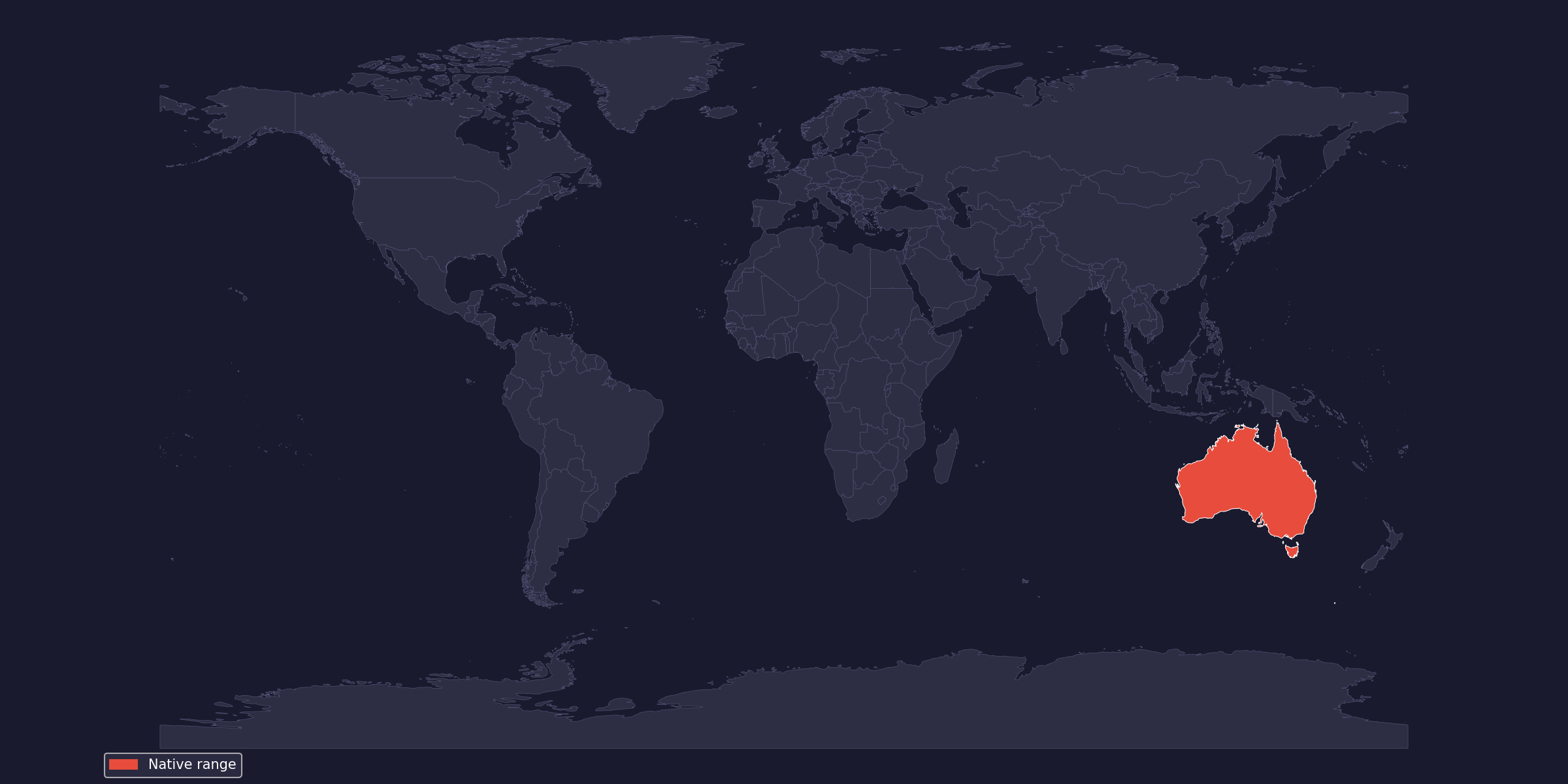
🌡 Climate across the native range
Monthly normals from reviewed occurrences in two rocky Central Australian localities:
Alice Springs region — Northern Territory (reviewed N. amyae occurrence)
| Month | Min °C | Mean °C | Max °C | RH % |
|---|---|---|---|---|
| January | 23.3 | 29.8 | 35.8 | 35 |
| February | 22.5 | 28.6 | 34.5 | 37 |
| March | 20 | 26.4 | 32.5 | 34 |
| April | 15.8 | 22.3 | 28.5 | 35 |
| May | 10.6 | 16.5 | 22.5 | 46 |
| June | 7 | 12.7 | 18.7 | 53 |
| July | 6.5 | 12.7 | 19.2 | 47 |
| August | 8.5 | 15.5 | 22.3 | 35 |
| September | 13.6 | 20.9 | 27.8 | 29 |
| October | 16.8 | 24.3 | 31 | 28 |
| November | 20 | 26.9 | 33.4 | 31 |
| December | 22 | 28.4 | 34.5 | 34 |
Watarrka region — Northern Territory (reviewed N. amyae occurrence)
| Month | Min °C | Mean °C | Max °C | RH % |
|---|---|---|---|---|
| January | 23.4 | 30.1 | 36.4 | 33 |
| February | 22.6 | 29 | 35.1 | 35 |
| March | 20.4 | 26.8 | 33 | 32 |
| April | 16.2 | 22.6 | 28.9 | 34 |
| May | 10.8 | 16.7 | 23 | 45 |
| June | 7.2 | 12.9 | 19.2 | 51 |
| July | 6.6 | 12.8 | 19.6 | 46 |
| August | 8.7 | 15.6 | 22.7 | 35 |
| September | 13.6 | 21 | 28.1 | 28 |
| October | 17.1 | 24.6 | 31.6 | 27 |
| November | 20 | 27 | 33.7 | 31 |
| December | 21.9 | 28.4 | 34.8 | 34 |
Weather data by Open-Meteo.com · CC BY 4.0 · Monthly normals calculated by Herpeton Academy from daily archive values.
Location references use GBIF.org occurrence data where available; original occurrence records retain their source dataset licenses.
⚖️ Legal status
Checked on 2026-08-30: Nephrurus amyae was not found in the current CITES Appendices or the EU wildlife-trade Annexes. The Bern Convention is not relevant because the species is not native to Europe.
Australian native wildlife is regulated nationally and by states or territories, and Australia does not allow ordinary commercial export of live native reptiles. Overseas animals should descend from established legal captive lines. Keep invoices, breeder details, hatch dates, photographs, and any historical import or transfer records; non-listing by CITES does not explain origin.
🤌 Husbandry
Provide one adult with at least 90 x 45 x 45 cm. Use the floor area for a broad thermal gradient, several tight rock-like shelters, and open hunting routes. House singly; permanent pairs create avoidable competition and breeding pressure.
Quarantine new stock for 60-90 days using paper, secure hides, a small humid hide, and dedicated tools. Record weight, tail condition, food, sheds, and droppings. Reptile-veterinary examination and faecal testing are warranted for weight loss, diarrhoea, regurgitation, mites, or uncertain collection history.
| Parameter | Practical target |
|---|---|
| Adult enclosure | at least 90 x 45 x 45 cm |
| Warm surface | 31-33°C |
| Daytime air | 24-28°C |
| Cool zone | 21-25°C |
| Night | 18-22°C |
| Humidity | dry air and surface; moist cool crevice or hide |
| UVB | optional but recommended, UVI 1-2 at the warm exposed area |
| Adult feeding | 2-4 insects about three evenings weekly |
💡 Lighting
Use an 11-hour winter day and up to 13 hours in summer, with gradual transitions and darkness at night. Low-level UVB is recommended even though dietary D3 can prevent deficiency. Target UVI 1-2 across part of the warm exposed area and complete shade inside all crevices.
A short linear lamp is easier to grade than a compact bulb. Measure or replace it on schedule and adjust supplementation to actual UVB access. Moderate visible light should illuminate the surface without shining directly into every refuge.
🌡 Heating and temperature
Offer a 31-33°C warm rock surface, daytime air of 24-28°C, a 21-25°C cool zone, and nights of 18-22°C. Use thermostatically controlled overhead heat and check the contact surface with an infrared thermometer. Digital probes should monitor the warm shelter and cool substrate.
Heat must not penetrate every crevice. Bottom heat beneath the only shelter can remove the safe cool refuge and desiccate the animal. Seasonal cooling to 16-18°C for one or two months is a breeding technique, not mandatory pet care; use it only for healthy, well-conditioned adults after food has cleared the gut, never for juveniles, new arrivals, thin animals, or sick animals.
💧 Humidity and water
Keep the general enclosure dry, commonly around 30-50% RH, but maintain one moist—not saturated—cool crevice or hide. Lightly dampen that refuge and allow the surrounding surface to dry. Uniform dryness causes dehydration and retained shed; wet stagnant substrate promotes skin and respiratory disease.
Provide a shallow water bowl and refresh it daily. A light evening spray on part of the décor can supply drinking droplets. Inspect the eyes, toes, and tail knob after each shed.
🌿 Enclosure and decoration
Build secure crevices from anchored cork, resin rock, or flat stone fixed to the enclosure base. Heavy rocks must never rest on loose substrate. Make at least one crevice warm, one cool and dry, and one cool and moist, and leave enough open floor for hunting.
Use 5-8 cm of compactable sandy loam or a fine sand/clay/soil mix rather than pure loose quartz. Provide a deeper moist laying box for an adult female. During quarantine and for very small juveniles use paper. Avoid calcium sand, sharp crushed stone, coarse gravel, wood chips, dusty powder, and unsupported rock piles. Feed from a smooth bowl or tongs when practical.
🪳 Feeding
Offer adults two to four appropriately sized insects about three evenings weekly. Juveniles usually eat daily or every other day. Suitable prey includes crickets, roach nymphs, locusts where legal, silkworms, black soldier fly larvae, and occasional beetle larvae. Prey should be slightly smaller than the gecko’s head.
Gut-load feeders for 24-48 hours. Lightly dust with plain calcium at most feeds, and use D3 and multivitamin according to product strength and measured UVB access. Do not combine several complete supplements. Remove loose insects before they bite the resting gecko, and limit fatty worms to prevent obesity.
🥚 Breeding notes
Females normally lay two large pliable-shelled eggs and may produce several clutches. Pair only well-conditioned adults under observation, then separate them. Provide a deep, moist but airy laying box even when mating was not planned.
Successful keeper protocols commonly use 27-29°C, with hatching around 75-100 days and sometimes longer at the cool end. Mark the upper surface before moving an egg and do not rotate it. Breeding females need close weight and calcium monitoring; prolonged digging, straining, or declining condition may indicate egg binding and requires a reptile veterinarian.
🩺 Common problems
Common preventable problems include dehydration, dysecdysis, skin infection, burns, overheating, metabolic bone disease, obesity, impaction associated with unsuitable substrate or poor hydration, feeder bites, and injuries from cohabitation or collapsing rocks. Persistent refusal to eat, tail or weight loss, tremors, a soft jaw, swollen limbs, abnormal droppings, eye problems, skin sores, or laboured breathing need veterinary assessment.
📌 Conclusion
The Centralian rough knob-tail suits a keeper who will build a stable rocky landscape and observe it after dark. Secure crevices, an accessible moist refuge, controlled overhead heat, and traceable captive origin are the non-negotiable points.
📚 Sources and further reading
- ReptiFiles: Knob-tailed gecko care
- GBIF Backbone Taxonomy: Nephrurus amyae
- The Reptile Database: Nephrurus amyae
- Oliver et al.: phylogeography and taxonomy of the Nephrurus asper group
- ACT Government: native reptile import risk assessment for N. amyae
- Baines et al. 2016: UV-Tool
- CITES Appendices, checked 2026-08-30
- Commission Regulation (EU) 2026/1383, checked 2026-08-30
- Australian Government: commercial trade of wildlife, checked 2026-08-30