Share

Leopard Gecko
🔤 Taxonomy
Eublepharis macularius is the currently accepted scientific name. In the hobby and in trade, the species is usually sold under the same name or under its common-name equivalents.
English common names used in the hobby:
- Leopard gecko
German common names used in the hobby:
- Leopardgecko
📌 Description
The leopard gecko (Eublepharis macularius) is a terrestrial gecko from arid and semi-arid parts of South Asia. It is one of the most common pet lizards because it stays a manageable size, feeds readily, and usually becomes calm with gentle handling.
Adults usually reach 17-25 cm. The tail stores fat and should look full but not swollen. With good care, leopard geckos often live 15-20 years, so they should be treated as a long-term animal, not a temporary beginner pet.
Unlike many geckos, leopard geckos have movable eyelids and do not climb smooth glass. They are mostly crepuscular and nocturnal, but they still use light, warmth, hides, and a stable day-night rhythm to regulate their body.
🌍 Distribution
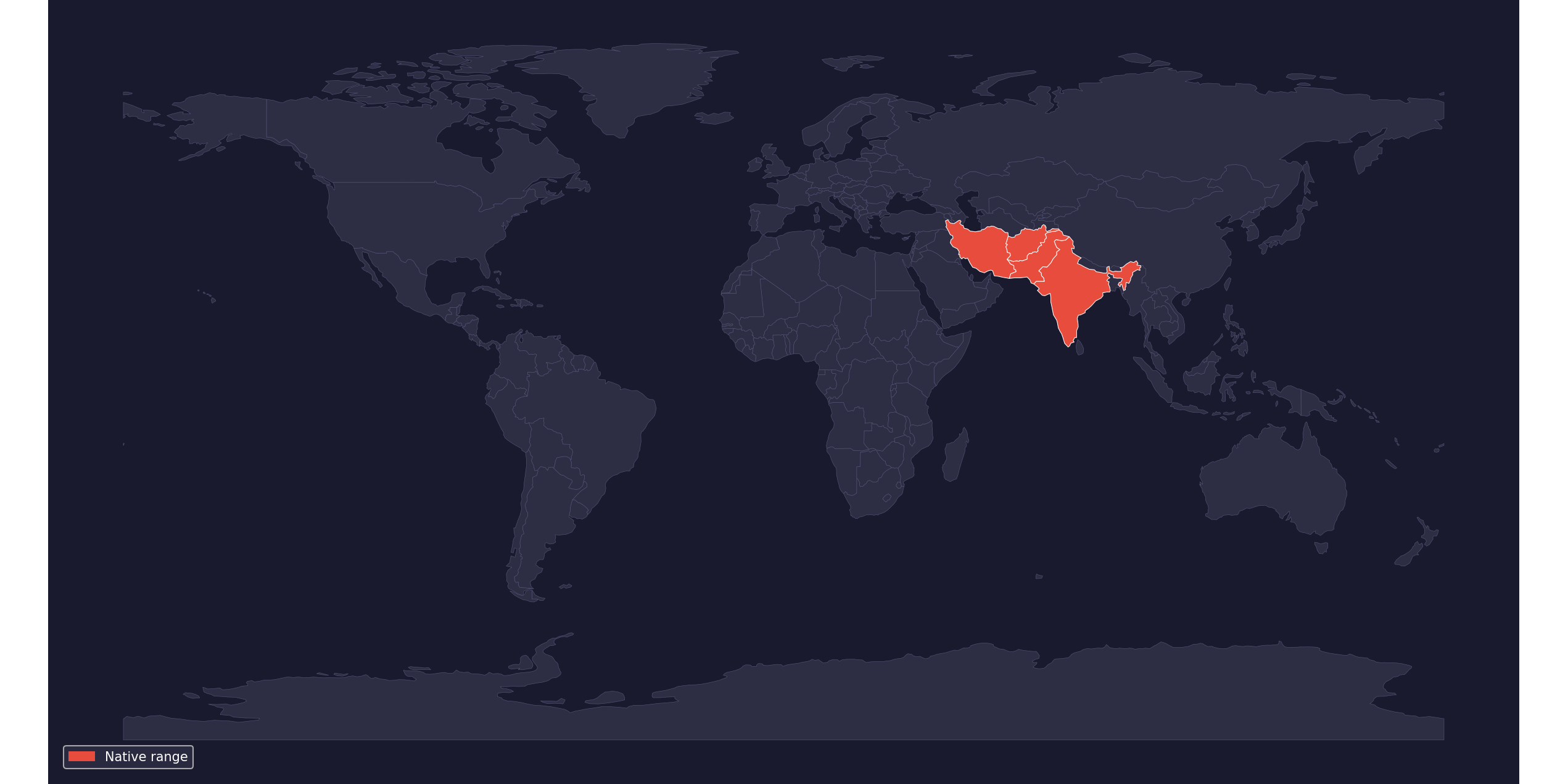
The species occurs in Afghanistan, Pakistan, northwestern India, parts of Iran, and nearby regions. It lives mainly in dry grassland, rocky scrub, semi-desert, and hard-packed ground with stones, cracks, burrows, and low vegetation.
Important habitat features include:
- Dry, well-drained ground
- Warm days and cooler nights
- Rocks, cracks, and burrows for shelter
- Sparse vegetation
- Seasonal access to insects
In captivity, the goal is not a bare desert box, but a dry, warm, structured enclosure with hides and enough floor space for natural movement.
🌡 Climate across the native range
Monthly climate normals from reviewed GBIF occurrence locations:
NCT of Delhi — India
| Month | Min °C | Mean °C | Max °C | RH % |
|---|---|---|---|---|
| January | 7.6 | 13.4 | 20 | 69 |
| February | 10.4 | 16.7 | 23.5 | 63 |
| March | 15.1 | 22.3 | 29.4 | 51 |
| April | 20.8 | 28.8 | 36.3 | 34 |
| May | 25.3 | 32.7 | 39.6 | 34 |
| June | 27.6 | 33 | 38.3 | 50 |
| July | 26.5 | 29.8 | 33.7 | 74 |
| August | 25.7 | 28.5 | 32 | 79 |
| September | 23.8 | 27.7 | 32.2 | 74 |
| October | 19 | 25.3 | 31.8 | 58 |
| November | 13.9 | 20.2 | 27.1 | 58 |
| December | 9.2 | 15.3 | 22.1 | 64 |
Himachal Pradesh — India
| Month | Min °C | Mean °C | Max °C | RH % |
|---|---|---|---|---|
| January | 4.8 | 10.5 | 16.7 | 78 |
| February | 6.7 | 13.1 | 19.7 | 73 |
| March | 10.4 | 17.7 | 24.8 | 65 |
| April | 15.1 | 23.4 | 31.2 | 52 |
| May | 19.4 | 27.8 | 35.4 | 46 |
| June | 22.8 | 28.9 | 34.7 | 60 |
| July | 23.8 | 26.8 | 30.3 | 83 |
| August | 23.3 | 26 | 29.4 | 87 |
| September | 20.9 | 24.8 | 29.2 | 83 |
| October | 15.1 | 21.2 | 27.9 | 71 |
| November | 10 | 16.4 | 23.5 | 71 |
| December | 6 | 12.2 | 19 | 75 |
Sind — Pakistan
| Month | Min °C | Mean °C | Max °C | RH % |
|---|---|---|---|---|
| January | 11.9 | 17.9 | 23.9 | 51 |
| February | 13.8 | 20.3 | 26.9 | 49 |
| March | 17.4 | 24.4 | 31.7 | 50 |
| April | 21.1 | 27.9 | 35.7 | 55 |
| May | 24.3 | 29.8 | 36.9 | 64 |
| June | 26.2 | 30.3 | 35.8 | 69 |
| July | 26 | 29 | 33.3 | 76 |
| August | 24.9 | 27.8 | 32 | 78 |
| September | 23.9 | 27.6 | 32.9 | 73 |
| October | 21.6 | 27.7 | 34.7 | 55 |
| November | 17.6 | 23.9 | 30.5 | 47 |
| December | 13.3 | 19.4 | 25.7 | 48 |
Weather data by Open-Meteo.com · CC BY 4.0 · Monthly normals calculated by Herpeton Academy from daily archive values.
Location references use GBIF.org occurrence data where available; original occurrence records retain their source dataset licenses.
⚖️ Legal status
As checked against current CITES and EU wildlife trade sources in April 2026, Eublepharis macularius is not listed in the CITES Appendices, and no specific EU Wildlife Trade Annex listing was found for the species.
It is not a European native species, so the Bern Convention is not the main legal framework for ordinary captive keeping in Europe. However, national and local rules may still apply to import, transport, sale, breeding, animal welfare, and proof of legal origin.
Buy only captive-bred animals from reliable sources. Wild-caught animals are unnecessary for the pet trade and are more likely to carry parasites, stress-related problems, or unclear origin.
🤌 Husbandry
An adult leopard gecko should have a terrarium with a minimum footprint of about 90 × 45 cm, with 45 cm height being sufficient for most setups. More floor space is always better because this is a ground-dwelling animal.
The enclosure should have:
- A warm side and a cool side
- At least three hides: warm, cool, and humid
- Stable rocks, cork, branches, and low climbing surfaces
- A shallow water dish
- Good ventilation
Leopard geckos should normally be kept alone. Males fight, and male-female pairs can lead to chronic stress and repeated breeding. Even females may compete, so solitary housing is the safest default.
💡 Lighting
Leopard geckos do not need intense desert-level light, but they benefit from a clear day-night cycle. Provide 10-12 hours of light per day.
Low-output UVB can be beneficial when installed correctly, especially for animals that can choose how much exposure they receive. A shaded enclosure with hides is essential. If UVB is not used, supplementation must be managed carefully to provide vitamin D3 without overdosing.
Bright light should not remove the animal’s sense of security. The gecko must always be able to retreat into dark hides.
For UV planning, treat this species as Ferguson Zone 1. Aim for about UVI 0.5-1.0 in the upper exposed area, while leaving retreats and a gradient down to shaded areas near zero UVI. This usually points to a low-output UVB tube such as a ShadeDweller-style or 2-7% T5, chosen for the enclosure height; measure with a Solarmeter 6.5 when possible, because reflector, mesh, distance, and lamp age change the real exposure.
🌡 Heating and temperature and temperature
Heat should come mainly from above, such as a halogen or deep heat projector controlled by a thermostat. A warm surface allows digestion and normal activity.
Recommended ranges:
- Basking surface: 34-36°C
- Warm hide: about 32-33°C
- Cool side: 21-25°C
- Night: usually 18-22°C, if the room stays safe
Measure surface temperature with an infrared thermometer and air temperature with digital probes. Heat rocks should not be used because they can cause burns.
💧 Humidity and water and water
Daytime humidity should usually stay around 30-40%, with good ventilation. Short rises after misting or seasonal changes are not a problem if the enclosure dries out again.
A humid hide is essential for shedding. It can contain damp sphagnum moss, paper towel, or a similar safe material. The hide should be moist, not wet or moldy.
Fresh water should always be available in a shallow dish. Leopard geckos may not drink visibly every day, but dehydration quickly affects shedding, appetite, and general condition.
🌿 Enclosure and decoration
The enclosure should allow the gecko to move through cover instead of crossing open empty space. Use hides, cork bark, rocks, artificial or live dry-tolerant plants, and low branches.
Suitable substrate options include:
- A compact soil-sand-clay style mix
- Commercial arid reptile substrate
- Paper towel for quarantine or sick animals
- Slate or textured tile in part of the enclosure
Avoid loose calcium sand, dusty substrate, wood shavings, and reptile carpet. Reptile carpet traps dirt and can catch claws and teeth.
🪳 Feeding
Leopard geckos are insectivores. Offer a varied diet instead of relying on one feeder.
Suitable feeders include:
- Crickets
- Dubia roaches
- Locusts
- Black soldier fly larvae
- Silkworms
- Mealworms as part of a varied diet
Waxworms and very fatty larvae should be treats, not staples. Feeders should be appropriately sized and gut-loaded before feeding.
Juveniles eat more often, usually every day or every other day. Healthy adults often do well with two or three meals per week. Adjust feeding to body condition; an obese leopard gecko has a very thick tail, fat pads, and reduced activity.
Use calcium and multivitamin supplements according to the lighting setup and product instructions. Vitamin A is important for insectivorous reptiles, but oversupplementation can also cause harm.
🥚 Breeding
Breeding should be planned, not accidental. Females use a lot of calcium and energy to produce eggs, and repeated breeding can seriously weaken them.
Mature males usually have visible hemipenal bulges at the base of the tail and a row of preanal pores. Females lack obvious bulges and have much less pronounced pores. Sexing young juveniles is unreliable.
Sexual maturity depends on age, size, and condition. Many leopard geckos become capable of breeding around 12-18 months, but females should not be bred just because they are technically mature. They should be fully grown, well-fed, and in excellent condition.
If breeding is attempted, prepare for egg laying, incubation, hatchling housing, feeding, and legal or welfare responsibilities for selling or rehoming offspring.
🩺 Common problems
Common problems are usually linked to incorrect heat, poor diet, bad substrate, or dehydration.
Watch for:
- Poor appetite or sudden weight loss
- Very thin tail
- Stuck shed on toes, eyes, or tail tip
- Swollen limbs or soft jaw
- Limping, tremors, or weakness
- Regurgitation or abnormal droppings
- Mouth swelling, wounds, or discharge
Check temperatures, humidity, supplementation, and feeder quality first. If symptoms persist, or if the gecko is losing weight, injured, swollen, or unable to shed properly, contact a veterinarian experienced with reptiles.
📌 Conclusion
The leopard gecko is hardy only when its basic requirements are met. It needs a dry but not barren terrarium, a reliable heat gradient, secure hides, safe substrate, clean water, and a varied insect diet.
With stable care and patient handling, it can be a calm, long-lived reptile. The key is consistency: correct temperatures, good nutrition, and early attention to small health changes.
📚 Sources and further reading
- CITES Appendices and Species+ trade database, checked April 2026
- EU wildlife trade regulations and annex references, checked April 2026
- GBIF species backbone and occurrence data for taxonomy and distribution context
- IUCN Red List and specialist husbandry references where applicable