Share

Coleonyx variegatus
🔤 Taxonomy
Coleonyx variegatus is the currently accepted scientific name. In trade, use the Latin name when checking animals, locality labels, invoices, and legal documents, because common names can overlap between related species.
English common names used in the hobby:
- Western Banded Gecko
📌 Description
The western banded gecko (Coleonyx variegatus) is a small, secretive lizard kept by specialist reptile keepers. Adults usually reach 10-15 cm total length and may live 8-15 years with stable long-term care.
This species should be planned around its adult needs, not its juvenile size. Good care depends on correct enclosure scale, secure hides, measured heat and UVB, clean water, and a diet that matches the species rather than convenient feeder habits.
For day-to-day keeping, the important point is predictability. The enclosure should let the animal choose between exposed warmth, shaded cover, slightly different humidity zones, and a secure sleeping place without being handled or moved by the keeper.
New arrivals should be quarantined and observed before being placed in a planted display enclosure. Track weight, appetite, shedding, feces, and behaviour for several weeks; small changes are easier to correct before the animal is stressed or dehydrated.
Because banded geckos are quiet and mostly crepuscular or nocturnal, poor care can be missed for a long time. A gecko that is always hidden may be normal, but a gecko that loses tail fullness, refuses food repeatedly, or becomes weak needs the setup reviewed immediately.
🌍 Distribution
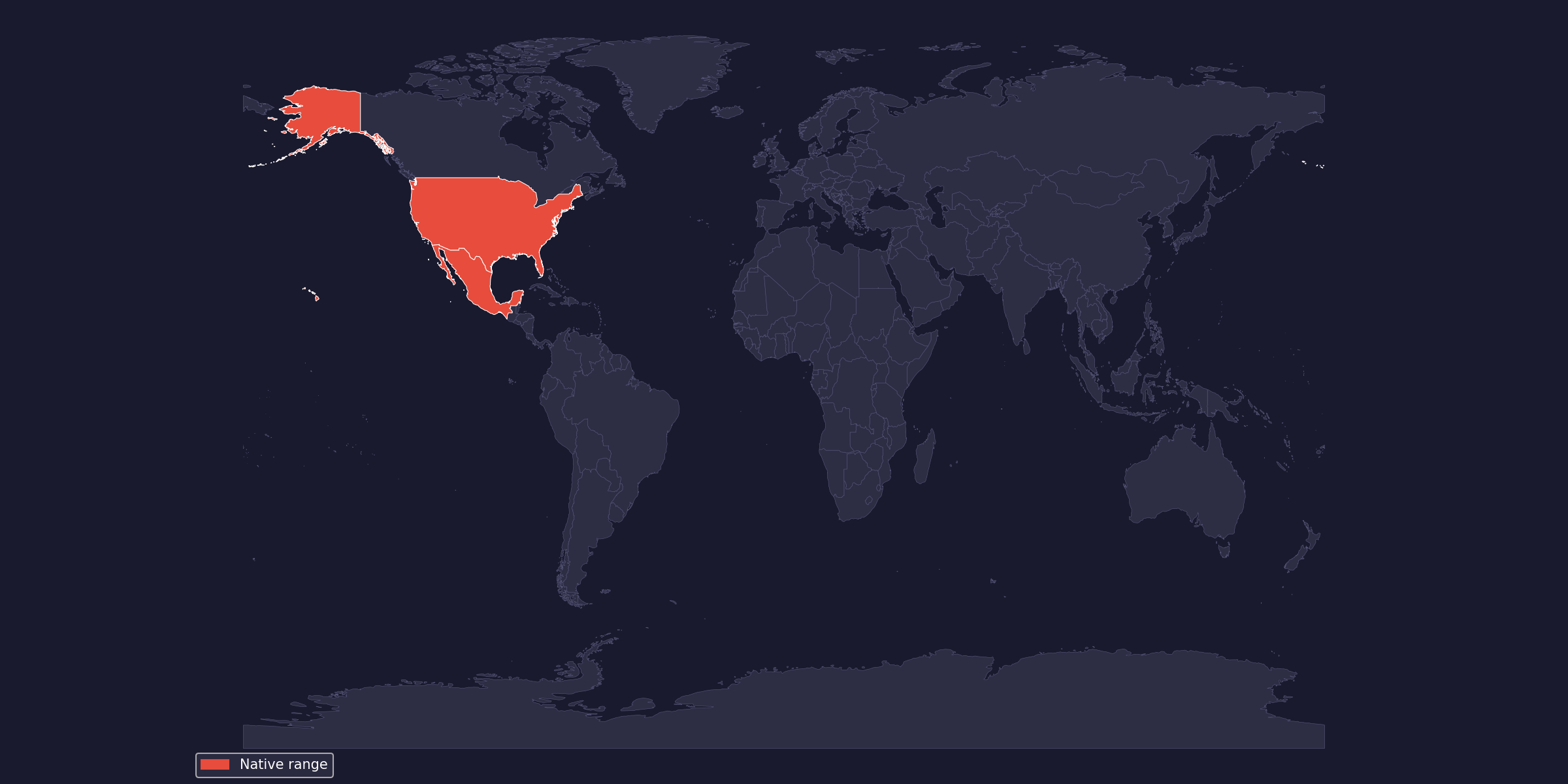
Coleonyx variegatus is native to the south-western United States and north-western Mexico. It is associated with desert washes, rocky arid scrub, semi-desert grassland, and dry slopes with crevices and burrows.
For husbandry, the useful model is protected desert-edge cover, not open desert floor. Provide tight hides, a controlled warm-to-cool gradient, modest UVB, dry cover, a small humid refuge and low rocks or cork that let the gecko move under shelter.
🌡 Climate across the native range
Monthly climate normals from reviewed GBIF occurrence locations:
Arizona — United States of America
| Month | Min °C | Mean °C | Max °C | RH % |
|---|---|---|---|---|
| January | 2.8 | 10.4 | 18 | 44 |
| February | 4.4 | 12.4 | 20.3 | 40 |
| March | 6.4 | 14.7 | 23 | 35 |
| April | 9.2 | 18.4 | 27.6 | 27 |
| May | 13.8 | 23.1 | 32.4 | 24 |
| June | 19 | 28.4 | 37.8 | 21 |
| July | 22.1 | 29.8 | 37.4 | 35 |
| August | 21.5 | 28.8 | 36.1 | 42 |
| September | 18.9 | 26.6 | 34.3 | 37 |
| October | 12.7 | 20.9 | 29.1 | 34 |
| November | 6.3 | 14.5 | 22.6 | 36 |
| December | 2.9 | 10.6 | 18.2 | 42 |
Baja California Sur — Mexico
| Month | Min °C | Mean °C | Max °C | RH % |
|---|---|---|---|---|
| January | 10.7 | 17.3 | 24 | 74 |
| February | 10.6 | 17.8 | 25 | 70 |
| March | 11.5 | 19 | 26.4 | 65 |
| April | 13.3 | 20.9 | 28.4 | 60 |
| May | 15.9 | 23 | 30.2 | 60 |
| June | 19.5 | 25.8 | 32.1 | 61 |
| July | 22.5 | 27.7 | 33 | 64 |
| August | 22.9 | 27.8 | 32.6 | 70 |
| September | 22.1 | 27.1 | 32 | 74 |
| October | 18.9 | 24.8 | 30.8 | 73 |
| November | 14.9 | 21.3 | 27.8 | 74 |
| December | 11.9 | 18.4 | 24.8 | 75 |
California — United States of America
| Month | Min °C | Mean °C | Max °C | RH % |
|---|---|---|---|---|
| January | 5.6 | 12.4 | 19.2 | 49 |
| February | 6.2 | 13.1 | 20 | 51 |
| March | 7 | 14 | 20.9 | 53 |
| April | 8.5 | 16.4 | 24.3 | 48 |
| May | 11.2 | 18.9 | 26.6 | 50 |
| June | 13.7 | 22.3 | 30.9 | 45 |
| July | 16.1 | 25.3 | 34.5 | 43 |
| August | 16.6 | 25.7 | 34.7 | 44 |
| September | 15.1 | 23.8 | 32.4 | 45 |
| October | 11.6 | 19.9 | 28.2 | 44 |
| November | 7.5 | 15.4 | 23.3 | 43 |
| December | 4.9 | 12.3 | 19.7 | 45 |
Weather data by WorldClim v2.1 · Monthly normals queried by Herpeton Academy from raster values; relative humidity is derived from vapor pressure and mean temperature.
Location references use GBIF.org occurrence data where available; original occurrence records retain their source dataset licenses.
The map shows the broad country-level native range. Within that range the useful husbandry model is not a uniform desert: these geckos use protected cracks, burrows, leaf litter, and soil pockets where temperature and humidity are more stable than the open surface.
⚖️ Legal status
As checked against current official sources in May 2026, No CITES Appendix listing was found for this species, and no specific EU Wildlife Trade Annex listing was found during the May 2026 check.
The species is not native to Europe, so the Bern Convention is not the main legal framework for ordinary captive keeping in Europe. National and local rules may still apply to ownership, import, export, transport, sale, breeding, registration, escape prevention, and proof of legal origin.
Buy captive-bred animals where available and keep purchase records. Do not collect wild animals; local state, provincial, protected-area, export, and animal-welfare rules may be stricter than the broad CITES/EU summary.
🤌 Husbandry
One adult can be kept in a 60 x 45 x 45 cm enclosure; a pair or richer display setup needs more floor space and careful monitoring.
The enclosure should include:
- a hot basking area and cooler retreat zones
- multiple hides or sheltered routes
- secure branches, cork, rocks, or platforms suited to the species
- fresh water that cannot be tipped easily
- strong ventilation without losing the needed humidity
- front access so maintenance does not become a chase
Keep animals singly unless there is a controlled breeding plan and space to separate them immediately. Cohabitation can cause stress, injuries, food competition, and repeated breeding pressure.
A useful layout has a warm hide near the heat source, a cooler hide, and a humid hide. The gecko should be able to cross from one side to the other under cork, stone, plants, or leaf litter rather than walking across a bare open floor.
For juveniles, start with a simpler enclosure so feeding and droppings can be monitored. Once the animal feeds reliably and sheds cleanly, add more cover and a deeper naturalistic substrate. Adults can use surprisingly complex layouts, but every hide must remain accessible for health checks.
💡 Lighting
Provide a consistent 10-12 hour day length with bright visible light. Use a quality linear UVB lamp over part of the enclosure, leaving shaded retreats so the animal can self-regulate.
For UV planning, treat this species as Ferguson Zone 1, about UVI 0.5-1.0 with deep shaded retreats. Measure with a Solarmeter 6.5 when possible because mesh, reflector, distance, and lamp age change the real exposure.
These geckos should not be forced under bright light all day. Use low to moderate visible lighting, shaded retreats, and a photoperiod that stays consistent. UVB should cover only part of the enclosure so a cryptic animal can get benefit without losing security.
🌡 Heating and temperature
Use overhead heat from halogen or other suitable reptile heating equipment controlled safely by thermostat or dimming control. Do not heat the whole enclosure evenly.
Useful targets:
- Basking area: 32-35°C surface warmth
- Warm side: 27-30°C
- Cool side: 22-25°C
- Night: 18-22°C
Measure basking surfaces with an infrared thermometer and ambient zones with digital probes. The animal must be able to leave the basking zone completely.
A thermostat probe should be placed where it controls the heat source effectively, but it does not replace manual checks. Surface temperatures under a hide can differ from the open basking surface, so check both. If the animal always stays at the cool end or never leaves the warm hide, adjust the gradient.
💧 Humidity and water
Maintain humidity around 30-45% with a humid hide, with local variation inside the enclosure. A single number is less useful than a stable gradient with dry resting places, humid retreats where needed, and good airflow.
Fresh water should always be available. Large lizards may need a basin big enough for soaking, while smaller geckos need a shallow dish and periodic light misting or a humid hide.
The humid hide is the main safety net for shedding. It should be moist enough to prevent stuck shed on toes and tail tip, but not sour, wet, or moldy. In seasonal setups, a slightly moister period can stimulate activity, but constant dampness with poor ventilation is a common cause of skin and respiratory problems.
🌿 Enclosure and decoration
The enclosure should let the animal move through cover instead of being exposed in an empty box. Use stable decor; heavy items must be supported from the floor or fixed securely before substrate is added.
Useful materials include:
- cork tubes, bark slabs, branches, and roots
- soil-based substrate appropriate to humidity needs
- live or artificial plants for cover
- elevated basking platforms for arboreal species
- tight hides where the animal can feel body contact
Quarantine new animals on simple substrate until feeding, shedding, droppings, and parasite status are understood.
Avoid sharp rock edges, loose stacks that can collapse, dusty sand, cedar or pine shavings, and reptile carpet. A soil-sand-clay mix with dry leaf litter works well when it is kept clean and compact enough that prey insects cannot disappear forever.
🪳 Feeding
This species is insectivorous. Suitable foods include small crickets, roach nymphs, small locusts, black soldier fly larvae, and occasional small mealworms.
Feed juveniles smaller meals more often and adults less often according to body condition. Use calcium and multivitamin supplements deliberately; do not use supplements to compensate for missing UVB, poor diet, or low temperatures.
Avoid obesity. These small geckos store fat quickly when prey is too large, too frequent, or too rich. Adults should stay lean, with a visible waist and active hunting response.
Offer prey after lights dim or in the evening when the gecko is more willing to hunt. Remove uneaten crickets so they do not bite the gecko overnight. Dust most meals lightly with calcium, use a multivitamin less often, and adjust supplements if reliable UVB is provided.
🩺 Common problems
Common captive problems include burns, dehydration, retained shed, parasite loads in wild-caught animals, mouth injuries, obesity, poor appetite from low basking temperatures, and stress from cramped or exposed housing.
Warning signs include weight loss, swelling, wheezing, repeated nose rubbing, weak grip, tremors, retained shed on toes or tail tip, abnormal droppings, wounds, and long refusal to feed. Check temperatures, UVB, humidity, diet, and hiding security first, but serious or persistent signs need an experienced reptile veterinarian.
A practical troubleshooting order is: confirm the warm hide temperature, confirm the humid hide, check that prey is small enough, review supplement use, and make sure the animal is not exposed by an overly bare layout. Weight loss, repeated failed sheds, swollen toes, mouth injury, or persistent refusal to feed should not be managed by guesswork.
📌 Conclusion
The western banded gecko is rewarding only when its adult size, climate, diet, and legal paperwork are taken seriously. Build the enclosure around natural behaviour and measurable gradients, then choose the animal from a source that can prove legal captive origin.
📚 Sources and further reading
- GBIF Backbone Taxonomy
- CITES Appendices, checked May 2026
- European Commission: Wildlife trade, checked May 2026
- Bern Convention appendices, checked May 2026
💬 Feedback
For questions, corrections, or practical notes, leave us a message in the forum thread.