Share

Bean Beetles
🔤 Taxonomy
Callosobruchus maculatus (Fabricius, 1775) is the accepted scientific name. Older sources often place it in a separate seed-beetle family, Bruchidae, or use the original combination Bruchus maculatus. Current GBIF taxonomy places seed beetles in the subfamily Bruchinae of Chrysomelidae.
Common names can be confusing because this is not a true weevil. Names used in teaching and the feeder trade include:
- Bean beetle
- Cowpea seed beetle
- Southern cowpea weevil
📌 Description
Bean beetles are tiny, non-biting beetles cultured on dry legume seeds. Adults are usually about 2.5-4 mm long and live only one to two weeks. Females glue eggs to beans; the larvae enter a seed, feed and pupate inside it, and emerge through round holes as adults.
Newly emerged adults are useful prey for small dart frogs, juvenile geckos, small mantids, spiderlings, and other predators that need prey around fruit-fly size but with a harder outline and different movement. They are not a complete diet. Adult beetles do not normally eat or drink, so they cannot be gut-loaded in the usual 24-48-hour sense; feeder variety and the predator’s appropriate supplement plan remain essential.
Most laboratory stock produces a largely sedentary adult form, but crowding and heat can increase dispersal forms that fly more readily. Treat every culture as capable of escape.
🌍 Distribution
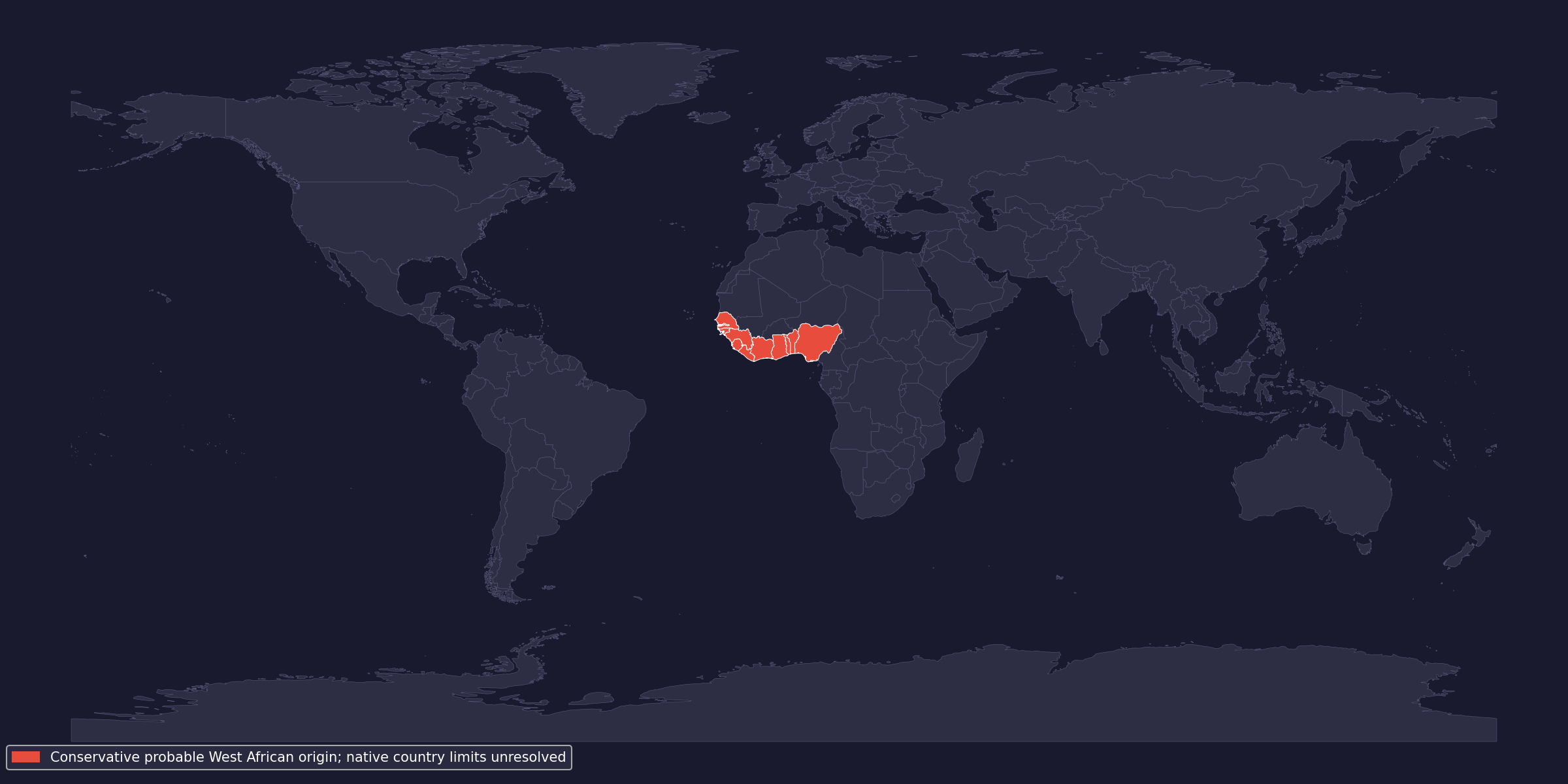
The species probably originated in West Africa, although older literature describes a broader African or African-and-Asian origin. Trade in cowpeas and other pulses has spread it through tropical and subtropical regions worldwide, and today it is a serious stored-legume pest far beyond its ancestral area. Country-level native boundaries cannot be stated confidently.
That uncertainty matters for the map: it represents the conservative probable West African origin, not every country where the beetle is now recorded. Captive cultures must never be released.
⚖️ Regulations and safety
Checked on 2026-09-04: C. maculatus was not found in the current CITES Appendices or in EU wildlife-trade Annexes A-D, and it is not treated here as a species on the EU list of invasive alien species. These checks do not make live cultures unrestricted.
The Bern Convention is not relevant to a protected European native-species question for this cosmopolitan stored-product pest.
This is a plant-feeding agricultural pest. EPPO records national quarantine categorisations for the species, while USDA APHIS states that permits are required for the import and interstate movement of most insects that feed on or infest plants or plant products. Other countries may regulate possession, import, transport, sale, classroom use, or the beans travelling with a culture. Confirm the rules with the destination country’s plant-protection authority before ordering or shipping.
Keep cultures in a dedicated room or cabinet, far from kitchens, animal feed, seed collections, and pantry legumes. Never release adults, and never compost exposed beans. Seal an unwanted culture and any beans that contacted adults, freeze at normal domestic-freezer temperature (about -18°C) for at least 72 hours, confirm that every stage is dead, then discard it under local waste rules.
🤌 Husbandry
A culture is simply a secure ventilated container, suitable dry beans, and beetles. Reliability comes from maintaining overlapping dated cultures rather than repeatedly adding beans to one old container.
| Parameter | Practical target |
|---|---|
| Adult size | about 2.5-4 mm |
| Adult lifespan | about 1-2 weeks |
| Routine temperature | 22-30°C |
| Productive range | 25-30°C |
| Relative humidity | roughly 40-60% |
| Egg to adult | about 3-4 weeks at 30°C; 4-5 weeks at 25°C; up to 7 weeks at 22°C |
| Main host seeds | mung beans or cowpeas; adzuki beans develop more slowly |
Use a 300-750 ml smooth-sided cup or jar for a modest culture, with a secure lid and pinholes, fine fabric, or mesh that adults cannot pass. Place it inside a second lidded catch box during handling. Label every culture with species, source, host bean, and start date.
Start at least two cultures on the same day and keep the old culture until adults emerge from its replacements. Isolate incoming stock from established feeder colonies and inspect it for mites, mold, parasitoid wasps, and unexpected flying insects.
💡 Lighting
UVB and specialist lamps are unnecessary. An ordinary 12-hour light and 12-hour dark rhythm works well and makes development more predictable. Keep cups out of direct sun: a small clear container can overheat rapidly.
🌡 Heating and temperature
Maintain cultures between 22 and 30°C. Around 25-28°C gives useful production without pushing the culture as hard as 30°C. Development accelerates with warmth: the published handbook reports emergence in about three to four weeks at 30°C, four to five weeks at 25°C, and about seven weeks at 22°C on suitable beans.
Do not exceed 30°C merely to speed production. High temperature and larval crowding encourage dispersal adults, shorten the safety margin against overheating, and can dry beans unevenly. If heat is needed, warm a ventilated cabinet or one side of a larger secondary box with a thermostat; never place a small culture directly on a heat mat.
💧 Humidity and water
Adults need no drinking water, and the culture needs no misting. Open water and wet food cause drowning, mold, and bean spoilage. Normal room humidity around 40-60% supports reliable emergence; very dry winter air may reduce emergence success.
If the room is extremely dry, humidify the surrounding cabinet or room cautiously while preserving ventilation. Do not pour water into the culture or seal the lid. Condensation means the setup is too wet, too warm, or inadequately ventilated.
🌿 Enclosure and decoration
Cover the bottom with one layer of clean, dry host beans. About 50 ml of beans in a 300 ml cup is a proven small-culture starting point. There is no need for substrate, egg crate, or decoration: larvae develop inside the seeds and adults move over their surface.
Mung beans (Vigna radiata) and cowpeas or black-eyed peas (Vigna unguiculata) are dependable hosts. Adzuki beans (Vigna angularis) work but usually prolong development. Do not assume every dried bean is suitable. In particular, the culture handbook reports poor development on many legumes and toxicity from black beans (Phaseolus vulgaris) to the beetles.
Use dry, mold-free, pesticide-free food-grade beans. Keep unused beans in sealed containers. Work over a light-coloured tray inside the catch box, close the culture immediately after harvesting, and wipe the work surface when finished.
🪳 Feeding
The beans are larval food, not gut-load for the short-lived adults. Do not add fruit, vegetables, commercial gut-load, or water gel. Such additions mainly create mold and do not turn the adults into a balanced feeder.
To offer beetles:
- tap newly emerged adults into a tall clean feeding cup
- select a prey size appropriate for the predator
- apply only the supplement specified for that predator, immediately before feeding
- offer small portions and remove persistent uneaten beetles
- rotate with other suitable feeders rather than relying on bean beetles alone
Do not feed from cultures exposed to insecticide, pantry-pest treatments, mold, mites, or unknown parasitoids. Never place infested beans in an animal enclosure; offer adults only.
🥚 Breeding
Add roughly 10 males and 10 females to 50 ml of beans for a dense 300 ml starter culture. Exact founder numbers are flexible, but old adults or too few founders can produce a failed generation. Within several days, eggs should be visible as small pale ovals glued to the beans.
Larvae remain hidden inside the beans through feeding and pupation. Do not discard a clean culture just because nothing moves for several weeks. When round emergence holes and fresh adults appear, harvest briefly and close the lid again.
Start a fresh culture every one to two weeks if a continuous supply is needed. Retire beans after no more than two or three generations: crowding, depleted seeds, mites, and dispersal forms become more likely in old cultures. Do not top up an exhausted culture indefinitely.
🩺 Common problems
- No eggs: founders may be old, too few, or mostly one sex; start paired backups from fresh adults.
- No emergence: check the host-bean species, temperature, excessive dryness, pesticide exposure, and culture age.
- Mold or condensation: discard heavily affected cultures and correct wetness, ventilation, and bean storage.
- Mites or tiny wasps: isolate the container and restart from verified clean stock; do not place it beside other feeders.
- Flying escapes: reduce density, keep temperatures at or below 30°C, and handle only inside a catch box.
- Pantry contamination: isolate all dry food, inspect nearby legumes, and use local pest-control guidance rather than spraying around animals or feeder cultures.
- Dust or allergy symptoms: stop exposure, damp-clean the work area, use gloves, and avoid raising dust. Repeated insect-culture exposure can cause occupational allergy; anyone with wheezing or persistent symptoms should seek medical advice.
📌 Conclusion
Bean beetles fill a useful prey-size gap, but their agricultural-pest status makes them a poor choice for careless culture. Keep two or more small dated colonies, use only known host beans, and establish a sealed freezing-and-disposal routine before the first culture arrives.
📚 Sources and further reading
- GBIF species record: Callosobruchus maculatus
- Beck & Blumer: A Handbook on Bean Beetles
- University of Florida IFAS: cowpea weevil biology and management
- EPPO Global Database: C. maculatus categorisation
- USDA APHIS: permits for insects and mites
- CDC/NIOSH: work-related allergies in insect-raising facilities
- CITES Appendices
- EU wildlife-trade Annexes: Regulation (EU) 2026/1383
- European Commission: invasive alien species