Share

Bearded Pygmy Chameleon
🔤 Taxonomy
Rieppeleon brevicaudatus is the accepted scientific name. The species was long sold as Rhampholeon brevicaudatus and appears in older literature as Brookesia brevicaudata. Those names remain useful when checking older import papers and husbandry reports.
English names include bearded pygmy chameleon, bearded leaf chameleon, and short-tailed pygmy chameleon. The small pointed scales below the chin distinguish it from several similar leaf-chameleon species.
📌 Description
Adults measure only 6-9 cm, but their small scale makes care less forgiving, not easier. This chameleon lives among leaf litter, grass, and low vegetation, moves slowly, and may flatten, drop, feign death, or vibrate when frightened. Those behaviors are defenses and should never be provoked for entertainment.
Most individuals live about two or three years, with four years possible under good conditions. Heat stress, dehydration, reproductive depletion, parasites, and delayed treatment can shorten that further. The species is an advanced display animal for a keeper able to culture tiny feeders and keep the enclosure cool during summer.
🌍 Distribution
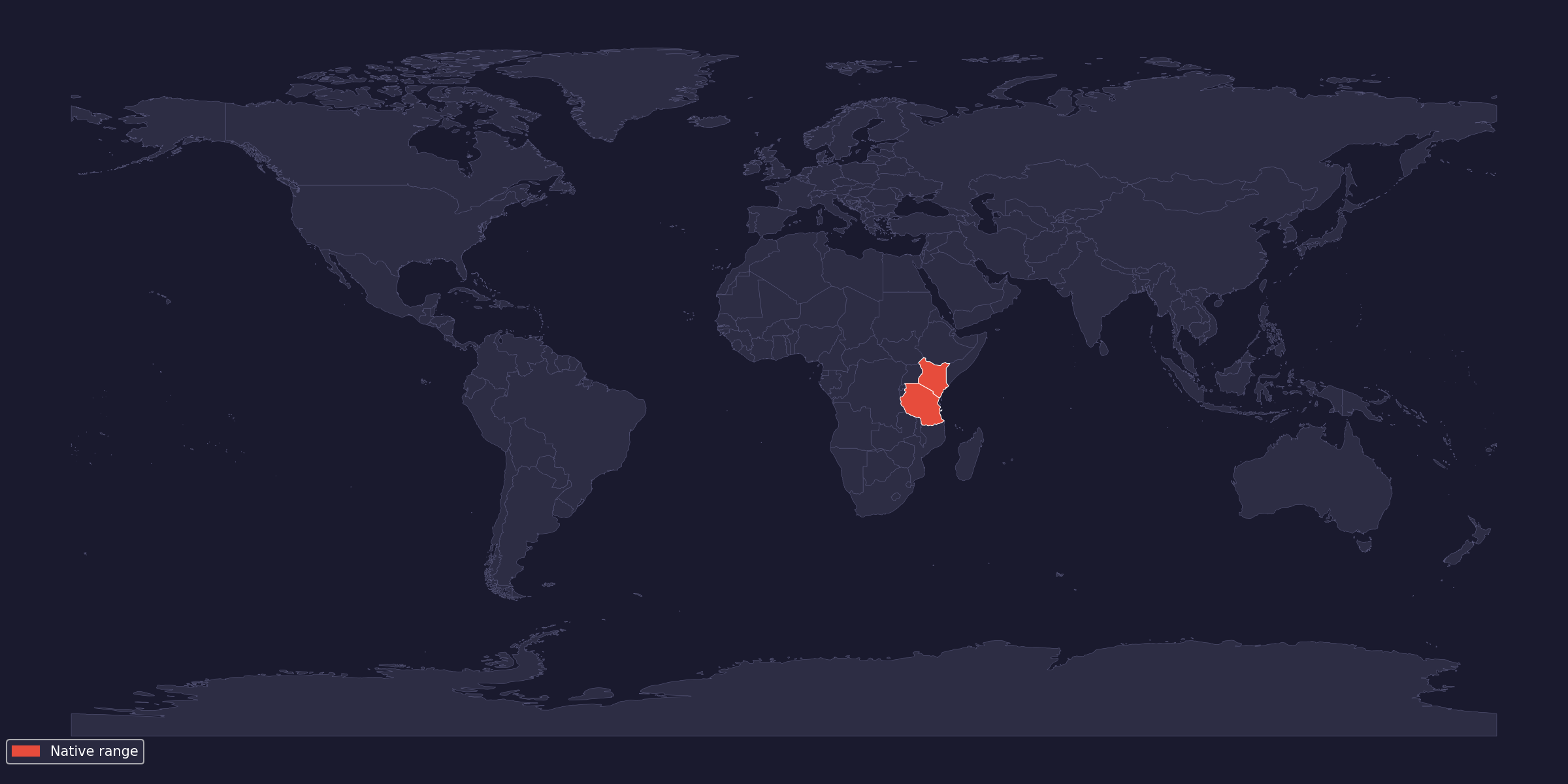
R. brevicaudatus occurs in eastern Tanzania and a small part of southern Kenya, including the Shimba Hills and forest and coastal-thicket systems extending south through Tanzania. It uses evergreen forest, low vegetation, grass, and leaf litter from near sea level to roughly 1,200 m.
Its microhabitat is shaded, humid, and well aerated, with cooler nights. A glass box kept hot and continually saturated is not equivalent to this forest floor.
⚖️ Legal status
Checked on 2026-08-20: Rieppeleon species are listed in CITES Appendix II and EU Annex B. International trade and import require the applicable permits, and lawful-origin records are necessary for EU commercial transfers. The Bern Convention is not relevant because the species is not native to Europe.
Many animals have historically entered trade as wild-caught stock. Prefer genuine captive-bred animals and retain the invoice, breeder and parent-stock details, CITES permit or import references where applicable, transfer record, and photographs. National registration, sale, transport, and exotic-animal rules can add further requirements.
🤌 Husbandry
Provide one adult with at least 45 x 45 x 45 cm. Floor area and low dense structure are more important than great height, but the enclosure must still allow several levels between leaf litter and about 30 cm. Use fine twigs, live plants, and visual cover throughout.
House singly. Some older sources describe groups, but a tiny animal can be suppressed without obvious fighting, and males are territorial. Solitary housing makes food intake, feces, hydration, and reproductive condition far easier to track.
Quarantine for at least 90 days in a separate room with separate tools. Use paper or a removable substrate layer, potted cover, and washable twigs. Record weight with a precise scale, feeding, feces, hydration, and behavior. Wild-caught or uncertain animals need prompt examination and fecal testing by a chameleon-experienced veterinarian; empirical deworming can be dangerous at this size.
| Parameter | Practical target |
|---|---|
| Adult enclosure | at least 45 x 45 x 45 cm for one |
| Day air | 20-24°C |
| Highest warm point | 24-25°C; avoid 26°C and above |
| Night | 15-19°C |
| Humidity | 60-80% by day, higher after evening misting, then drying |
| UVB | low linear UVB, measured UVI about 0.5-1 |
| Adult feeding | four to six small, varied insects daily or every other day |
💡 Lighting
Use bright but diffuse visible light and a low-output linear UVB lamp for 11-12 hours daily. Target UVI about 0.5-1 on the highest regularly used twig, with dense plant shade and leaf litter at zero UVI. Strong desert lamps can injure this forest-floor species at short distance.
Position lights outside the enclosure and measure both UV and heat at animal level. Plants must not create a completely dark box, but the chameleon should never be forced to remain exposed in order to feed or drink.
🌡 Heating and temperature
Keep daytime air around 20-24°C with, at most, a small warm patch of 24-25°C. Provide a cool zone of 17-20°C and a night drop to 15-19°C. Sustained temperatures of 26°C or higher are dangerous, especially when the animal cannot reach a cooler retreat.
Many rooms need no dedicated basking bulb. If heat is required, use a very low-wattage guarded source on a thermostat and measure at the highest twig. Before purchase, plan how the enclosure will remain cool during heat waves; air conditioning may be essential.
💧 Humidity and water
Maintain roughly 60-80% humidity by day, allowing an evening rise to 80-95%, but provide cross-ventilation and let leaves partly dry between mistings. Mist in the morning and evening so droplets form on leaves and twigs. Drain excess water before the soil becomes anaerobic.
These chameleons drink discreetly from droplets. A water dish is not a reliable primary source and can be a drowning hazard for feeders. Use safe water, clean misting equipment, and watch for sunken eyes, thick saliva, yellow urates, or repeated poor sheds.
🌿 Enclosure and decoration
After quarantine, use 8-10 cm of pesticide-free forest soil or a soil/coconut mix beneath abundant clean leaf litter. The lower layer should remain lightly moist while the surface varies from damp to nearly dry. Mature females need this depth for nesting.
Plant densely with small-leaved safe species and add many pencil-thin horizontal and diagonal twigs from ground level upward. Avoid sharp wire, sticky traps, fertilizer, pesticide residues, waterlogged sphagnum across the whole floor, and gaps through which pinhead feeders or hatchlings can escape. Drainage and side ventilation are mandatory.
🪳 Feeding
Offer adults four to six small prey items daily or every other day, mainly during the first half of the light period. Rotate flightless fruit flies, small crickets, bean beetles, houseflies, tiny roach nymphs, and other cultured invertebrates. Prey should be no longer than the width of the chameleon’s head.
Gut-load prey for 24-48 hours. Lightly dust with plain calcium about twice weekly, calcium with D3 roughly once monthly, and a multivitamin roughly once monthly, modifying the schedule for product concentration and measured UVB. Over-supplementation is particularly risky in such a small animal.
Count prey and remove oversized or aggressive insects. Hatchlings require fruit flies and pinhead prey several times daily and can starve quickly if the culture supply fails.
🥚 Breeding notes
Females commonly bury 3-9 eggs after a gestation of roughly one month and may retain sperm for later clutches. Provide at least 8-10 cm of suitable moist soil throughout the adult enclosure; a visibly gravid animal should not be repeatedly handled or moved to a bare laying bin.
Eggs can incubate around 22-24°C and often hatch in 50-90 days. Preserve orientation if an egg is moved. Neonates are only about 2 cm long, require cooler conditions than adults, and need a dependable supply of dusted fruit flies. Repeated clutches can exhaust a female, so solitary recovery housing and close weight monitoring are essential.
🩺 Common problems
Major risks include fatal overheating, dehydration, respiratory infection from stagnant wet air, metabolic bone disease, tongue or eye injury, parasites in imports, nutritional deficiency, egg binding, and reproductive exhaustion. Because the animal is tiny, a modest weight change can be clinically important.
Seek an experienced veterinarian urgently for closed or sunken eyes during the day, weak grip, falls, failure to shoot the tongue, swollen joints, tremors, wheezing, mucus, persistent dark stress colour, diarrhea, visible worms, straining, or food refusal with weight loss. Do not force-feed or dose medicine without an accurately measured body weight and veterinary plan.
📌 Conclusion
The bearded pygmy chameleon saves space but not effort. It suits a specialist who can guarantee cool summers, ventilated humidity, tiny varied live food, strict quarantine, and minimal disturbance; the smallest enclosure in the collection may require the closest monitoring.
📚 Sources and further reading
- ReptiFiles was checked first; no species-specific Rieppeleon brevicaudatus guide was available on 2026-08-20
- Chameleon Forums: Pygmy chameleon care sheet
- The Reptile Database: Rieppeleon brevicaudatus
- Spawls et al.: Pocket Guide to the Reptiles and Amphibians of East Africa
- Matthee et al. 2004: Phylogenetic review of African leaf chameleons
- Baines et al. 2016: UVB provision for captive reptiles
- CITES Appendices, checked 2026-08-20
- Commission Regulation (EU) 2026/1383, checked 2026-08-20