Share

Panther Chameleon
🔤 Taxonomy
Furcifer pardalis is the currently accepted scientific name. In older literature and some older trade material, the species is often encountered as Chamaeleo pardalis.
English common names used in the hobby:
- Panther chameleon
German common names used in the hobby:
- Pantherchamaeleon
📌 Description
The panther chameleon is one of the most famous chameleon species in captivity and is especially valued for the intense colors shown by adult males. Depending on locality and lineage, males may develop combinations of blue, red, orange, yellow, green, and turquoise, while females are usually more muted.
Like other chameleons, it has independently moving eyes, a prehensile tail, zygodactyl feet for climbing, and a projectile tongue for catching prey. It is an arboreal species and depends on height, visual security, and good airflow.
Males are larger and more colorful than females. Adult males commonly reach around 40-50 cm total length, while females remain smaller and should not be overfed because obesity and reproductive problems are common risks in captivity.
🌍 Distribution
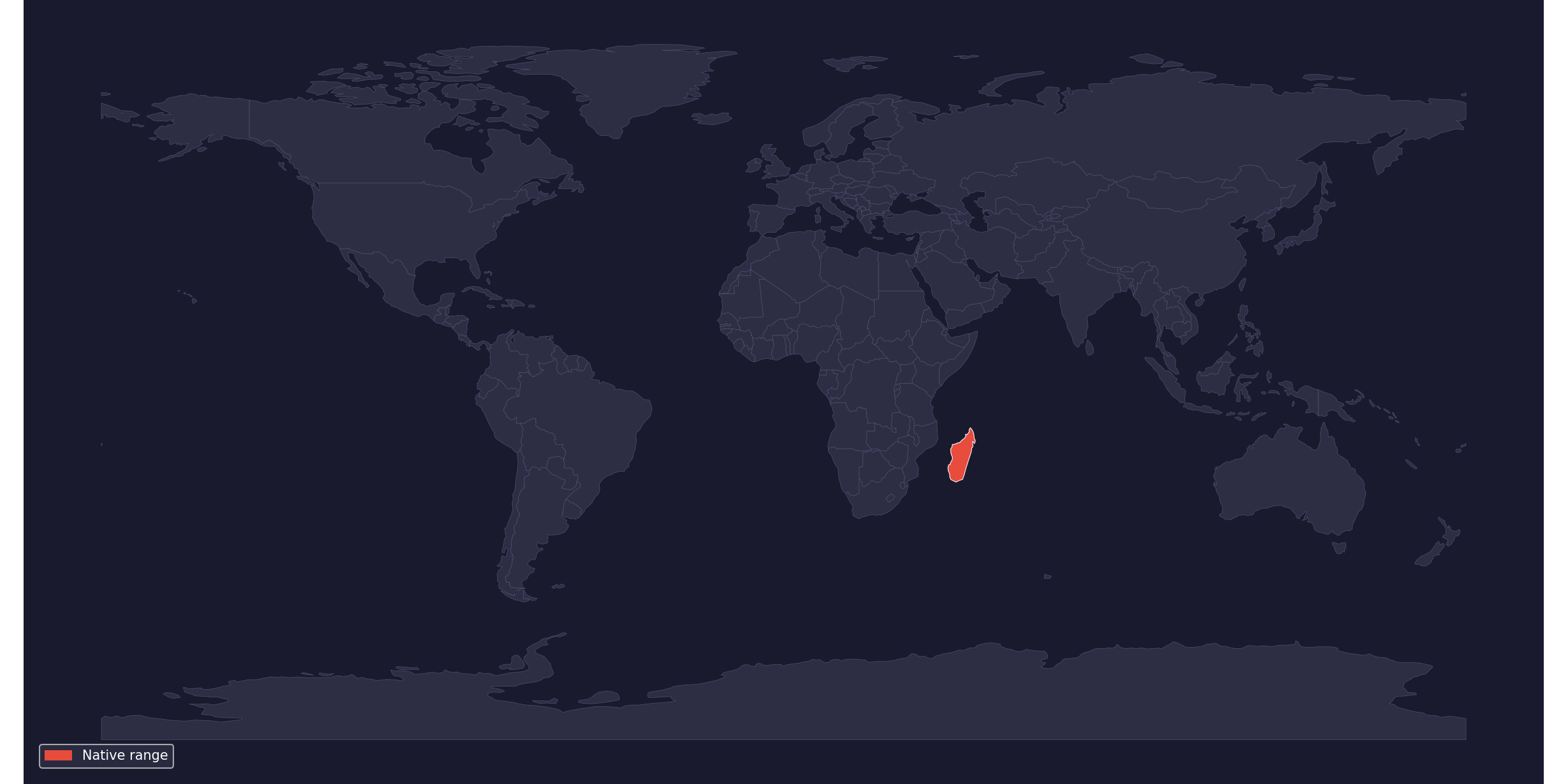
Furcifer pardalis is native to Madagascar, especially warm humid and subhumid lowland and coastal regions, with well-known localities such as Ambilobe, Nosy Be, Sambava and Tamatave. In the wild it is associated with shrubs, forest edge, plantations, gardens and coastal vegetation with daily light, foliage and regular moisture.
For captive care, the useful lesson from this distribution is:
- a tall, well-ventilated enclosure with usable branches and foliage
- strong light and UVB with shaded retreat options
- daily access to drinking droplets, mist, rain, or moving water
- a warm basking zone combined with cooler night and retreat areas
- visual barriers, because chameleons are solitary and easily stressed by constant exposure
🌡 Climate across the native range
Monthly climate normals from reviewed GBIF occurrence locations:
Antsiranana — Madagascar
| Month | Min °C | Mean °C | Max °C | RH % |
|---|---|---|---|---|
| January | 19.6 | 21.9 | 26 | 88 |
| February | 19.7 | 21.9 | 25.9 | 90 |
| March | 19.7 | 22.2 | 26.3 | 87 |
| April | 19.3 | 22.1 | 26.4 | 82 |
| May | 18.3 | 21.4 | 26 | 77 |
| June | 16.8 | 20 | 24.7 | 72 |
| July | 15.9 | 19.2 | 24.2 | 70 |
| August | 15.8 | 19.3 | 24.6 | 70 |
| September | 16.2 | 20 | 25.8 | 69 |
| October | 17.1 | 21.2 | 27.1 | 71 |
| November | 18.3 | 22.1 | 27.6 | 74 |
| December | 19.2 | 22.2 | 27 | 82 |
Weather data by Open-Meteo.com · CC BY 4.0 · Monthly normals calculated by Herpeton Academy from daily archive values.
Location references use GBIF.org occurrence data where available; original occurrence records retain their source dataset licenses.
⚖️ Legal status
As checked against current official sources in April 2026, Furcifer pardalis is listed in CITES Appendix II. Under the EU wildlife trade rules, that normally places the species in Annex B unless a stricter listing applies.
The species is not relevant to the Bern Convention because it is not native to Europe. National and local rules on import, sale, breeding, transport, and proof of legal origin may still apply. Captive-bred animals with clear documentation are strongly preferable.
🤌 Husbandry
Panther chameleons require a tall, well-ventilated enclosure with dense climbing structure. Screen or hybrid enclosures usually work better than poorly ventilated all-glass setups.
A practical minimum for an adult male is often around 60 x 60 x 120 cm, while smaller females can sometimes be kept in slightly smaller setups if ventilation, planting, and height remain adequate. More space is usually beneficial when it is well structured.
Good basic husbandry includes:
- Solitary housing
- Many branches of different thicknesses
- Dense live or safe artificial plants
- Strong ventilation
- Reliable drainage for misting
- Limited visual contact with other chameleons
💡 Lighting
Panther chameleons are diurnal and require both strong visible light and appropriate UVB exposure.
Recommended in principle:
- Linear T5 HO UVB system of suitable strength for the enclosure height
- Bright daylight-style lighting across the enclosure
- 10-12 hours of light daily
UVB is essential for vitamin D3 synthesis and calcium metabolism. Lamps must be mounted at safe distances and replaced on schedule according to the manufacturer.
For UV planning, treat this species as Ferguson Zone 3, but use the lower practical end in a planted enclosure. Aim for about UVI 2-3 on the highest routinely used basking branch, with a gradient down to shaded areas near zero UVI. This usually points to a correctly distanced 5-6% T5 system in many tall chameleon setups rather than a stronger lamp placed too close; measure with a Solarmeter 6.5 when possible, because reflector, mesh, distance, and lamp age change the real exposure.
🌡 Heating and temperature
The enclosure should provide a clear temperature gradient:
- Basking area: around 29-32°C
- Ambient daytime range: about 23-27°C
- Night: a drop to around 18-22°C is usually acceptable
Chronic overheating is dangerous and often worsens dehydration. Panther chameleons need access to both warmer and cooler zones rather than a uniformly hot enclosure.
💧 Humidity and water
Hydration is one of the most important parts of panther chameleon care. They usually do not drink from still water bowls in any meaningful way and instead rely on droplets from leaves, misting, and sometimes dripper systems.
Practical hydration points:
- Regular misting sessions
- Time for leaves to dry between wetter periods
- Good morning hydration opportunities
- Strong airflow so the enclosure does not stay swampy
Many keepers aim for moderate daytime humidity with higher humidity at night, provided ventilation remains strong and surfaces can dry out again.
🌿 Enclosure and decoration
The enclosure should be heavily structured with horizontal and diagonal branches, climbing routes, and visual barriers. Live plants are especially useful because they improve security, hold droplets, and help build a more stable microclimate.
Useful enclosure elements include:
- Ficus, pothos, schefflera, or other safe plants
- Basking branch below the heat and UVB zone
- Mid-level and lower retreat areas
- Drainage layer or other drainage solution
- Easy-to-clean floor area
Substrate on the floor is optional in many setups. What matters more is hygiene, drainage, and preventing feeder escape.
🪳 Feeding
Panther chameleons are insectivorous. Suitable staple prey includes:
- Crickets
- Roaches
- Locusts
- Silkworms where available
Mealworms and waxworms should be limited because they are not ideal staples. Feeder insects should be properly gut-loaded before use.
Supplements are important:
- Plain calcium at most feedings
- Calcium with D3 more sparingly depending on UVB strength and schedule
- Multivitamins in moderation
Juveniles are fed more often than adults. Adult males are usually fed in controlled portions, and adult females should not be overfed because excessive body condition can contribute to egg-related problems.
🩺 Common problems
Most captive problems come from dehydration, poor ventilation, weak UVB, excessive heat, incorrect supplementation, falls, and chronic stress.
Warning signs include:
- Sunken or frequently closed eyes
- Weak grip
- Persistent dark stress coloration
- Wheezing or open-mouth breathing outside normal basking
- Declining appetite
- Swelling, deformity, or grip problems linked to metabolic bone disease
If problems appear, first check hydration, temperatures, UVB distance, plant cover, supplement routine, and enclosure airflow. Chameleons decline quickly when conditions are wrong, so breathing problems, severe weakness, repeated falls, or prolonged refusal to eat should be treated as urgent veterinary cases.
📌 Conclusion
The panther chameleon is a spectacular display reptile, but it is not forgiving of careless husbandry. A tall planted enclosure, strong UVB, sensible heat, careful hydration, good airflow, and disciplined supplementation are the foundations of long-term success.
📚 Sources and further reading
- CITES Appendices and Species+ trade database, checked April 2026
- EU wildlife trade regulations and annex references, checked April 2026
- GBIF species backbone and occurrence data for taxonomy and distribution context
- IUCN Red List and specialist husbandry references where applicable