Share

Parson's Chameleon
🔤 Taxonomy
Calumma parsonii is the accepted scientific name. GBIF gives the authority as Cuvier, 1825; some herpetological references use 1824 for the original description. Older books and trade records often use Chamaeleo parsonii.
Two subspecies are currently recognized:
- Calumma parsonii parsonii — the widespread, generally larger nominate form
- Calumma parsonii cristifer — a smaller form from the Andasibe/Analamazaotra area, distinguished by a low dorsal crest
Trade labels such as “orange eye”, “yellow lip”, “yellow giant”, and “green giant” refer to locality-associated colour forms of the nominate subspecies, not additional subspecies. Keep lineage records intact and do not promise a precise adult colour from a juvenile label.
English and German names often seen in Europe are Parson’s chameleon, Parson’s giant chameleon, and Parsons Chamäleon.
📌 Description
Parson’s chameleon is a very large, slow-growing forest chameleon. Adult nominate males commonly reach 55-68 cm total length; females and C. p. cristifer are usually smaller, commonly around 50-60 cm. Mature males develop paired rostral processes and a broader head, but juveniles can remain difficult to sex reliably for many months.
Ten to fifteen years is realistic for a well-kept animal, and some individuals approach 20 years. That lifespan, the size of the enclosure, summer cooling, heavy water use, and a dependable supply of varied large insects make this an expert-level commitment. It is a display animal, not a reptile for routine handling.
🌍 Distribution
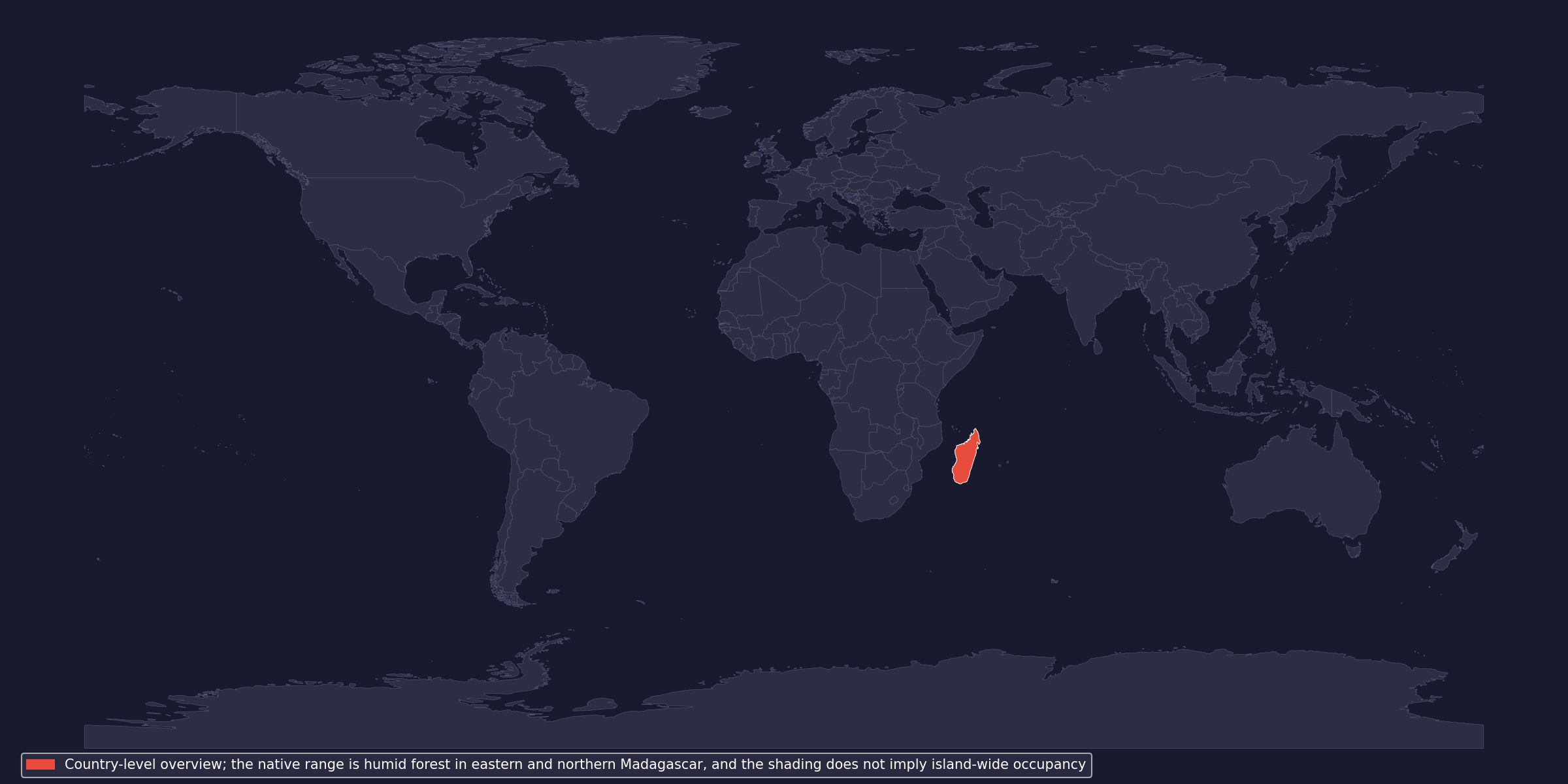
The species is endemic to Madagascar’s humid eastern and northern forest belt, from the Fianarantsoa/Ranomafana region north toward the Masoala and Anjanaharibe-Sud areas, with records from lowland forest to roughly 1,600 m and from Nosy Boraha. It uses trees in intact humid forest, forest edge, riparian corridors, and some mature secondary vegetation.
The nominate subspecies occupies most of that range. C. p. cristifer has a much more restricted central-eastern distribution around Andasibe and Analamazaotra. Country shading on the map therefore greatly overstates the occupied habitat.
Recent field work at Vohimana found C. parsonii especially along forest and watercourse edges. Microclimate measurements were warm and humid in summer but markedly cooler in winter. Captive care should provide the animal with leafy cover, moving air, drinking water, and choices between exposed and shaded branches rather than holding the whole enclosure at one wet, warm setting.
🌡 Climate across the native range
Monthly normals from two reviewed eastern-forest reference locations:
Analamazaotra Reserve — Madagascar (verified GBIF occurrence; C. p. cristifer range)
| Month | Min °C | Mean °C | Max °C | RH % |
|---|---|---|---|---|
| January | 18.1 | 20.7 | 25.1 | 88 |
| February | 18.2 | 20.6 | 24.7 | 89 |
| March | 17.9 | 20.2 | 24.2 | 89 |
| April | 16.8 | 19.2 | 22.9 | 89 |
| May | 15.1 | 17.5 | 21.1 | 89 |
| June | 13 | 15.4 | 18.7 | 89 |
| July | 12 | 14.3 | 17.6 | 89 |
| August | 12 | 14.8 | 18.6 | 88 |
| September | 12.7 | 16 | 20.4 | 85 |
| October | 14.4 | 17.9 | 22.7 | 84 |
| November | 16 | 19.5 | 24.6 | 83 |
| December | 17.4 | 20.5 | 25.3 | 86 |
Ranomafana region — Madagascar (representative southern C. p. parsonii habitat)
| Month | Min °C | Mean °C | Max °C | RH % |
|---|---|---|---|---|
| January | 17.8 | 20.5 | 24.6 | 88 |
| February | 17.7 | 20.4 | 24.2 | 89 |
| March | 17.3 | 19.9 | 23.7 | 89 |
| April | 15.9 | 18.7 | 22.4 | 89 |
| May | 14 | 16.9 | 20.6 | 89 |
| June | 11.8 | 14.8 | 18.5 | 89 |
| July | 10.8 | 13.8 | 17.4 | 89 |
| August | 11.1 | 14.5 | 18.6 | 86 |
| September | 12.1 | 15.9 | 20.5 | 85 |
| October | 14.3 | 17.9 | 22.6 | 84 |
| November | 15.9 | 19.4 | 24.1 | 85 |
| December | 17.2 | 20.3 | 24.8 | 86 |
Weather data by Open-Meteo.com · CC BY 4.0 · Monthly normals calculated by Herpeton Academy from daily archive values.
Location references use GBIF.org occurrence data where available; original occurrence records retain their source dataset licenses.
⚖️ Legal status
Checked on 2026-08-30: Calumma parsonii is included in CITES Appendix II and, through the current EU wildlife-trade annexes, EU Annex B. The species is not listed in the Bern Convention appendices and is not native to Europe.
The trade context needs careful wording. The latest CITES suspension notification located during this review, issued in 2025, explicitly excludes C. parsonii from the broader recommendation to suspend trade in many Calumma and Furcifer from Madagascar. That exception does not remove normal CITES export/import permits, legal-acquisition findings, non-detriment requirements, or national rules. The CITES quota database shows a Madagascar quota of 300 live animals annually through 2021; do not treat that historic figure as proof that a later export was authorized.
Prefer genuine captive-bred stock. Retain the invoice, scientific name and subspecies/locality label, breeder and parent-stock details, CITES permit or re-export certificate references where applicable, transfer record, and photographs. Verify national registration, commercial-use, transport, breeding, and import conditions before purchase or transfer.
🤌 Husbandry
House Parson’s chameleons singly and prevent constant visual contact with other chameleons. A commercial 120 x 60 x 120 cm enclosure is a lower limit for one adult, not an ideal target. A large nominate male benefits from approximately 180 x 90 x 180 cm or a safe planted room-scale enclosure. Use a screen, hybrid, or purpose-built enclosure that retains enough humidity without trapping warm stale air.
The animal must be able to move horizontally as well as vertically. Heavy adults need wide, firmly anchored branches and broad routes through foliage; a tall empty cage is unsafe. Automated misting needs a drainage system sized for several litres of water, plus easy access for cleaning.
Quarantine a new animal for at least 90 days in a separate room with separate tools. Use a removable floor layer, potted cover, and washable branches. Record weight, appetite, drinking, feces, grip, eyes, and breathing. Wild-caught or uncertain-origin animals should receive an early examination and fecal testing from a chameleon-experienced veterinarian; do not medicate such a large, long-lived animal from guesswork.
| Parameter | Practical target |
|---|---|
| Adult enclosure | 120 x 60 x 120 cm absolute lower limit; substantially larger preferred |
| Day air | 21-25°C, with an 18-21°C retreat |
| Basking branch | 27-30°C, broad and measured |
| Night | 15-20°C during the active season |
| Humidity | 50-70% by day; 80-100% overnight only with cooling and airflow |
| UVB | Ferguson Zone 3; UVI about 2-3 at the main basking branch, shade to 0 |
| Adult feeding | roughly 3-5 varied large insects every 2-3 days while active |
💡 Lighting
Provide bright full-spectrum visible light and a linear T5 HO UVB lamp across a wide part of the canopy. Baines et al. place the species in Ferguson Zone 3, and a 2026 Vohimana field study measured mean daytime UVI 2.6 at observed C. parsonii in summer. A practical captive target is UVI 2-3 over the animal’s back on the main basking route, with dense shade falling toward zero.
The animal’s entire body must fit within the usable light and warmth; a narrow high-output hotspot is not adequate. Measure UVI with a Solarmeter 6.5 and temperature at the same branch, accounting for mesh, reflector, distance, foliage, and lamp age. Replace lamps according to measured output or the manufacturer’s schedule.
Use about 12-13 hours of light in the warm active season and 10-11 hours during a mild winter cycle. Experienced breeding programs may shorten this further during controlled cooling, but light, heat, food, and hydration changes must be gradual and coordinated.
🌡 Heating and temperature
During the active season, keep most daytime air at 21-25°C. Provide a broad basking branch at 27-30°C and a well-planted retreat around 18-21°C. Allow nights to fall to 15-20°C. The enclosure should warm gradually after lights come on and cool before night humidity rises.
Room-level climate control is often more important than a powerful basking bulb. Sustained warm air above about 27-28°C, especially with no cool retreat, creates a serious heat and dehydration risk. Plan air conditioning before acquiring the animal if summer room temperatures cannot remain within range.
Use guarded overhead heat on a thermostat and verify the full length of the animal’s branch with digital probes and an infrared thermometer. Do not use heat rocks, ceramic heaters without light as a daytime basking substitute, or night heat unless the room would fall below the planned range.
💧 Humidity and water
Aim for 50-70% relative humidity through much of the day, with surfaces drying and air moving. After lights go out and temperature falls, humidity may rise to 80-100%. High night humidity is safe only with a genuine temperature drop and ventilation; warm stagnant saturation favors respiratory and skin problems.
Parson’s chameleons need generous opportunities to drink:
- Long misting sessions before lights come on and after the enclosure begins cooling
- A dripper or rain system for 30-60 minutes once or twice during the day when needed
- Broad clean leaves and branches that collect droplets
- A drainage reservoir that cannot be reached by the animal or feeder insects
Observe drinking rather than assuming a timer is adequate. Clean nozzles, lines, leaves, and drains regularly, and use potable water. A water bowl is not a substitute for moving droplets and can become a contamination source.
🌿 Enclosure and decoration
Build a continuous canopy of strong horizontal and diagonal branches in several diameters. Give the animal an open basking route, shaded retreat, drinking surfaces, and enough visual cover to disappear completely. Secure every branch for the weight of a large adult.
Use non-toxic live plants with sturdy foliage, such as hibiscus, Schefflera, Ficus, or pothos, after confirming plant identity and removing pesticide residues. Protect soil so feeders cannot become coated in fertilizer or substrate.
A bare or removable floor is easiest during quarantine. A mature bioactive floor can work with drainage and about 10-15 cm of suitable soil, but it must not stay waterlogged. Avoid sharp bark, cedar or other aromatic wood, loose dusty chips, exposed fertilizer, and standing wastewater.
Every mature female needs permanent access to an opaque laying area with roughly 30-40 cm of moist, tunnel-holding soil or a similarly deep connected laying container. Test the substrate by hand: it should hold a tunnel without dripping water. Waiting until a female looks gravid can lead to egg retention.
🪳 Feeding
Use varied, well-fed insects as the staple diet. Adults can take appropriately sized locusts, crickets, roaches, silkworms, hornworms, stick insects from safe cultures, and other legal captive-reared feeders. Prey should be no wider than the chameleon’s head and must not be able to injure the animal.
Juveniles eat daily. An active adult often takes about three to five large insects every two or three days, but season, body condition, sex, and prey size matter more than a fixed count. Intake may fall sharply during a planned cool season. Do not compensate with fatty larvae or vertebrate prey. Birds and rodents are unnecessary and add injury, obesity, and nutritional risk.
Gut-load feeders for at least 24-48 hours with a varied high-calcium diet and clean moisture. Offer plain calcium lightly at most active-season feedings. Use a balanced multivitamin containing vitamin A and D3 no more than about once or twice monthly, following the product label and adjusting for measured UVB and feeder variety. Avoid stacking several fortified products; both deficiency and excess of fat-soluble vitamins can cause harm.
🥚 Breeding
Breeding is an expert project, not a reason to house a pair together continuously. Most animals mature at roughly three to five years. Introduce adults only under close observation and separate them immediately if either animal shows avoidance, dark stress colour, gaping, or aggression.
Females may carry eggs for four to six months and lay about 20-69 eggs; they may not reproduce every year. Nesting can involve a long tunnel, so privacy and deep stable soil are essential. A female that searches repeatedly, stops eating, strains, weakens, or cannot dig needs urgent veterinary assessment for dystocia.
Incubation commonly lasts 15-24 months. The front-matter value of 22-24°C describes the warmer phases, not a flat year-round setting. Successful protocols use carefully timed cooler diapause phases, sometimes 13-18°C, with tightly controlled moisture. Eggs from this species should be managed only with a documented breeder protocol and redundant temperature monitoring.
💤 Seasonal cooling
Healthy mature animals can receive a gradual cool season that mirrors the eastern Malagasy winter. Experienced keepers may reduce daytime air toward 18-21°C, allow nights around 12-16°C, shorten the photoperiod, and reduce feeding as the animal’s activity falls. Drinking water and ventilation continue throughout, and weight and hydration are monitored.
Do not impose deep cooling on juveniles, thin or sick animals, new imports, or an animal without stable baseline records. Do not abruptly stop heat or food, and never assume months without eating are harmless without checking body condition. A breeding cycle involving stronger or longer cooling should be planned with an experienced breeder and reptile veterinarian.
🩺 Common problems
Watch for:
- Sunken eyes, tacky saliva, weak grip, or concentrated urates — dehydration or systemic disease
- Persistent gaping, frantic movement, very pale colour, or seeking the floor — overheating
- Bent limbs, soft jaw, poor grip, or falls — metabolic bone disease from UVB, calcium, or diet errors
- Swollen eyelids, skin changes, or abnormal shedding — humidity, vitamin, infection, or systemic problems
- Mouth redness, plaques, drooling, or reluctance to shoot the tongue — stomatitis or injury
- Wheezing, bubbles, raised-head breathing, or open-mouth breathing away from basking — respiratory disease
- Foot-pad sores — narrow, dirty, wet, or abrasive perches
- Repeated digging, straining, weakness, or abdominal enlargement in a female — possible egg retention
Recheck measured temperature, UVI, drainage, misting, supplement products, and feeder records, but do not delay treatment while experimenting with the setup. Breathing signs, falls, severe weakness, inability to drink, mouth lesions, or reproductive distress require a reptile-experienced veterinarian promptly.
📌 Conclusion
Parson’s chameleon suits an experienced chameleon keeper who can dedicate room-scale space, summer cooling, high-capacity drainage, measured UVB, varied live food, and long-term veterinary and legal records. The enclosure and cooling plan should be running reliably before the animal is reserved; heat and dehydration are the fastest preventable routes to failure.
📚 Sources and further reading
- ReptiFiles, species-specific search checked 2026-08-30; no Calumma parsonii care guide was found
- GBIF: Calumma parsonii, taxonomy and occurrence context checked 2026-08-30
- The Reptile Database: Calumma parsonii, accepted subspecies and synonymy checked 2026-08-30
- Marquis, Gansuana & Métrailler 2026: chameleon distribution and microclimate at Vohimana Reserve
- Rabearivony et al. 2007: habitat use in low-altitude eastern Malagasy forest
- Baines et al. 2016: UV-Tool and Ferguson-zone guidance
- Laube, Augustin & Negro 2023: keeping and breeding C. p. parsonii
- BION Terrarium Center: keeping and reproduction report
- CITES Appendices, checked 2026-08-30
- CITES Notification 2025/031: current significant-trade suspensions and Madagascar exceptions, checked 2026-08-30
- CITES export quota database, checked 2026-08-30
- Commission Regulation (EU) 2026/1383, checked 2026-08-30
- Bern Convention appendices, checked 2026-08-30