Share

African Clawed Frog
🔤 Taxonomy
Xenopus laevis is the accepted scientific name of the African clawed frog. Older scientific literature may use Dactylethra laevis. Do not confuse it with the much smaller African dwarf frogs in the genus Hymenochirus; their housing and feeding needs differ.
English common names used in the hobby:
- African clawed frog
- Common platanna
- African claw-toed frog
📌 Description
This is a fully aquatic, tongueless frog with a flattened body, powerful webbed hind feet and dark claws on the three inner toes. It uses its forefeet to push food into its mouth and surfaces regularly to breathe. Adult males are commonly 5-8 cm and around 50-80 g; females can reach 10-14 cm and more than 200 g.
The species is robust, intelligent and long-lived, but those traits also make an escaped or released animal a serious ecological risk. A 15-20 year lifespan is possible. It is a display animal for a keeper able to maintain an aquarium and comply with strict local law, not a frog for casual purchase.
📋 Quick reference
| Care point | Practical target |
|---|---|
| Adult size | 5-14 cm; females are much larger |
| Adult enclosure | At least 90 x 45 x 45 cm for one large adult, with a secure lid |
| Water temperature | Preferably 18-22°C; avoid prolonged exposure below 16°C or above 24°C |
| Water depth | At least 20 cm for an adult, with easy access to the surface |
| Water quality | 0 ammonia, 0 nitrite, nitrate preferably below 20-40 mg/l; stable pH about 6.5-8.5 |
| Filtration | Mature biological filtration with gentle flow |
| Lighting | 10-12 hour cycle, subdued and with dark refuges; no special UVB requirement |
| Diet | Complete aquatic-frog pellets plus earthworms and varied safe aquatic prey |
| Social housing | Alone is simplest; only similarly sized conspecifics in a spacious monitored aquarium |
| Handling | Display-only; use a submerged container when movement is essential |
| EU status | Invasive alien species of Union concern; ordinary acquisition, sale, breeding and keeping are restricted |
🌍 Distribution
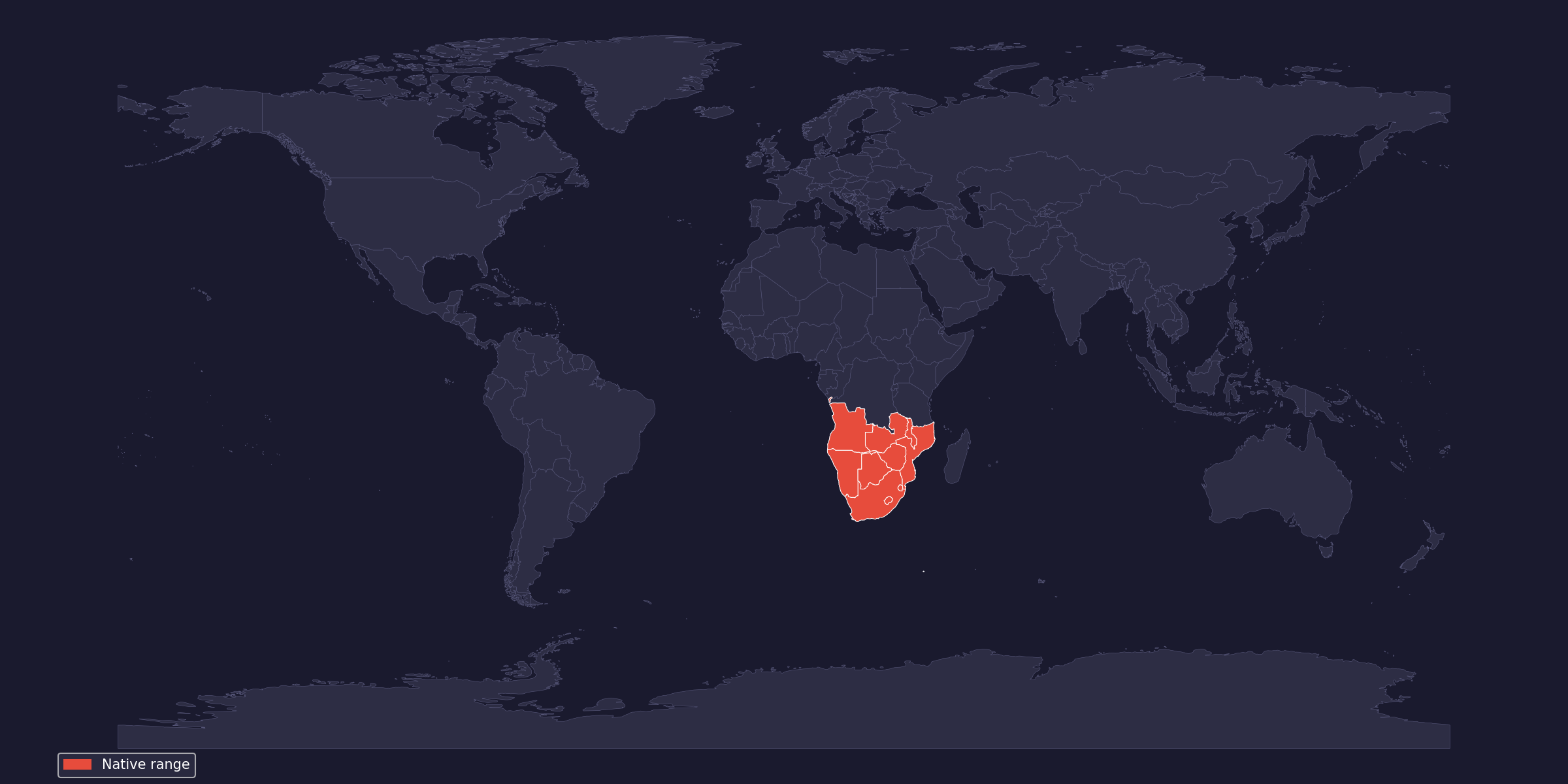
Xenopus laevis is native to southern Africa, with a broad range centred on South Africa and extending into neighbouring parts of the region. It occupies ponds, dams, slow streams and other still or gently moving waters, including seasonally variable and human-modified sites.
Introduced populations occur on several continents after releases and escapes from research, teaching and the pet trade. This history is directly relevant to care: every aquarium needs a fitted escape-proof lid, and no frog, egg, tadpole, aquarium plant, filter sludge or untreated tank water may be released outdoors or transferred to natural water.
⚖️ Legal status
The official CITES Appendices and EU Wildlife Trade Annexes checked on 2026-08-20 do not list Xenopus laevis. It is not native to Europe, so the Bern Convention is not relevant to its natural range. That does not make it freely tradeable in the European Union. The species is on the EU list of invasive alien species of Union concern under Implementing Regulation (EU) 2022/1203.
Article 7 of Regulation (EU) No 1143/2014 generally prohibits intentional import, keeping, breeding, transport, sale, exchange and release in the EU. Narrow permits exist for authorised research, ex-situ conservation and certain other approved establishments. Transitional rules may allow a non-commercial owner who already held a companion animal before listing to keep it until natural death only if reproduction and escape are prevented. Anyone in the EU should contact the competent national authority before acquiring, moving or transferring this species. Elsewhere, national and subnational bans or permits are also common.
🤌 Husbandry
This guide describes biological care for animals that may lawfully be held; it is not an invitation to acquire one where possession is prohibited. One adult needs a broad, fully cycled aquarium. A 90 x 45 cm footprint gives a large female useful swimming and resting space; more volume makes water chemistry more stable.
Keeping one frog is simplest. Similarly sized adults can sometimes share a much larger aquarium, but monitor feeding and body condition because small frogs may be swallowed and timid animals may lose food. Do not mix the species with fish, crustaceans, snails or other amphibians: they may be eaten, injure the frog or carry disease.
Quarantine any legally acquired arrival in a separate, escape-proof system with dedicated nets, siphons and buckets. Keep feeding, weight, skin and water-test records. Laboratory or imported origin, abnormal skin or unexplained weight loss justifies veterinary and pathogen assessment before the animal joins another aquatic-amphibian system.
🧪 Filtration and water
Cycle the aquarium fully before introducing the frog. Use a mature sponge filter or protected external/canister filter with diffused return; filtration must process heavy waste without producing a current that pushes the frog around.
Practical targets are:
- ammonia: 0 mg/l
- nitrite: 0 mg/l
- nitrate: preferably below 20-40 mg/l
- pH: stable, approximately 6.5-8.5
- moderate mineral content rather than distilled water
Treat all new tap water for chlorine and chloramine and match its temperature. Test regularly and replace roughly 20-30% weekly, adjusting frequency to measured nitrate and waste. Siphon leftover food immediately. Never wash biological media in untreated tap water.
Use a tight lid with no gaps around cables or pipes. Fit intakes with sponge guards. Dispose of removed water to the foul-water/sewer system where local guidance permits, never to a garden pond, stream or storm drain; disinfect equipment according to amphibian-biosecurity guidance before it leaves the system.
💡 Lighting
Provide 10-12 hours of gentle light and a complete dark period. Xenopus has no need for a basking lamp and strong illumination can cause hiding and agitation. Use floating or overhanging cover, opaque pipes and shaded areas.
Routine UVB is not required for a complete aquatic diet. If low UVB is used as part of a professionally designed system, keep exposure in Ferguson Zone 1, provide full shade and ensure the animal cannot approach a hot or unguarded lamp.
🌡 Heating and temperature
Keep water stable at about 18-22°C. Welfare guidance advises against maintaining adults below 16°C or above 24°C; sudden changes are also stressful. Warmer water holds less oxygen and increases both metabolism and waste toxicity.
Cool-room housing usually needs no heater. If heating is essential, use a guarded aquarium heater controlled by a separate thermostat. In summer, room cooling or an aquarium chiller is safer than improvised ice bottles, which cause abrupt local changes. Monitor continuously with a reliable digital thermometer.
💧 Humidity and water
Because the frog is fully aquatic, air humidity is not a husbandry target. Water chemistry, temperature, dissolved oxygen and access to the surface replace the terrestrial humidity gradient used for other frogs.
Keep at least about 20 cm of water for an adult, but leave an air gap below the lid and make surfacing easy. Provide broad resting structures below the surface. Do not fill the tank so high that a frog can push through the lid or become trapped above a rigid background.
🌿 Enclosure and decoration
Use bare glass, smooth slate or a thin layer of sand too fine to lodge in the mouth. Avoid aquarium gravel and pebbles that can be swallowed. Smooth caves, wide PVC tubes, rounded wood and robust plants provide cover; every object must be stable and free of narrow gaps that can trap a foot.
The frog has delicate skin but powerful movements. Guard heaters and filter intakes, remove sharp plastic, and choose decorations that tolerate thorough cleaning. Rearrange only part of the aquarium at a time so familiar refuges remain.
🪱 Feeding
Use a nutritionally complete sinking pellet formulated for Xenopus or carnivorous aquatic frogs as the staple. Add earthworms, blackworms and occasional safe invertebrate or small whole-fish items from controlled sources for variety. Do not use wild-caught prey, feeder goldfish, mammal meat, dog food or fish fillet as a routine diet.
Feed juveniles small measured portions daily; most adults need food every 2-3 days. Offer only what is consumed promptly, direct food toward timid individuals with tongs, and siphon remains. Because females are naturally broad, body weight and the outline of the limbs are more useful than appetite when judging obesity.
A complete formulated diet and whole prey normally make powder supplements unnecessary. Never add reptile vitamin or calcium powder directly to the aquarium unless an amphibian veterinarian has prescribed a product and dose.
🥚 Breeding notes
Adults can produce hundreds to several thousand eggs, which may hatch within about 2-4 days at 18-22°C. Tadpoles are small filter feeders and require separate rearing, stable water and appropriately fine food. Sexual maturity can occur within roughly a year.
Breeding is legally prohibited for ordinary private keepers in the EU and may be restricted elsewhere. Grandfathered animals must be prevented from reproducing. Eggs and tadpoles carry the same escape and disposal risk as adults; never flush or release them.
🧍 Handling and safety
Avoid netting or hand capture. Guide the frog into a smooth container while it remains submerged, cover the container and keep transport short. If direct contact is unavoidable, use clean wet powder-free gloves.
Wash hands after aquarium maintenance and keep tank tools away from kitchens. The frog is not venomous, but aquatic amphibians and their water can carry microorganisms, and chemicals on human skin can injure the frog.
🩺 Common problems
- Ammonia or nitrite poisoning: reddened skin, excessive surfacing, lethargy or frantic swimming requires immediate water testing and veterinary advice when signs persist.
- Bacterial or fungal skin disease: ulcers, cotton-like growth, abnormal sloughing and poor appetite need an amphibian-experienced veterinarian, not unmeasured fish medication.
- Obesity: overfeeding energy-dense pellets or vertebrate prey shortens healthy life; weigh adults and ration food.
- Ingested gravel or foreign material: loss of appetite, bloating or abnormal buoyancy may follow swallowing unsafe substrate.
- Gas-bubble disease and supersaturation: bubbles under the skin or in webbing require urgent investigation of incoming water and aeration.
- Escape trauma: a frog outside water dehydrates and injures its skin quickly; secure the lid before filling the aquarium.
📌 Conclusion
The African clawed frog can thrive for decades in cool, clean, gently filtered water, but its invasive-species status outweighs ordinary pet suitability in the EU. Existing lawful keepers need escape-proof lifetime containment and careful waste-water practice. Outside the EU, check local law first and have a mature aquarium ready before considering the species.
📚 Sources and further reading
- McNamara, Wlizla & Horb — husbandry, general care and transportation of Xenopus
- RSPCA/LASA — welfare guidelines for Xenopus laevis
- Animal Diversity Web: Xenopus laevis
- USGS nonindigenous species profile: African clawed frog
- Current CITES Appendices
- Commission Implementing Regulation (EU) 2022/1203 — Union list update
- Regulation (EU) No 1143/2014 — invasive alien species restrictions