Share

Malagasy Rainbow Frog
🔤 Taxonomy
Scaphiophryne gottlebei is the accepted scientific name. The species belongs to a Malagasy group of narrow-mouthed frogs and has no recognised subspecies. Its combination of burrowing and climbing is genuine: adults dig backward into sand yet also use holes and near-vertical sandstone walls.
English trade names include Malagasy rainbow frog, rainbow burrowing frog, painted burrowing frog, red rain frog and Gottlebe’s narrow-mouthed frog. A seller should always provide the scientific name because “rainbow frog” is not unique.
📌 Description
Adults are compact frogs patterned in sharply bounded white, greenish, orange-red and black patches. Field measurements place males around 25.2-33.9 mm and 1.9-4.0 g, with females around 26.2-34.5 mm and 2.8-7.0 g. The species is primarily nocturnal, secretive outside rain and capable of climbing as well as burrowing.
This is not a colourful alternative to a common captive-bred frog. Published husbandry knowledge is limited, historical captive mortality has been high, and a field study suggested a wild lifespan of only about two years. Any prospective keeper must accept that a longer captive lifespan is not established and that conservation and legal provenance outweigh novelty.
📋 Quick reference
| Care point | Practical target |
|---|---|
| Adult size | 2.5-3.6 cm, usually under 7 g |
| Adult enclosure | At least 60 x 45 x 60 cm for one; floor area, burrowing depth and climbable surfaces all matter |
| Wet-season day | 20-25°C with humid retreats; never copy exposed Isalo heat |
| Night/cool retreat | 17-21°C |
| Humidity | 60-85% overall, with 80-90% in wet refuges and strong ventilation |
| Substrate | 15-20 cm graded sandy soil, damp below and never compacted or waterlogged |
| Lighting | Low-level Ferguson Zone 1 UVB recommended; 10-13 hour seasonal photoperiod |
| Diet | Varied, gut-loaded tiny invertebrates every 2-4 days |
| Handling | Display-only |
| Legal status | CITES Appendix II and EU Annex B; proof of lawful origin is essential |
🌍 Distribution
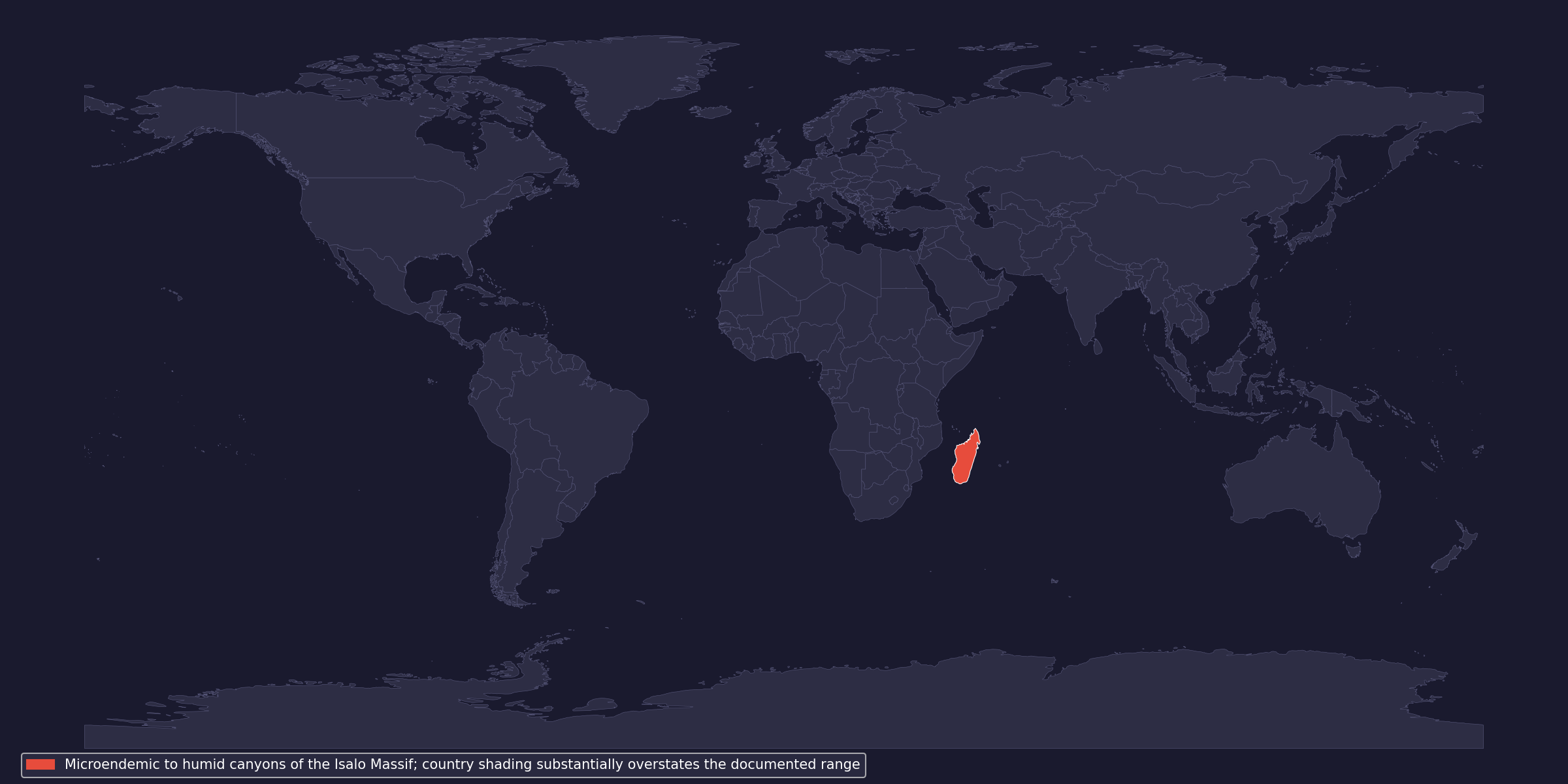
The Malagasy rainbow frog is endemic to the Isalo Massif of south-central Madagascar, chiefly at about 700-1,000 m. It survives in humid, shaded canyon systems cut through a much hotter, seasonally dry sandstone landscape. Adults shelter in sand, crevices and wall cavities; intense November-March rain creates temporary pools and stimulates movement and explosive breeding.
The IUCN assesses the species as Endangered. Its narrow range is affected by habitat disturbance and fire around canyon systems, and historical demand from the pet trade has added pressure. Country-scale maps necessarily exaggerate this microendemic distribution.
The climate normals below represent conditions around a traceable Isalo occurrence. They include exposed landscape heat and are not vivarium targets: canyon holes, damp sand and nocturnal activity give frogs access to cooler, moister microclimates.
🌡 Climate across the native range
Monthly normals from a traceable Isalo canyon occurrence in the species’ restricted native range:
Canyon des Singes, Isalo — Madagascar (verified museum occurrence)
| Month | Min °C | Mean °C | Max °C | RH % |
|---|---|---|---|---|
| January | 20.1 | 23.8 | 28.5 | 78 |
| February | 19.9 | 23.7 | 28.4 | 78 |
| March | 19.3 | 23.5 | 28.6 | 76 |
| April | 17.6 | 22.3 | 28 | 71 |
| May | 15.1 | 20.2 | 26.2 | 67 |
| June | 13 | 18.1 | 24.4 | 67 |
| July | 12.2 | 17.5 | 24.1 | 65 |
| August | 13 | 19.1 | 26.1 | 60 |
| September | 14.7 | 21.6 | 29 | 54 |
| October | 17 | 23.6 | 30.8 | 56 |
| November | 18.7 | 24.8 | 31.3 | 60 |
| December | 19.7 | 24.3 | 29.8 | 72 |
Weather data by Open-Meteo.com · CC BY 4.0 · Monthly normals calculated by Herpeton Academy from daily archive values.
Location references use GBIF.org occurrence data where available; original occurrence records retain their source dataset licenses.
⚖️ Legal status
As checked on 2026-08-30, Scaphiophryne gottlebei is in CITES Appendix II and EU Wildlife Trade Annex B. It is not a European native, so the Bern Convention is not relevant to its natural range. EU Regulation 2025/6 removed the earlier species-specific suspension on introduction from Madagascar, but that did not remove CITES, Annex B, national import or origin-document requirements.
Only consider a clearly identified animal with traceable lawful origin, ideally established captive-bred stock. Keep the dated invoice, breeder or exporter details, scientific name and every transfer/import document. A claim that a frog is “farm bred” or “legal” without records is inadequate, and the species’ conservation status makes undocumented purchases especially irresponsible.
🤌 Husbandry
House one adult alone unless an experienced breeding programme has a reason and facilities to combine compatible animals temporarily. The species is rarely maintained well enough for confident social recommendations, and solitary housing makes feeding, weight and faecal output measurable.
Quarantine for at least 60-90 days with simple hides and separately controlled substrate. Use dedicated gloves, tongs, water, misting equipment and drainage. Record weight weekly at first, photograph the dorsal pattern for identity, and arrange amphibian-veterinary advice on faecal, chytrid and ranavirus testing. Do not share water or live plants with another amphibian enclosure, and never release an animal, tadpole, plant or wastewater outdoors.
🧪 Filtration and water
Outside breeding, provide a shallow, easy-exit dish rather than a permanent deep pool. Use temperature-matched water treated for chlorine and chloramine, change it daily, and disinfect the dish safely between occupants. The frog must not be able to enter a false bottom or pump chamber.
A temporary breeding pool is an expert project, not standard furniture. It needs stable water chemistry, broad shallow exits, gentle or no current, and a plan for larvae that naturally use both bottom sediment and the water column. Never create flooding by saturating the entire terrestrial substrate.
💡 Lighting
Provide a 10-13 hour seasonal photoperiod with no night light. A plant LED can illuminate the enclosure during the day, but caves, deep crevices and leaf cover must remain dark.
Low-output Ferguson Zone 1 UVB is recommended, with about UVI 0.5-1.0 at the most exposed usable surface and zero in shelters. Use mesh and distance to soften the output and verify it with a meter where possible. Replace lamps according to measured decline or manufacturer guidance.
🌡 Heating and temperature
Maintain a wet-season daytime range near 20-25°C, with shaded retreats around 17-21°C and a night drop to the same range. Do not use the 29-31°C monthly landscape maxima in the climate table as cage targets; field frogs avoid exposed daytime heat inside humid canyon refuges.
Use a cool room first. If heating is necessary, apply weak overhead heat to one area on a thermostat and monitor at frog level, inside a burrow and on climbable rockwork. Heat mats beneath the substrate are unsafe because a frog digging to escape heat moves closer to them.
A cooler, drier seasonal phase may be useful for healthy established adults, but published captive protocols are incomplete. Never attempt strong cycling with a new, thin, sick or juvenile animal. Breeding rain should not be simulated until the keeper can control both the cool refuge and the aquatic stage.
💧 Humidity and water
Create choices rather than one saturated reading: an overall 60-85% RH, damp deeper substrate and 80-90% humid refuges during the active wet phase. Allow the uppermost sand and leaf litter to dry partially while the lower layers retain moisture. During a rest phase reduce misting gradually, but always preserve a cool damp refuge and clean drinking water.
Cross-ventilation is essential. Warm stagnant moisture encourages bacterial and fungal disease, while dry loose sand can dehydrate the frog. Check moisture by hand below the surface and use several digital probes; a single hygrometer near the lid cannot describe a 20 cm substrate profile.
🌿 Enclosure and decoration
For one adult use at least 60 x 45 cm of floor space and 60 cm height. Supply 15-20 cm of diggable substrate graded from damp finer soil below to a sandier, partly dry surface. A workable starting mix is washed sand with pesticide-free topsoil and leaf mould; it should hold a shallow burrow without collapsing into mud.
Add firmly secured sandstone-like slabs, cork tubes, narrow shaded gaps, leaf litter and plants with robust roots. Build low climbable walls with no fall onto sharp rock. Put heavy pieces on the enclosure base before adding substrate so digging cannot undermine them. Avoid pure coconut fibre, calcium sand, fertilised soil, small gravel, abrasive concrete and exposed drainage media.
🪱 Feeding
Offer prey no wider than the space between the eyes. Suitable rotation includes flightless fruit flies, pinhead crickets, springtails, bean beetles, small roach nymphs and other clean captive-cultured invertebrates. Avoid wild insects, hard oversized beetles and fatty larvae as staples.
Feed a small adult every 2-4 days during active periods, adjusting to weekly weight and body condition. Remove crickets that remain overnight. During a planned cool/dry phase appetite may fall; never assume seasonal rest when weight loss, skin changes or abnormal posture could indicate illness.
Gut-load prey for 24-48 hours. Apply a light dusting of plain calcium regularly and an amphibian-safe multivitamin about every 1-2 weeks, adjusted for measured UVB and label instructions. Avoid overlapping vitamin A or D3 products.
🥚 Breeding notes
Field breeding is explosive. After the first heavy rain, frogs gather in temporary canyon pools; eggs are attached just below the surface and hatched in about three days in one studied event at cool air temperatures around 16.7-18.7°C. Two examined females contained 168 and 196 eggs. These observations explain natural history but are not a complete captive recipe.
Captive breeding remains an expert conservation-level undertaking. A programme needs unrelated documented founders, precise seasonal control, quarantine testing, a temporary aquatic system and capacity for filter-feeding/detritivorous tadpoles and many metamorphs. Do not cycle or combine animals merely to experiment.
🧍 Handling and safety
Do not handle routinely. Move the frog by guiding it into a clean damp container or with powder-free nitrile gloves moistened in treated water. Change gloves between animals and block climbing escape routes before opening the enclosure.
The species is non-venomous and is not known as a medically significant toxin hazard. The principal safety issue is the frog’s fragile, absorbent skin: hand oils, disinfectant residue and excessive restraint can injure it.
🩺 Common problems
- Heat and desiccation: weakness, sunken appearance, abnormal posture or exposed daytime activity can signal loss of a cool humid refuge.
- Bacterial dermatitis / “red leg”: red skin, sores, lethargy or loss of righting response requires urgent veterinary assessment.
- Chytridiomycosis and ranavirus: abnormal shedding, sudden decline or deaths demand isolation and diagnostic testing.
- Parasites and poor adaptation: weight loss despite eating, abnormal faeces or persistent anorexia is especially concerning in an imported or poorly documented frog.
- Nutritional secondary hyperparathyroidism: weak limbs and deformity can follow deficient feeder nutrition, calcium or inappropriate UVB/supplement use.
- Substrate failure: compact wet mud causes skin and air-quality problems; bone-dry sand prevents normal moisture balance and burrowing.
Avoid home treatment with salt, antiseptics or fish medication. Amphibian skin absorbs chemicals rapidly.
📌 Conclusion
The Malagasy rainbow frog belongs with expert keepers or coordinated conservation collections, not impulse buyers. Before acquisition, verify lawful captive origin, specialist veterinary access, cooling, deep mixed substrate, quarantine and a sustainable tiny-prey supply. The most serious mistake is treating exposed Isalo weather—or an unverified seller’s generic frog care—as a substitute for the species’ humid canyon microclimate.
📚 Sources and further reading
- Amphibian Species of the World: Scaphiophryne gottlebei
- Andreone et al. 2013 — spatial ecology in the canyons of the Isalo Massif
- Rosa et al. 2011 — breeding aggregation and reproductive data
- Guarino et al. 2010 — sexual maturity and short lifespan
- Baines et al. 2016 — UVB provision for reptiles and amphibians
- Current CITES Appendices
- EU Wildlife Trade Annexes — consolidated Regulation (EC) No 338/97
- Commission Implementing Regulation (EU) 2025/6 — current import suspensions
- Bern Convention appendices