Share

Pyxicephalus adspersus
🔤 Taxonomy
Pyxicephalus adspersus is the currently accepted scientific name and is stable in modern hobby use.
English common names used in the hobby:
- African bullfrog
- Pixie frog
German common names used in the hobby:
- Afrikanischer Ochsenfrosch
📌 Description
Pyxicephalus adspersus is one of the largest frogs kept in captivity. It is a heavy-bodied, ground-dwelling ambush predator from sub-Saharan Africa, recognized by its enormous head, broad mouth, thick limbs, and powerful feeding response.
Adult males can become extremely large and robust, often far bulkier than females. Females stay noticeably smaller, but both sexes are strong animals with a powerful bite and a very direct feeding style. With consistent care, captive animals can live 15-20 years and sometimes longer.
This is not a handling species. Even calm adults can lunge suddenly, and frequent disturbance leads to stress, defensive posturing, and refusal to feed. It is best treated as a solitary display amphibian for keepers who appreciate large, impressive behavior rather than interaction.
🌍 Distribution
Pyxicephalus adspersus is native to southern and eastern Africa in seasonal grassland, savanna and scrub regions. In the wild it is associated with open ground with deep soil, temporary rain pools and long dry periods when frogs retreat underground.
For captive care, the useful lesson from this distribution is:
- deep, safe substrate for burrowing or sheltering below the surface
- moisture held in retreats rather than a permanently wet surface
- cooler or more stable hiding areas as well as a warmer active zone
- secure cover and low disturbance
- seasonal moisture changes handled carefully rather than extreme drying or soaking
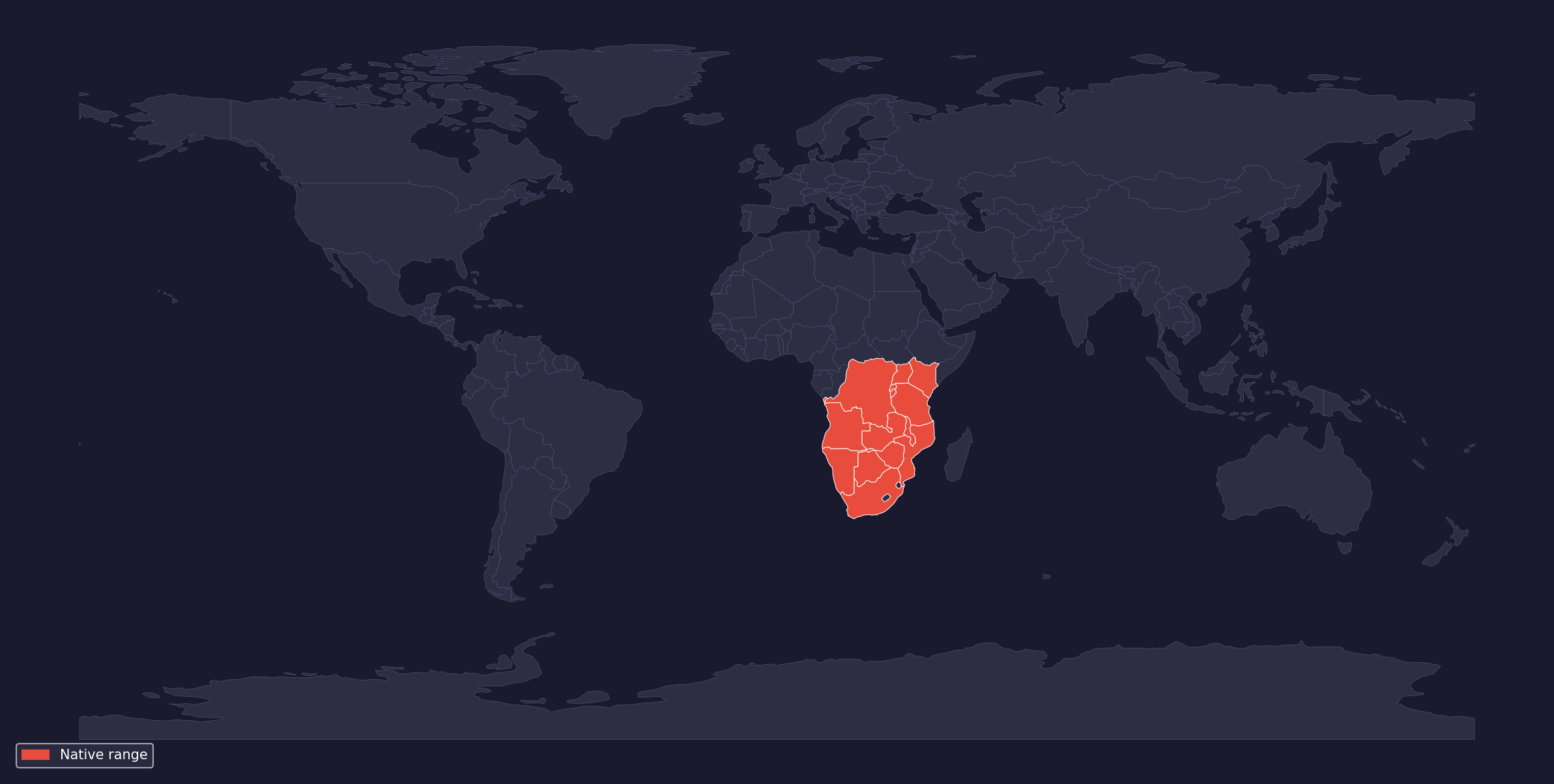
🌡 Climate across the native range
Monthly climate normals from seasonal savanna and grassland regions in southern Africa:
Pretoria, Gauteng — South Africa (southern grassland range)
| Month | Min °C | Mean °C | Max °C | RH % |
|---|---|---|---|---|
| January | 16.7 | 21.8 | 27.3 | 65 |
| February | 16.6 | 21.8 | 27.3 | 64 |
| March | 15.1 | 20.3 | 25.8 | 64 |
| April | 12 | 17.5 | 23.3 | 62 |
| May | 8.4 | 14.6 | 21.2 | 54 |
| June | 5.3 | 11.7 | 18.7 | 52 |
| July | 4.8 | 11.5 | 18.9 | 47 |
| August | 7.3 | 14.5 | 22.1 | 43 |
| September | 11.1 | 18.6 | 26.2 | 41 |
| October | 13.4 | 20.3 | 27.2 | 50 |
| November | 14.7 | 20.6 | 26.8 | 59 |
| December | 16.1 | 21.4 | 27 | 64 |
Nywane River floodplain, South-East District — Botswana (verified seasonal savanna occurrence)
| Month | Min °C | Mean °C | Max °C | RH % |
|---|---|---|---|---|
| January | 19.4 | 24.8 | 30.2 | 59 |
| February | 19.3 | 24.4 | 29.8 | 60 |
| March | 17.4 | 22.8 | 28.4 | 60 |
| April | 13.9 | 19.7 | 25.8 | 59 |
| May | 9.7 | 16.4 | 23.3 | 52 |
| June | 6.4 | 13.2 | 20.5 | 52 |
| July | 5.7 | 12.9 | 20.3 | 48 |
| August | 8.3 | 16.1 | 23.9 | 41 |
| September | 12.6 | 20.5 | 28.4 | 35 |
| October | 15.9 | 23.2 | 30.3 | 41 |
| November | 17.4 | 23.8 | 30.3 | 49 |
| December | 18.9 | 24.6 | 30.4 | 56 |
Weather data by Open-Meteo.com · CC BY 4.0 · Monthly normals calculated by Herpeton Academy from daily archive values.
Location references use GBIF.org occurrence data where available; original occurrence records retain their source dataset licenses.
⚖️ Legal status
As checked against current official sources in April 2026, no current CITES listing was found for Pyxicephalus adspersus. No specific EU Wildlife Trade Annex A-D listing was found in the same check.
The species is not relevant to the Bern Convention because it is not native to Europe. Local ownership, collection, transport, import, sale, breeding, and animal-welfare rules may still apply. In some source countries or regions, wild collection may be restricted, so documented captive-bred stock is the safest option.
🤌 Husbandry
Pyxicephalus adspersus does best in a spacious terrestrial enclosure with deep substrate, secure hides, and a large clean soaking bowl. Adults should generally be housed alone. Their size, feeding response, and territorial intolerance make cohabitation risky and unnecessary.
Useful husbandry priorities include:
- Deep substrate for digging and retreating
- A clear warm area and cooler retreat
- Clean water available at all times
- Moist lower substrate with a drier surface zone
- Careful portion control to prevent obesity
Young animals often spend more time visible and feeding actively, while adults may bury themselves for long periods. That behavior can be normal if body condition, hydration, and temperatures are correct.
🧪 Filtration and water
This species does not need a large aquatic section, but water management still matters. A broad, stable bowl should be available at all times so the frog can soak when it chooses. Because these frogs often drag substrate into the bowl and may foul it quickly, the water should be changed very frequently.
Key points include:
- Use dechlorinated or otherwise amphibian-safe water
- Keep the soaking bowl shallow enough for safe entry and exit
- Replace water promptly after fouling
- Avoid turning the whole enclosure into a wet sludge zone
Aquarium-style filtration is usually unnecessary unless the enclosure includes a much larger water section than normal. Clean manual water changes are more practical in most setups.
💡 Lighting
A normal day-night cycle is sufficient. Bright basking-style lighting is much less important than thermal control at substrate level and the ability to choose sheltered retreats.
If the enclosure includes live plants, plant lighting can be used as long as the frog still has shaded areas. Low-level UVB is optional rather than essential, and if it is offered, the animal must always be able to avoid direct exposure.
Night lighting is unnecessary. Darkness at night supports a more natural activity rhythm.
For UV planning, treat this species as Ferguson Zone 1. Aim for about UVI 0.5-1.0 in the upper exposed area, while leaving retreats and a gradient down to shaded areas near zero UVI. This usually points to a low-output UVB tube such as a ShadeDweller-style or 2-7% T5, chosen for the enclosure height; measure with a Solarmeter 6.5 when possible, because reflector, mesh, distance, and lamp age change the real exposure.
🌡 Heating and temperature
This species prefers warmth, but not constant overheating. A daytime range of about 24-30°C works well in many setups, provided the frog can retreat to a cooler area. Night temperatures around 22-25°C are usually suitable.
Suitable approximate values:
- Warm daytime zone: 28-30°C
- General ambient range: 24-28°C
- Night: 22-25°C
Heat should not bake the frog from directly above without escape options. Belly heat through uncontrolled mats can also be risky if it dries the substrate too hard or creates hot spots. Temperatures should always be checked at animal level.
💧 Humidity and water
Humidity should be moderate rather than extreme. The lower substrate layers should retain some moisture, while the upper surface and at least part of the enclosure should be allowed to dry out between wetter periods.
Good practice includes:
- Keeping a moist zone below the surface
- Allowing a drier upper layer in part of the enclosure
- Avoiding constantly swampy substrate
- Offering clean soaking water at all times
Permanent wetness leads to skin problems, foul substrate, and bacterial trouble. On the other hand, a completely dry setup with no moist refuge can cause dehydration and poor sheds. A moisture gradient works better than uniform dampness.
🌿 Enclosure and decoration
Floor space matters more than height. Juveniles can start in modest terrestrial setups, but adults need a strong, easy-to-clean enclosure with room to turn, soak, and burrow safely. Many keepers use enclosures around 90 x 45 cm or larger for big adults, especially males.
The enclosure should include:
- Deep diggable substrate such as a soil-based mix without sharp particles
- One or more sturdy hides
- A broad soaking bowl
- Open ground for feeding response and movement
- Secure furnishings that cannot collapse onto a burrowing frog
Decoration should stay practical. Heavy stones, loose wood piles, and unstable platforms are poor choices because this frog digs forcefully and can undermine them.
🪱 Feeding
Pyxicephalus adspersus is an opportunistic carnivore and should be fed a varied diet of appropriately sized prey. Suitable staples include roaches, crickets, earthworms, and other safe feeder invertebrates.
Suitable foods often include:
- Roaches
- Crickets
- Earthworms
- Locusts where available
- Occasional higher-value prey items only in moderation
Juveniles usually need more frequent feeding because they grow quickly. Adults often do well on two or three substantial meals per week, sometimes less for very heavy animals. Appetite is not a safe guide on its own, because this species will often overeat if given the chance.
Calcium should be used regularly, with broader vitamin supplementation added according to the feeder range and product instructions. Vertebrate prey, if used at all, should not become a routine staple because overuse promotes obesity and unbalanced nutrition.
🩺 Common problems
The most common problems in captivity are obesity, impaction, dehydration, rostral and mouth injuries during feeding, and bacterial skin issues associated with dirty wet substrate.
Warning signs include:
- Rapid weight gain and an overly rounded body profile
- Refusal to feed outside seasonal patterns
- Red or irritated skin
- Staying in the water constantly
- Weakness, poor strike accuracy, or abnormal posture
Impaction risk rises when frogs consume large amounts of loose indigestible substrate during feeding. Overheating is another serious threat, especially in simple enclosures with no cool retreat. Any persistent bloating, severe lethargy, skin lesions, or feeding problems should be evaluated by a veterinarian experienced with amphibians.
📌 Conclusion
Pyxicephalus adspersus is an impressive long-lived frog that rewards keepers who provide space, depth, clean water, and sensible feeding control. It is not difficult in concept, but it is easy to keep badly if the enclosure is too wet, too small, or too heavily fed.
For keepers who want a powerful solitary terrestrial amphibian rather than a social display group, this species is a memorable and highly distinctive choice.
📚 Sources and further reading
- CITES Appendices and Species+ trade database, checked April 2026
- EU wildlife trade regulations and annex references, checked April 2026
- GBIF species backbone and occurrence data for taxonomy and distribution context
- IUCN Red List and specialist husbandry references where applicable
💬 Feedback
For questions, corrections, or practical notes, leave us a message in the forum thread.