Share

Golden Mantella
🔤 Taxonomy
Mantella aurantiaca is the accepted name of the golden mantella, a Malagasy mantellid frog. The invalid hobby name M. aurantiaca rubra still appears occasionally; red, orange and yellow animals are colour variation, not recognised subspecies. Do not confuse this species with M. milotympanum, which has a conspicuous dark tympanum.
English common names used in the hobby include golden mantella, golden frog and Madagascan golden frog.
📌 Description
This is a tiny, day-active frog: males are usually 20-22 mm and females 24-26 mm from snout to vent. Adults are uniformly yellow, orange or red-orange with black eyes; young froglets begin brownish and acquire the adult colour gradually. Captive animals commonly live beyond five years, and exceptional records approach 12 years.
Golden mantellas are display animals, not miniature handling pets. Their permeable skin is easily damaged by dry hands, soap, insect repellent and cleaning residue. Wild frogs obtain defensive lipophilic alkaloids from their prey; long-term captive-bred animals normally lack that wild chemical profile, but this is not a reason to touch them.
📋 Quick reference
| Care point | Practical target |
|---|---|
| Adult size | 2.0-2.6 cm; females are larger |
| Group enclosure | At least 45 x 45 x 45 cm for a small compatible group |
| Warm/wet season | 18-24°C and 80-90% RH |
| Cool/drier season | 15-20°C; about 70% RH without drying the substrate completely |
| Heat limit | Avoid prolonged temperatures above 24°C |
| Substrate | 8-10 cm drained soil/leaf-litter system with abundant cover |
| Lighting | Low-level Ferguson Zone 1 UVB recommended; 10-14 hour seasonal photoperiod |
| Diet | Flightless fruit flies, springtails and other tiny gut-loaded invertebrates |
| Handling | Display-only; damp gloves only when movement is unavoidable |
| Legal status | CITES Appendix II, EU Annex B; EU import of wild Madagascar specimens is currently suspended |
🌍 Distribution
The golden mantella is microendemic to a small upland area of east-central Madagascar around Moramanga, Torotorofotsy and the remaining forest-wetland mosaic nearby, roughly 873-1,054 m above sea level. It uses humid forest and swamp margins with deep leaf litter and temporary breeding pools. Habitat loss, degradation, mining pressure and historical collection for trade make the species conservation-sensitive; the current IUCN category is Endangered.
The monthly climate table below describes open-air conditions near the range, not the exact temperature under leaf litter. In captivity the safe lesson is a cool, ventilated moisture gradient. The frog must always be able to retreat into damp cover, and room cooling may be essential in summer.
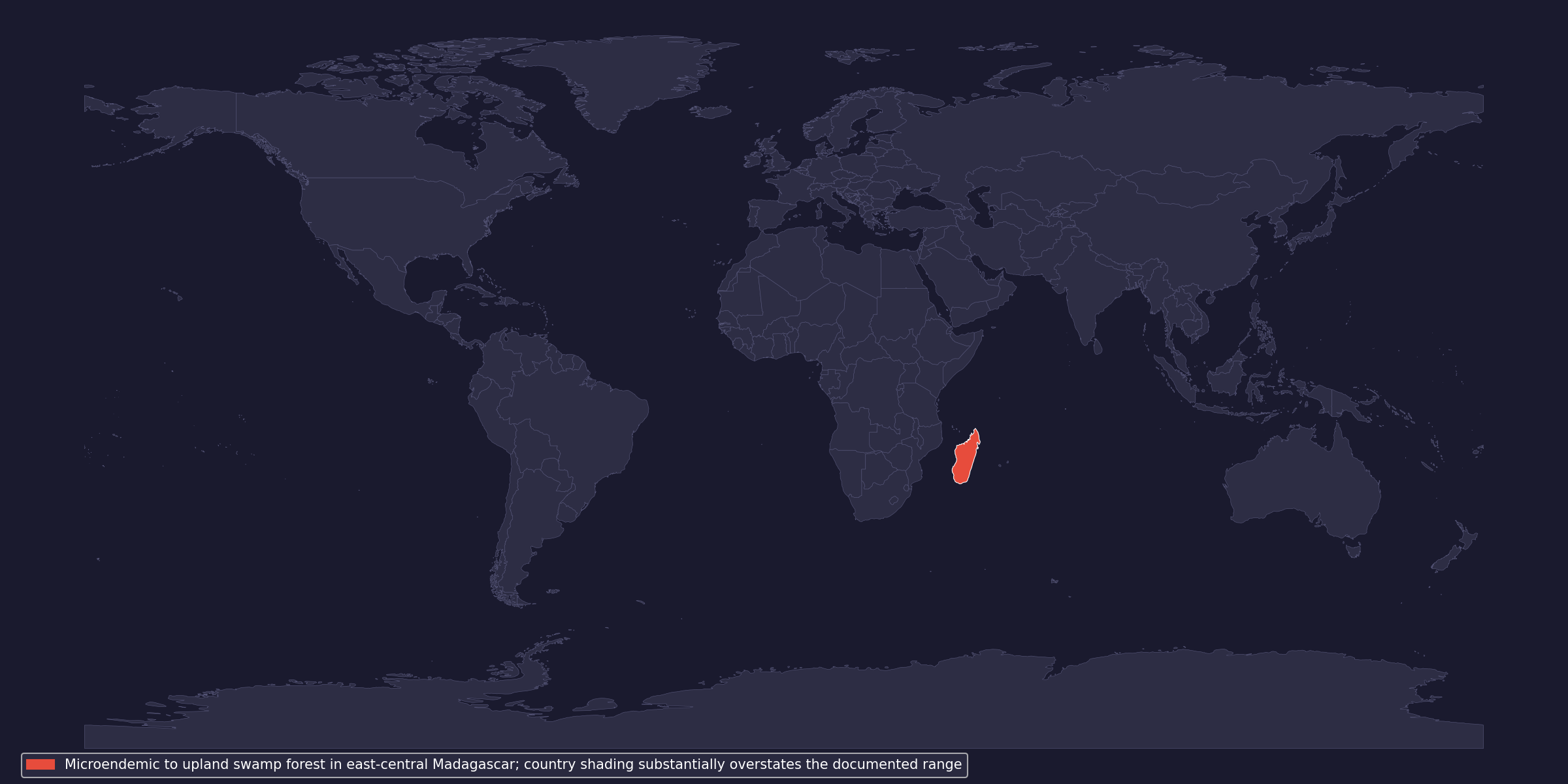
🌡 Climate across the native range
Monthly normals from a representative occurrence near the species’ documented upland core range:
Alaotra-Mangoro — Madagascar (GBIF occurrence near the documented core range)
| Month | Min °C | Mean °C | Max °C | RH % |
|---|---|---|---|---|
| January | 17.9 | 20.7 | 25.3 | 87 |
| February | 18 | 20.6 | 24.9 | 88 |
| March | 17.7 | 20.2 | 24.4 | 88 |
| April | 16.6 | 19.2 | 23.1 | 88 |
| May | 14.9 | 17.5 | 21.3 | 88 |
| June | 12.8 | 15.3 | 18.8 | 88 |
| July | 11.8 | 14.3 | 17.8 | 88 |
| August | 11.8 | 14.7 | 18.8 | 86 |
| September | 12.5 | 16 | 20.7 | 84 |
| October | 14.2 | 18 | 23.1 | 82 |
| November | 15.7 | 19.6 | 25 | 82 |
| December | 17.2 | 20.5 | 25.6 | 84 |
Weather data by Open-Meteo.com · CC BY 4.0 · Monthly normals calculated by Herpeton Academy from daily archive values.
Location references use GBIF.org occurrence data where available; original occurrence records retain their source dataset licenses.
⚖️ Legal status
As checked on 2026-08-30, Mantella aurantiaca is covered by the genus listing in CITES Appendix II and by EU Wildlife Trade Annex B. It is not native to Europe, so the Bern Convention is not relevant to its natural range. Commission Implementing Regulation (EU) 2025/6 also suspends introduction into the EU of wild specimens from Madagascar.
Buy only a correctly identified, demonstrably captive-bred animal. Keep the dated invoice, breeder identity, scientific name, parent-stock or transfer information and any import documents for the frog’s lifetime. Appendix II and Annex B do not replace national rules on registration, sale, breeding, transport or welfare, and an online listing is not proof of lawful origin.
🤌 Husbandry
A 45 x 45 x 45 cm enclosure can support a carefully observed group of three or four. Larger groups need proportionally more floor area, visual barriers and feeding sites. Several males can provide normal calling and territorial behaviour, but crowding produces chronic competition; separate any animal that loses weight or is repeatedly displaced.
Quarantine every new frog for 60-90 days in another room where possible. Use dedicated gloves, misting bottles, feeding tools and drainage equipment. Record body condition, appetite and faeces, and discuss chytrid and ranavirus testing with an amphibian-experienced veterinarian. Never move plants, water or substrate between amphibian enclosures without an appropriate disinfection protocol, and never release captive animals or wastewater outdoors.
🧪 Filtration and water
Adults do not need a deep swimming pool. Provide one or more very shallow dishes or a gently sloping margin from which a 2 cm frog can leave immediately. Use clean, temperature-matched water treated for chlorine and chloramine; replace it daily and after fouling.
A false bottom or drainage layer prevents the soil from becoming anaerobic, but frogs must not be able to enter it. Standing water, pumps and breeding pools require easy cleaning and very low flow. Distilled or reverse-osmosis water used alone is too mineral-poor for routine soaking unless appropriately remineralised.
💡 Lighting
Provide a clear seasonal day-night rhythm: about 14 hours of light during the warmer wet season and gradually reduce toward 10 hours in the cooler period. Plant LEDs are useful, but dense leaf litter, cork and plants must create full shade.
Low-output UVB is recommended. Treat the species as Ferguson Zone 1, with roughly UVI 0.5-1.0 at the brightest usable position and zero inside retreats. Measure through the actual mesh and replace lamps according to measured output or manufacturer guidance; never compensate for a weak lamp by removing all shade.
🌡 Heating and temperature
During the active November-April season, keep the enclosure around 18-24°C. Prolonged exposure above 24°C is a recognised husbandry risk, and 26°C should be treated as an emergency warning rather than a routine target. From May to October, healthy established adults may be eased gradually toward 15-20°C.
Most homes need cooling rather than heating. Place the enclosure away from windows and hot equipment; use an air-conditioned room or controlled cabinet if summer room temperature is unsafe. If supplemental heat is genuinely needed, use weak overhead heat on a thermostat. Measure at frog level and within the leaf litter, not only near the lid.
Seasonal cooling is not automatic for newly acquired, thin, ill or juvenile frogs. Stabilise them first and seek experienced advice before attempting a breeding cycle.
💧 Humidity and water
Target roughly 80-90% RH in the wet season with frequent light misting, then about 70% during the cooler period. These figures are guides: the substrate should stay damp below the surface while the top leaf litter can partially dry between mistings. No part of the occupied substrate should become dusty or desiccated.
High humidity without fresh air quickly becomes dangerous. Use cross-ventilation and remove decaying food, faeces and waterlogged leaf litter. Persistent hiding, wrinkled skin, unusual posture or loss of appetite may reflect heat, dehydration or infection; flooding the enclosure without diagnosing the cause can make matters worse.
🌿 Enclosure and decoration
Build over a secure drainage layer with 8-10 cm of pesticide-free topsoil, fine orchid bark, leaf mould and a little sphagnum where moisture buffering is needed. Cover most of the surface with clean leaf litter. Add cork pieces, coconut shelters, moss patches, low plants and several dark nesting crevices.
All openings must exclude springtail-sized froglets. Screen drainage gaps and cable ports, and check doors before misting. Avoid sharp gravel, fertilised compost, aromatic wood, bare sticky surfaces and exposed expanded-clay balls. For quarantine, a simple enclosure with damp leaf litter and removable hides is easier to inspect than a mature bioactive display.
🪱 Feeding
Offer a varied stream of prey small enough to swallow safely—generally no wider than the space between the eyes. Flightless Drosophila, springtails, pinhead crickets, bean beetles and tiny captive-cultured isopods can be rotated. Wild-collected invertebrates carry pesticide, parasite and predator risks and are best avoided.
Adults are active foragers and normally receive small meals daily or every other day; juveniles need tiny food available more consistently. Use several feeding points so subordinate frogs eat, and remove larger uneaten crickets.
Gut-load feeders for 24-48 hours. Dust lightly with plain calcium on most juvenile meals and regularly for adults, with an amphibian-safe multivitamin about once weekly or according to its label. Adjust D3 to measured UVB provision and do not combine multiple vitamin products. Monitor each frog: group appetite is not evidence that every individual is maintaining condition.
🥚 Breeding notes
Breeding requires a healthy mature group, usually including more than one male, and gradual seasonal changes in temperature, rainfall and photoperiod. Females deposit roughly 20 to more than 100 eggs in humid cover near water. At 20-24°C embryonic development commonly lasts about 10-14 days before rain washes or the keeper transfers hatchlings into shallow rearing water.
Tadpoles need aged, clean, gently aerated water, careful feeding and frequent removal of debris; metamorphosis often takes 56-90 days. Newly metamorphosed froglets dehydrate rapidly and require springtails plus secure, easy-to-monitor damp housing. Do not breed without space, food cultures, legal records and a plan for every offspring.
🧍 Handling and safety
Routine handling is inappropriate. For essential movement, guide the frog into a clean damp cup or wear powder-free nitrile gloves moistened with treated water. Change gloves between animals.
The species is non-venomous: it does not inject venom. Wild mantellas may carry diet-derived skin alkaloids, so avoid contact with eyes, mouth and broken skin and wash after enclosure work. The greater risks are chemical transfer to the frog and accidental crushing or escape.
🩺 Common problems
- Heat stress: frantic movement, gaping, collapse or loss of coordination in a warm enclosure is an emergency; cool the room safely and contact an amphibian veterinarian.
- Dehydration: wrinkled skin, weakness and sunken appearance point to failed moisture access, excessive ventilation or heat.
- Nutritional secondary hyperparathyroidism: weak limbs, poor growth and deformity can follow inadequate calcium, poor feeder nutrition or inappropriate UVB/supplement balance.
- Bacterial dermatitis / “red leg”: reddening, ulcers, lethargy or abnormal posture require urgent veterinary assessment, not home antiseptics.
- Chytridiomycosis, ranavirus and parasites: abnormal shedding, weight loss, sudden deaths or persistent anorexia require immediate isolation and diagnostic testing.
- Group competition: one frog becoming thin while others feed normally means feeding access and social pressure must be reviewed at once.
📌 Conclusion
The golden mantella suits an advanced keeper who can keep a humid display cool through summer, maintain several tiny feeder cultures and enforce amphibian biosecurity. Resolve cooling, quarantine and legal-origin documentation before purchase; excess heat and assuming that every frog in a group is eating are the most avoidable failures.
📚 Sources and further reading
- Amphibian Species of the World: Mantella aurantiaca
- Amphibian Ark — husbandry guidelines for Mantella aurantiaca
- Edmonds et al. — captive husbandry and reproduction at the Mitsinjo facility
- Baines et al. 2016 — UVB provision for reptiles and amphibians
- Current CITES Appendices
- EU Wildlife Trade Annexes — consolidated Regulation (EC) No 338/97
- Commission Implementing Regulation (EU) 2025/6 — current import suspensions
- Bern Convention appendices