Share

Dendrobates leucomelas
🔤 Taxonomy
Dendrobates leucomelas is the currently accepted scientific name and is stable in current use.
English common names used in the hobby:
- Yellow-banded poison frog
- Bumblebee poison frog
German common names used in the hobby:
- Gelbgebänderter Pfeilgiftfrosch
📌 Description
Dendrobates leucomelas is a lively yellow-and-black poison frog that is often recommended to keepers who want a visible daytime species for a planted display terrarium. It is active, vocal, and often somewhat more outgoing than many other dart frogs when the enclosure is set up well.
Adults usually reach about 3.5-4.5 cm and may live 10-15 years in captivity. Mature females are often slightly broader than males, while males are usually more active around calling and breeding sites.
Captive-bred animals are not dangerous in normal keeping conditions, but they remain delicate amphibians that should be handled as little as possible. Their welfare depends much more on climate control and nutrition than on any concern about toxins.
🌍 Distribution
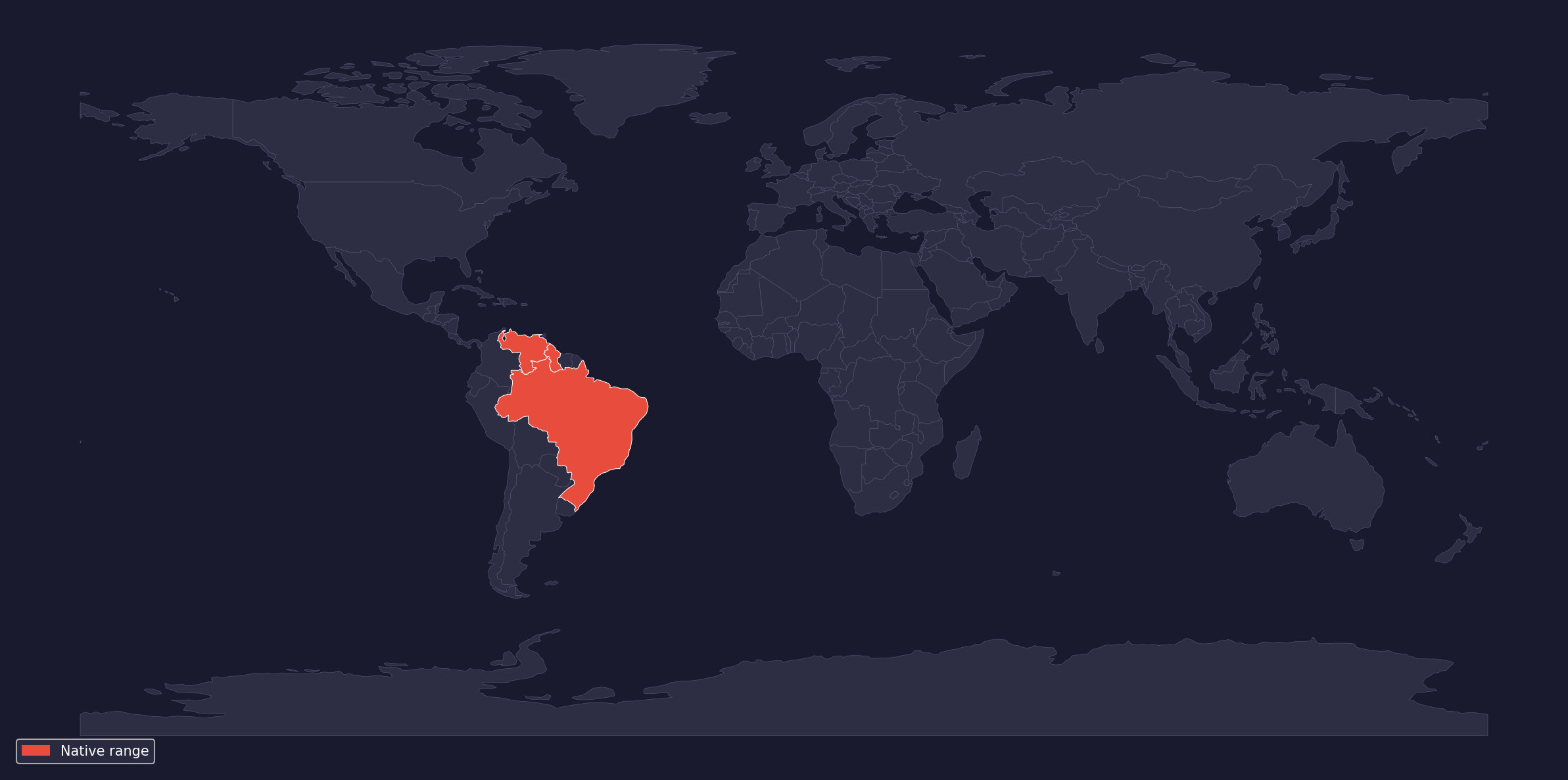
Dendrobates leucomelas is native to northern South America, especially Venezuela with nearby Guyana and Brazil. In the wild it is associated with warm humid forest, forest edge, leaf litter and low woody structure.
For captive care, the useful lesson from this distribution is:
- stable humidity with fresh airflow rather than stagnant wetness
- leaf litter, roots, plants, or other natural cover at the level the species actually uses
- clean water sources or deposition sites appropriate to the species
- moderate temperatures with night drops where they occur naturally
- a planted enclosure that creates several small microclimates
🌡 Climate across the native range
Monthly climate normals from representative northern South American stations near the native range:
Puerto Ayacucho, Amazonas — Venezuela (Orinoco edge of range)
| Month | Min °C | Mean °C | Max °C | RH % |
|---|---|---|---|---|
| January | 24 | 27.8 | 32.3 | 67 |
| February | 24.6 | 28.5 | 33.1 | 64 |
| March | 24.6 | 28.1 | 32.6 | 73 |
| April | 24 | 26.5 | 30 | 86 |
| May | 23.6 | 25.5 | 28.6 | 91 |
| June | 23 | 24.9 | 27.8 | 92 |
| July | 22.6 | 24.6 | 27.7 | 91 |
| August | 22.9 | 25.1 | 28.5 | 90 |
| September | 23.3 | 25.7 | 29.4 | 90 |
| October | 23.6 | 26 | 29.7 | 90 |
| November | 23.6 | 26.1 | 29.7 | 89 |
| December | 23.6 | 26.5 | 30.4 | 81 |
Upper Takutu-Upper Essequibo — Guyana (verified Rupununi occurrence)
| Month | Min °C | Mean °C | Max °C | RH % |
|---|---|---|---|---|
| January | 23 | 26.1 | 30.6 | 73 |
| February | 23 | 26.3 | 30.9 | 72 |
| March | 23.3 | 26.9 | 31.8 | 70 |
| April | 23.5 | 26.6 | 31.3 | 75 |
| May | 23.1 | 25.6 | 29.6 | 85 |
| June | 22.6 | 25 | 29 | 88 |
| July | 22.2 | 25 | 29.1 | 88 |
| August | 22.6 | 25.6 | 29.9 | 86 |
| September | 23.2 | 26.7 | 31.4 | 80 |
| October | 23.9 | 27.7 | 32.7 | 74 |
| November | 23.9 | 27.3 | 32.3 | 75 |
| December | 23.4 | 26.5 | 31.1 | 76 |
Weather data by Open-Meteo.com · CC BY 4.0 · Monthly normals calculated by Herpeton Academy from daily archive values.
Location references use GBIF.org occurrence data where available; original occurrence records retain their source dataset licenses.
⚖️ Legal status
As checked against current official sources in April 2026, Dendrobates leucomelas is listed in CITES Appendix II. Under EU wildlife-trade rules, that generally corresponds to Annex B unless a stricter measure applies.
The species is not relevant to the Bern Convention because it is not native to Europe. Local ownership, collection, transport, import, sale, breeding, and animal-welfare rules may still apply. Clearly documented captive-bred animals are the best choice.
🤌 Husbandry
Dendrobates leucomelas needs a planted humid terrarium with drainage, visual clutter, and stable moderate temperatures. It is often considered one of the more approachable poison frogs for prepared keepers, but it still responds badly to overheating and poor hygiene.
Pairs and small groups can work when the enclosure offers enough floor area and enough visual barriers. As with other poison frogs, crowding increases stress even if the frogs still appear active.
Useful husbandry priorities include:
- Consistent humidity with airflow
- Reliable drainage below the substrate
- Plenty of leaf litter and retreats
- Frequent feeding with tiny live prey
- Minimal unnecessary disturbance
🧪 Filtration and water
This species does not need a large water feature. What matters is clean misting water and a terrarium design that keeps the upper substrate damp but not stagnant.
Key points include:
- Use dechlorinated or reverse-osmosis water for misting
- Keep drainage systems functioning properly
- Avoid standing pools in the main walking zones
- Clean small deposition sites if breeding is attempted
A sour-smelling or permanently muddy enclosure is a warning sign that water management is failing.
💡 Lighting
Dendrobates leucomelas is diurnal and benefits from a clear day-night cycle of about 10-12 hours. Bright plant lighting is acceptable when the frogs still have shaded retreats and low cover.
Low-level UVB can be provided cautiously, but only if the frogs can avoid it completely when they choose. Constant night lighting should be avoided.
For UV planning, treat this species as Ferguson Zone 1. Aim for about UVI 0.5-1.0 in the upper exposed area, while leaving retreats and a gradient down to shaded areas near zero UVI. This usually points to a low-output UVB tube such as a ShadeDweller-style or 2-7% T5, chosen for the enclosure height; measure with a Solarmeter 6.5 when possible, because reflector, mesh, distance, and lamp age change the real exposure.
🌡 Heating and temperature
Suitable temperatures are usually around 22-26°C by day and about 20-22°C at night. The species tolerates modest warmth, but prolonged overheating is dangerous.
Suitable approximate values:
- Daytime ambient: 22-26°C
- Warm daytime peak: around 26-27°C
- Night: 20-22°C
Temperatures above about 28°C create rapid stress, especially in humid enclosures with limited cooling.
💧 Humidity and water
Humidity should stay high, often around 80-100% with some daily fluctuation. The enclosure should feel fresh and humid rather than stale and swampy.
Good practice includes:
- Regular misting based on ventilation
- Damp leaf litter that does not break down into sludge
- Moist lower layers over a proper drainage system
- Enough airflow to prevent stagnant air
Poison frogs do poorly in both extremes: bone-dry terrariums and soaked poorly ventilated terrariums.
🌿 Enclosure and decoration
A cube or horizontal terrarium with useful floor space is usually more practical than a very tall setup. For a pair or small group, many keepers begin around 45 x 45 x 45 cm or larger.
The enclosure should include:
- A drainage layer or false bottom
- Humid tropical substrate
- Generous leaf litter
- Cork bark, roots, seed pods, and low branches
- Live plants such as Philodendron, Epipremnum, bromeliads, and mosses
These frogs often become bolder when they can move through complex cover rather than across exposed glass and open ground.
🪱 Feeding
Dendrobates leucomelas should be fed frequent meals of very small live prey. Variety helps maintain body condition and reduces dependence on a single feeder culture.
Suitable foods include:
- Drosophila melanogaster
- Drosophila hydei
- Springtails
- Bean beetles
- Tiny crickets or roach nymphs for larger adults where appropriate
Juveniles generally need daily feeding. Adults are often fed five or six times per week in small portions. Calcium should be used regularly, while vitamin and mineral supplementation is added according to the prey range and product schedule.
🩺 Common problems
The most common problems are overheating, dehydration from poor balance between airflow and misting, weak supplementation, skin irritation from dirty surfaces, and chronic stress from sparse enclosures.
Warning signs include:
- Weight loss
- Reduced feeding response
- Spending too much time hidden
- Abnormal sheds
- Red irritated belly or feet
- Lethargy during normally active periods
New animals should be quarantined before entering an established group. Any frog with persistent anorexia, swelling, visible skin damage, or abnormal posture should be evaluated by a veterinarian experienced with amphibians.
📌 Conclusion
Dendrobates leucomelas is an excellent display poison frog when its enclosure is humid, clean, planted, and well drained. It can be a good entry point into poison frog keeping, but only when the keeper takes temperature and hygiene seriously.
In a mature terrarium with stable routines, this species is active, attractive, and very enjoyable to observe.
📚 Sources and further reading
- CITES Appendices, checked 2026-05-04
- EU wildlife trade regulations and annex references, checked April 2026
- GBIF species backbone and occurrence data for taxonomy and distribution context
- IUCN Red List and specialist husbandry references where applicable
💬 Feedback
For questions, corrections, or practical notes, leave us a message in the forum thread.