Share

Cynops pyrrhogaster
🔤 Taxonomy
Cynops pyrrhogaster is the accepted scientific name for the Japanese fire-bellied newt. Regional Japanese forms are discussed in the hobby, so avoid mixing locality lines for breeding.
English common names used in the hobby:
- Japanese fire-bellied newt
📌 Description
Cynops pyrrhogaster is an amphibian kept for observation rather than handling. Adult size is usually around 9-14 cm, and a realistic lifespan in stable care is about 10-20 years. It needs clean water, secure hides, correct temperature, and calm maintenance more than decorative complexity.
Like other amphibians, it has permeable skin and should not be handled casually. Use wet, clean hands or a soft container only when movement is necessary for health checks or enclosure work.
🌍 Distribution
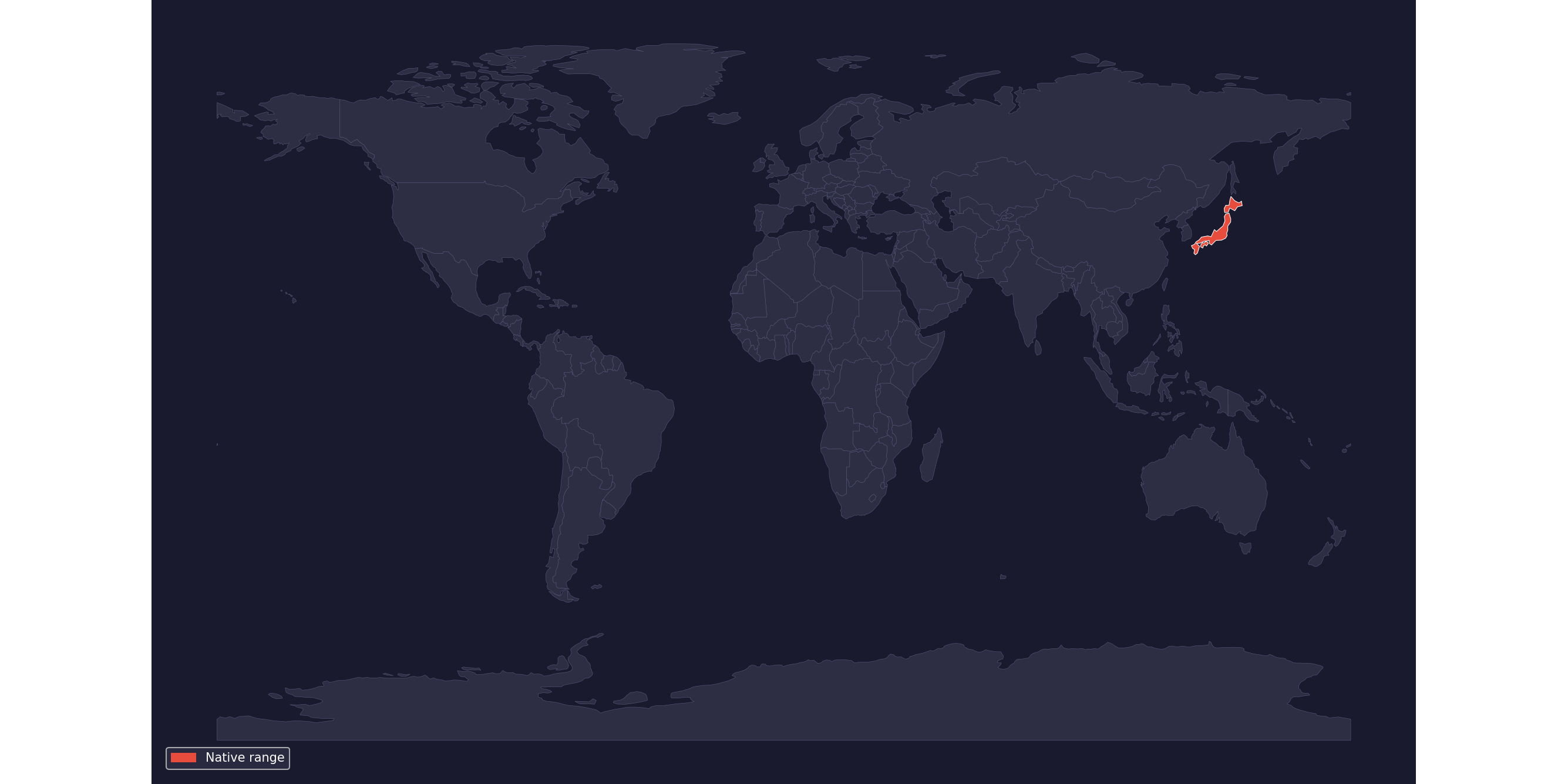
Japan, where regional forms use ponds, rice fields, ditches, and slow vegetated water.
For captive care, the useful lesson from this distribution is:
- match the broad habitat type rather than copying one weather station
- provide clean water and secure retreats at all times
- keep temperatures moderate and avoid chronic overheating
- create microclimates so the animal can choose wetter, drier, warmer, and cooler areas
- buy captive-bred animals and avoid pressure on wild populations
🌡 Climate across the native range
Monthly climate normals from reviewed GBIF occurrence locations:
Kyoto — Japan
| Month | Min °C | Mean °C | Max °C | RH % |
|---|---|---|---|---|
| January | -0.5 | 2.9 | 6.3 | 75 |
| February | -0.8 | 2.9 | 6.5 | 74 |
| March | 1.3 | 5.8 | 10.2 | 71 |
| April | 6.5 | 11.7 | 16.9 | 68 |
| May | 11.4 | 16.4 | 21.4 | 70 |
| June | 16.4 | 20.5 | 24.6 | 76 |
| July | 20.7 | 24.7 | 28.7 | 77 |
| August | 21.6 | 25.9 | 30.2 | 75 |
| September | 17.7 | 21.6 | 25.5 | 77 |
| October | 11.5 | 15.7 | 20 | 75 |
| November | 6.3 | 10.5 | 14.7 | 75 |
| December | 1.6 | 5.5 | 9.5 | 75 |
Okayama — Japan
| Month | Min °C | Mean °C | Max °C | RH % |
|---|---|---|---|---|
| January | -3.3 | 0.1 | 3.6 | 81 |
| February | -3.5 | 0.3 | 4.1 | 80 |
| March | -1 | 3.7 | 8.3 | 76 |
| April | 4.5 | 9.7 | 15 | 72 |
| May | 9.5 | 14.5 | 19.6 | 73 |
| June | 14.5 | 18.6 | 22.7 | 81 |
| July | 19.4 | 23 | 26.7 | 82 |
| August | 19.8 | 23.8 | 27.9 | 80 |
| September | 15.4 | 19.4 | 23.3 | 83 |
| October | 8.9 | 13.3 | 17.8 | 80 |
| November | 3.6 | 8.1 | 12.5 | 79 |
| December | -1 | 3 | 6.9 | 79 |
Kanagawa — Japan
| Month | Min °C | Mean °C | Max °C | RH % |
|---|---|---|---|---|
| January | -2.9 | 2.4 | 7.7 | 58 |
| February | -2.6 | 2.5 | 7.7 | 58 |
| March | 0.3 | 5.3 | 10.4 | 65 |
| April | 6 | 10.9 | 15.9 | 68 |
| May | 10.5 | 15.3 | 20.1 | 72 |
| June | 14.6 | 18.4 | 22.3 | 82 |
| July | 18.4 | 22.1 | 25.8 | 84 |
| August | 19.5 | 23.5 | 27.5 | 82 |
| September | 16.4 | 20 | 23.7 | 82 |
| October | 10.4 | 14.5 | 18.6 | 76 |
| November | 4.9 | 9.8 | 14.6 | 69 |
| December | -0.2 | 5.1 | 10.3 | 61 |
Weather data by WorldClim v2.1 · Monthly normals queried by Herpeton Academy from raster values; relative humidity is derived from vapor pressure and mean temperature.
Location references use GBIF.org occurrence data where available; original occurrence records retain their source dataset licenses.
⚖️ Legal status
As checked against current official sources in April 2026, no current CITES listing was found for Cynops pyrrhogaster. No specific EU Wildlife Trade Annex A-D listing was found in the same check. The species is not relevant to the Bern Convention unless local native-population rules apply.
It is not native to Europe and is not relevant to the Bern Convention. EU animal-health measures for salamanders and Bsal may still affect movement and trade. Local ownership, import, transport, sale, breeding, collection, release, and animal-welfare rules may still apply. Captive-bred animals with clear origin records are strongly preferable.
🧭 Life stage differences
For adults: Adults are usually calm aquatic newts, but locality lines and seasonal behavior matter. Good care relies on cool water, heavy planting, and easy exits rather than strong current.
For babies and juveniles: Larvae and juveniles are much more sensitive to unstable water, strong current, and food competition. Keep them in shallower, well-covered setups where feeding and cleaning can be checked every day.
After metamorphosis, some juveniles may be temporarily more terrestrial. At that stage, provide a secure damp setup with shallow water, easy exits, and small foods. Forcing a young newt back into deep water is risky if it is not swimming confidently.
Watch closely: Adults need more water volume and more stable biological filtration. A small container may look clean, but ammonia and nitrite can rise quickly after feeding.
🤌 Husbandry
Cycle the aquarium before the animal is introduced. Sponge filters, low-flow internal filters, or external filters with a spray bar are suitable when they do not create a strong current. Plants and hides reduce stress, but they do not replace ammonia, nitrite, and nitrate testing.
Keep this species in a cool, cycled aquarium with gentle filtration, many plants or hides, and an easy land or floating rest option. Adults are mostly aquatic, but they still need secure exits and calm water. Avoid mixing species.
🧪 Filtration and water
Water quality is central. Cycle the aquarium before adding animals, use dechlorinated water, keep ammonia and nitrite at zero, and control nitrate with water changes and plants. Flow should be gentle, not a strong current.
💡 Lighting
Moderate plant lighting on a 10-12 hour cycle is enough. Low-level UVB can be used cautiously over part of the enclosure if shaded water and hides remain available. Avoid lighting that warms the water.
🌡 Heating and temperature
Practical target range: 14-22 °C; avoid warm water. Use digital thermometers and place the enclosure where seasonal room temperatures are predictable. Amphibians often tolerate cool conditions better than heat, and overheating can become dangerous quickly.
💧 Humidity and water
Keep ammonia at 0 mg/l and nitrite at 0 mg/l. Nitrate should be controlled with partial water changes, plants, and moderate feeding. With any odd smell, cloudy water, red skin, or an animal lingering at the surface, water quality is the first thing to check.
Ambient humidity matters less than water quality, but the land or floating rest area must not dry the animal. Keep the aquarium covered securely while maintaining gas exchange.
🌿 Enclosure and decoration
Minimum practical adult housing: 60 x 30 x 30 cm aquarium for a pair; larger for groups. Bigger is useful when it creates more stable water, more hiding choices, or a better temperature gradient. Baby and juvenile setups should be smaller, secure, and easy to monitor; upgrade before the animal becomes cramped or water quality becomes unstable.
Use a cool aquarium with plants, cork or floating platforms, hides, and smooth surfaces. Juveniles may go through a terrestrial stage and need a small escape-proof damp setup before returning to water. Adults need more water volume than height.
🪱 Feeding
Juveniles feed more often on small moving foods, while adults usually eat a few times per week depending on temperature and body condition. Earthworms are an excellent staple for larger animals; frozen foods must be clean and should not foul the water.
Feed earthworms, blackworms where legal and clean, bloodworms, daphnia, small aquatic invertebrates, and soft chopped foods. Remove leftovers promptly. Avoid feeder fish and fatty foods.
🥚 Breeding
Breeding is usually encouraged by strong adult condition, seasonal cooling, and stable water. Eggs are placed on plants or fine leaves and are often safer when separated for rearing. Larvae need clean water, tiny live foods, protection from filter intake, and size sorting if aggression or cannibalism appears. Do not breed animals of unclear origin, animals showing disease signs, or locality lines that should be kept separate.
🩺 Common problems
In aquatic newts, abnormal floating, staying on land, trying to leave the water, or reddened skin often points to water, temperature, or infection problems. Do not add fish medications without veterinary guidance; many products are unsafe for amphibians.
Common problems include ammonia or nitrite poisoning, warm water stress, fungal skin patches, bloating, escape, wounds from sharp decor, and starvation from competition. Warning signs include floating, frantic swimming, curled body, skin fuzz, red skin, refusal to feed, or gasping at the surface.
Persistent refusal to feed, swelling, wounds, breathing difficulty, abnormal floating, severe weakness, or spreading skin changes should be assessed by a veterinarian experienced with amphibians.
📌 Conclusion
Use this care sheet as a practical framework, not as an excuse for minimalism: stable conditions, observation, and origin records are the foundation of good amphibian keeping.
This species rewards keepers who treat it like a cool-water amphibian, not a tropical fish: stable water chemistry, modest temperatures, gentle flow, and clean food.
📚 Sources and further reading
- GBIF species backbone entry for Cynops pyrrhogaster
- CITES Appendices, checked April 2026
- Bern Convention appendices and European wildlife-trade references where relevant
💬 Feedback
For questions, corrections, or practical notes, leave us a message in the forum thread.